Deep SHT · Primary-Source Analysis · Castle Rock · Nov 1990
Misery Analysis: I’m Your Number One Fan
One locked room · One missing letter · A ritual turned against its owner
Misery is remembered for a sledgehammer, but it runs on paperwork. Two characters, one farmhouse, and a typewriter carry nearly the whole picture: James Caan as captive novelist Paul Sheldon, Kathy Bates as Annie Wilkes, the self-declared number one fan who pulls him from a wrecked car and into a locked room. William Goldman adapted Stephen King’s most personal novel; Rob Reiner directed it into $61.3 million worldwide and the only acting Oscar ever awarded for a King adaptation. This Misery analysis runs on the same paperwork: Goldman’s fifth draft dated November 17, 1989, the film’s own dialogue track, and Reiner talking about the picture in 1990, 2017, and 2025. If a quote or a timestamp appears below, it came off one of those pages.
What the record shows is a thriller built like a legal argument about ownership. Annie’s opening flattery is a property claim. Paul’s private ritual for finishing a novel — one cigarette, one match, one glass of Dom Pérignon — is captured on the script’s first page and returned to him, weaponized, 97 minutes later. And the draft preserves a scene the film cut: a delirium chorus of fan voices that says out loud what the finished film only implies.
8m
“I’m your number one fan”
97
Minutes from plant to payoff
p.85
“The operation was called hobbling”
1
Acting Oscar for a King adaptation
DIRECTED
Rob Reiner
SCREENPLAY
William Goldman
STARRING
James Caan, Kathy Bates
RELEASED
November 1990
DRAFT EXAMINED
Fifth Draft · Nov 17, 1989
SERIES
Deep SHT · Primary-Source
Contents
Primary source
The Draft on the Table: Goldman’s Fifth Draft
The screenplay examined here is Goldman’s fifth draft, dated November 17, 1989, carrying colored revision pages through December 21, 1989 — weeks before cameras rolled. Its first page also settles an old piece of received wisdom about the movie. The script does not fade in on a typewriter. It fades in on three objects: “A SINGLE CIGARETTE. A match. A hotel ice bucket that holds a bottle of champagne.” The cigarette is unlit, the match is “of the kitchen variety,” and the champagne, unopened, is Dom Pérignon. Only then does a burst of typing pull back to reveal Paul.
The Ritual and the Payoff
That opening is a plant, and the payoff is 97 minutes away. When Annie stages her murder-suicide finale, she announces the menu herself: “And you need one glass of champagne. Dom Pérignon” (98m). Paul’s private ritual of completion — one cigarette, one match, one glass — has been captured, memorized, and turned against him by his fan. The scare underneath the scare is surveillance: the sledgehammer breaks his ankles, but the champagne proves she has memorized his private self. The film’s final act literally runs on its opening image. Cinematographer Barry Sonnenfeld remembered the first day of shooting being consumed by exactly those inserts: the cigarette, the match, the glass, and a director coaching Caan on how a man relaxes after finishing a novel.
Goldman’s page one also announces its hero in a sentence no camera can photograph but every actor can play: “He’s the hero of what follows. Forty-two, he’s got a good face, one with a certain mileage to it. We are not, in other words, looking at a virgin.” The draft’s confidence is the film’s confidence — a story so sure of its trap that it opens with the bait.
I’M YOUR NUMBER ONE FAN.
Flattery as a property claim · Annie Wilkes · 8m
Inside the trap
The Pressure Cooker: Setting and Structure
The Isolated World
A blizzard-wrapped Colorado farmhouse does the work an army of henchmen does in lesser thrillers. Paul’s car goes off the road in the storm’s opening minutes; he wakes in a spare bedroom to a stranger’s voice telling him, “I’m your number one fan” (8m). Shattered legs and snowed-in roads seal the exits before the first act ends. The location functions as a character that escalates stakes on its own — a lesson for any writer tempted to solve tension problems with external action.
Pacing Through Psychological Beats
Goldman meters the dread through Annie’s outbursts, and the first one is quieter than memory suggests. At 18m she objects to the profanity in Paul’s new manuscript, spirals into a rant about the feed store and “one big bastard of a check,” catches herself, and apologizes. The scene teaches escalation by contrast: the eruption lands harder because the apology that follows is so complete. Ten minutes later the mask fails for real. Finishing Misery’s Child, she wheels on her captive — “You dirty bird… you murdered my Misery!” (29m) — and the power dynamic of the house is spoken aloud for the first time: nobody knows where he is.
The midpoint dinner (67m) offers candlelit false relief, then the script tightens again: Annie’s depression surfaces, and she shows Paul her gun with the flattest threat in the picture — “I might put bullets in it” (74m). This rhythm of eruption, apology, and escalation keeps the confined story moving without ever leaving the house.
Climactic Reversals and Payoffs
Tension peaks with the hobbling (83m), staged in the draft with clinical calm: Goldman’s page 85 has Annie wedge “a 16-inch piece of 4 x 4 wood” between Paul’s legs while narrating the Kimberly Diamond Mine story that ends with the film’s most dreaded sentence — “The operation was called hobbling, Paul.” Sheriff Buster finally reaches the farmhouse near 94m, finds Paul in the cellar, and is killed within the same sequence: rescue and its destruction arrive in a single scene, which is why the beat lands like a trapdoor. The duel that follows pays off the manuscript Annie demanded. Paul burns it in front of her and forces the pages on her — “Eat it! Eat it till you choke, you sick, twisted fuck!” (101m). Plant the object early, make the antagonist need it, and the finale writes itself.
The thesis
Toxic Fandom, Creative Torment, and the Cut Montage
The Perils of Obsessive Adoration
“I’m your number one fan” (8m) begins as flattery and curdles into a property claim. Annie’s rage at Misery Chastain’s death (29m) treats a plot decision as a personal betrayal, and her theology closes the loop: “God said, ‘I delivered him unto you so that you may show him the way'” (35m). Reiner read the novel the same way. In his telling, King had gone unoptioned on this book because it was personal — the story of a writer trapped by his own success, with Annie standing in for the fan base that would punish him for leaving. Reiner also noted, in 1990, that he and King never discussed that reading directly; the film argues it anyway, right down to the epilogue, where a waitress approaches Paul’s table with the same nine words (105m).
The Montage the Film Cut
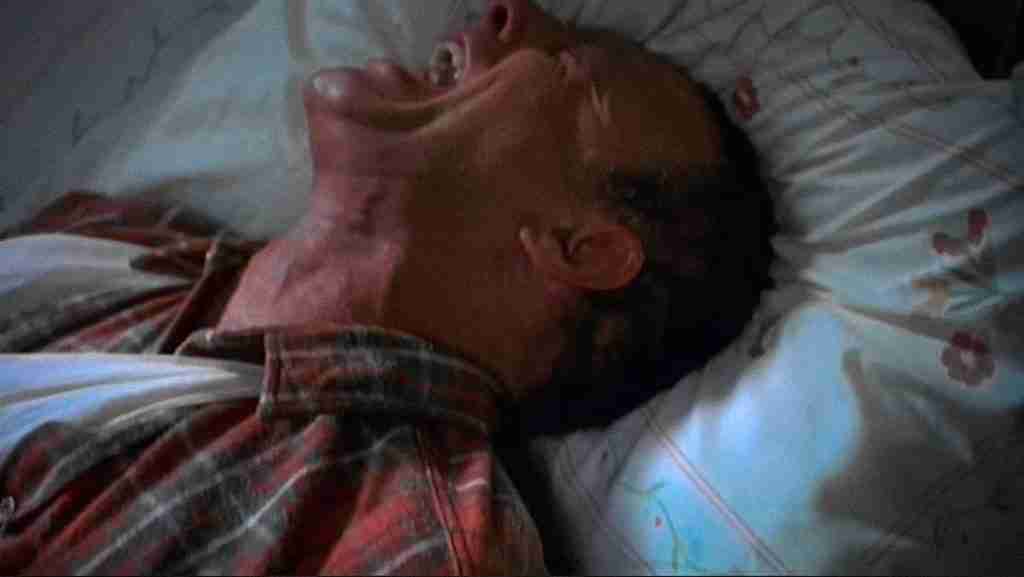
The fifth draft preserves a sequence, on script page 36, that the finished film dropped. Deep in Paul’s captivity, delirious and dehydrated, the script dissolves to a parade of distorted faces — “young, oriental, female, male, pretty, sad, black, not so pretty, happy, white, old” — while overlapping voices chant fragments of fan devotion: “I’m your number one fan… I’m your biggest fan… I feel like you’re writing just for me…” The chorus accelerates until one voice resolves out of the blur: Annie’s, saying “you poor dear thing.” Not one line of it survives in the film’s subtitle track. The cut made the film leaner and the idea sharper — Annie was never one aberrant reader. She’s the whole crowd, condensed into a nurse with a sledgehammer. The montage is the thesis written in the margin; the finished film deletes the margin and trusts Bates’s face to play the entire chorus.
Art as Pain and Survival
Creative torment gets literalized piece by piece. The demanded resurrection novel arrives with a title before it has a page: “Misery’s Return” (43m). The secondhand typewriter arrives missing its “N” (44m) — a writing tool that fights back, like every blocked draft. Painkiller dependency (“I want my pills now!” 56m) shadows the dependency on inspiration itself. The script’s cruelest joke is that captivity works: forced back into the genre he fled, Paul writes the best Misery novel of his career, then burns it to survive. Creation as salvation and torture in the same gesture.

The ledger
Meet the Cast: Six Arcs, Six Lessons
| Character | Arc & Screenwriting Lesson |
|---|---|
| Paul Sheldon (James Caan) | From celebrity author despising his popular work to a survivor who writes his way out. Lesson: Art as Survival. Give the hero one skill and make it the only weapon in the room. |
| Annie Wilkes (Kathy Bates) | Savior to captor to tragic monster, always the hero of her own story. Lesson: The Antagonist as Hero of Their Own Story. Humanize villains through their delusions, then make the delusion the threat. |
| Sheriff Buster (Richard Farnsworth) | Patient investigator who solves the case and dies for it. Lesson: Subverting Tropes. Kill the rescuer to force the hero into self-reliance. |
| Misery Chastain (Paul’s fictional heroine) | Burden Paul kills off, then revives as a lifeline and finally a weapon. Lesson: The MacGuffin with Meaning. Make the plot device an argument between the characters. |
| Virginia (Frances Sternhagen) | Comic relief and grounding foil to Buster. Lesson: Thematic Foil. A loving, teasing marriage set against a delusional, one-sided obsession. |
| Marcia Sindell (Lauren Bacall) | The commercial world Paul is trying to outgrow. Lesson: The Stakes of Success. Fame is the machine that manufactured Annie. |
HE DIDN’T GET OUT OF THE COCKADOODIE CAR!
Editorial notes from a madwoman · 63m
The documented layer
From Airport Paperback to Oscar: How Misery Got Made
The project began at an airport. Reiner’s Castle Rock partner Andy Scheinman, stuck with nothing to do, bought a copy of the novel, loved it, and assumed the rights were long gone. They weren’t. In Reiner’s telling, King had held the book back because it was personal, and released it on one condition: he’d sell to Castle Rock — where his books optioned for a dollar — if Reiner would produce or direct. King’s affection for Stand By Me, which Reiner says King called the best adaptation of anything he’d written, closed the deal.
The Graveyard of Famous Refusals
Casting Paul was a graveyard of turndowns, and Reiner has named them himself: Warren Beatty, Robert Redford, William Hurt (approached more than once), and Richard Dreyfuss among them. Beatty’s exit was the productive one. At the TCM Classic Film Festival in 2025, Reiner described Beatty spending two months working on the script with him and Scheinman — who by then had taken over drafts from Goldman — insisting the film wasn’t a horror movie or a thriller but a prison movie, with a hero who had to be as smart as the writers about getting out of jail. The drugged-wine dinner scene came out of that pass, Reiner and Scheinman’s invention. Beatty then declined, and Reiner cast James Caan — a famously physical actor he pinned to a bed for the length of a shoot, greeting him daily, by his own delighted account, with the same direction: “In this scene, you’re in bed.”
Annie Was Never a List
Goldman said plainly that he wrote the part for Kathy Bates, then a Broadway actress with essentially no film career, and told Reiner so. Reiner’s version matches: at the audition she read two or three lines before he stopped her and told her she had the part. Her response — “Can I call my mother?” — both of them still told 35 years later. Two more changes defined the adaptation. The novel’s foot amputation became an ankle-breaking; Reiner explained he wanted Paul to come out of the ordeal intact, having learned — Bates recalled him saying you shouldn’t have to lose something after you’ve learned something. The ending was rebuilt too: in the novel Paul only fakes burning the manuscript and returns to writing Misery; in the film, by contrast, he burns it and breaks free.
King’s verdict arrived at a Century City screening, where Reiner watched him talk back at a story he wrote — and heard him rank it above Stand By Me. Barry Sonnenfeld shot it as his final film as a cinematographer, pushing 21mm wide-angle close-ups to put the audience inside arm’s reach of Annie, and Marc Shaiman scored it. Bates left her first screening convinced the film would end her career. It won her the Oscar instead.
The blueprint
Save the Cat Beat Sheet: Misery Structure
This Misery beat sheet maps the film onto Blake Snyder’s Save the Cat beats. Act I springs the trap, Act II escalates inside it, and Act III turns the captive’s one skill into the murder weapon. Timestamps come straight off the film’s dialogue track, rounded up to the whole minute.
Act I: Setup and Inciting Incident
Triumph turns to captivity in barely half an hour.
| Beat (Save the Cat!) | Key Event / Description |
|---|---|
| Opening Image | 0m – An unlit cigarette, a kitchen match, and a bottle of Dom Pérignon: Paul’s ritual for finishing a book, per the script’s first page. The ritual returns against him at 98m. |
| Theme Stated | 5m – At the lodge, Paul’s talk of his first book and the battered manuscript bag frames the question: serious writer, or the Misery guy forever? |
| Catalyst | 6m – The Mustang leaves the road in the blizzard. Paul’s legs are shattered; a stranger pulls him from the wreck. |
| Debate | 8m – Paul wakes to “I’m your number one fan.” Gratitude and dread occupy the same bedroom while the phone lines stay conveniently down. |
| Break into Two | 36m – “You must rid the world of this filth.” Annie forces Paul to burn the serious manuscript. The free writer is now a captive author. |
Act II: Confrontation and Escalation
From there, the screws tighten while Annie’s instability worsens and the outside world creeps closer.
| Beat (Save the Cat!) | Key Event / Description |
|---|---|
| B Story | 16m – Sheriff Buster and Virginia open the missing-person thread, the film’s pressure valve and ticking clock. |
| Fun and Games | 43m – Misery’s Return is commissioned; the 50-pound typewriter arrives missing its “N” (44m). Paul writes for his life under editorial notes from a madwoman (“He didn’t get out of the cockadoodie car!” 63m). |
| Midpoint | 67m – The dinner. False peace by candlelight while the drugged wine waits — and spills. The stakes reset: finish the book to stay alive. |
| Bad Guys Close In | 74m – Annie’s depression spirals; she shows Paul the gun. “I might put bullets in it.” Buster keeps pulling the thread in town. |
| All is Lost | 83m – The hobbling. Annie has found the bobby pin and the wandering; the sledgehammer ends the escape plans. “The operation was called hobbling.” |
| Dark Night of the Soul | 94m – Buster finds Paul and dies for it in the same scene. No one else is coming. |
| Break into Three | 95m – “I put two bullets in my gun. One for you and one for me.” Paul buys time with the only currency Annie accepts: the ending of the book. |
Act III: Resolution and Aftermath
The captive turns his one skill into the weapon.
| Beat (Save the Cat!) | Key Event / Description |
|---|---|
| Finale | 100m – Champagne poured, ritual complete, Paul burns Misery’s Return and uses Annie’s obsession as the trigger. The brutal fight ends with her death. |
| Final Image | 105m – New York, eighteen months on. A serious novel, a cane, and a waitress with a knife and a familiar greeting. He escaped the house, not the fan. |
EAT IT TILL YOU CHOKE.
Manuscript into weapon · 101m
The verdict
The Final Image, and What Misery Still Teaches
Eighteen months after the farmhouse, Paul sits in a New York restaurant with a cane and a serious novel to his name, and a waitress crosses the room to tell him she’s his number one fan (105m). For one held frame she wears Annie’s face. He escaped the house. The fan is permanent. The draft needed a chorus of faces to say it; the film needs one.
Practical Applications for Your Writing
Steal what works. Confine the story until every scene must escalate character conflict. Write the antagonist as the hero of her own story and let her delusion set the rules of the house. Plant a private ritual on page one and pay it off in the finale. Give your hero one skill and take everything else away. Beatty’s note to Reiner is a free masterclass on its own: whatever the genre label says, if your character is trapped, you’re writing a prison movie — so make the escape plan as smart as you are.
Misery excels at character-driven horror because every scare grows from a relationship. Goldman’s dialogue balances menace with black comedy, the structure converts a fan’s love into a functioning plot engine, and the film still holds a 91% on Rotten Tomatoes. The performances at its center made a Broadway actress an Oscar winner in her first leading film role.
The primary-source method used here runs through the rest of the Deep SHT catalog, including the other films in the Rob Reiner series — the emotional architectures he left behind, examined one draft at a time.