Uncut Gems Screenplay Breakdown: Why This Script Is a Masterclass
This Uncut Gems screenplay breakdown explores how the Safdie brothers, with co-writer Ronald Bronstein, created a relentless thriller capturing addiction and high-stakes gambling frenzy. Adam Sandler’s portrayal of Howard Ratner in this 2019 film pushes writers to master unbearable tension via overlapping dialogues, rapid pacing, and a flawed protagonist who propels every turn. Moreover, it challenges creators to make a chaotic anti-hero compelling enough for audiences to cheer his improbable victories, despite his crumbling world. Thus, this Uncut Gems screenplay breakdown proves essential for screenwriters studying character-driven suspense with real-world grit and thematic depth.
Uncut Gems Screenplay Breakdown: Mastering Tension Through Structure
The script transforms New York’s Diamond District into a suffocating arena, amplifying Howard’s desperation in every interaction. This Uncut Gems screenplay breakdown examines those techniques closely.
The Chaotic Diamond District as a Character
The opening at 1m contrasts the Welo mine in Ethiopia with Howard’s bustling KMH shop, establishing hidden values and constant hustle. For instance, goons confront Howard over his $100k debt at 6m, piling professional threats on personal chaos. Consequently, the setting mirrors Howard’s inner turmoil, showing writers how environment escalates pressure in any Uncut Gems screenplay breakdown.
Overlapping Dialogues and Frenetic Pacing
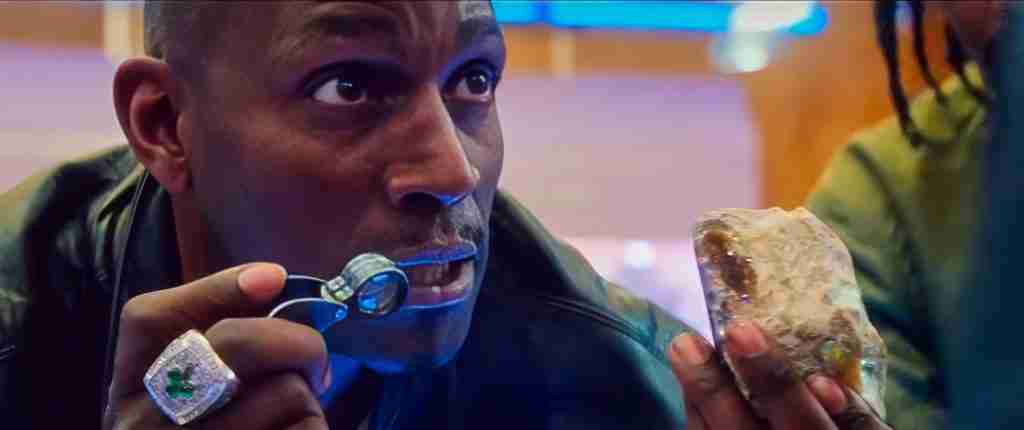
Rapid-fire talks, like Howard’s opal pitch to Kevin Garnett (KG) at 20m—”They say you can see the whole universe in opals”—build unrelenting momentum. Additionally, the abduction at 44m mixes humor and dread with quick cuts that spike anxiety. Therefore, this Uncut Gems screenplay breakdown reveals how dialogue overload mimics real-life stress, ideal for thrillers.
The Ticking Clock of Debts and Gambles
Howard’s wagers begin with pawning jewelry at 11m and peak with the massive parlay at 27m, acting as literal timers. Meanwhile, setbacks like Arno halting the bet at 46m raise stakes, pushing Howard into deeper risks. As a result, writers can use this approach for perpetual urgency and viewer engagement, a core takeaway from any thorough Uncut Gems screenplay breakdown.

Key Themes in Uncut Gems: Addiction, Value, and Fate
Uncut Gems probes deep ideas through Howard’s path, revealing human frailties.
The Thrill of Addiction and Gambling
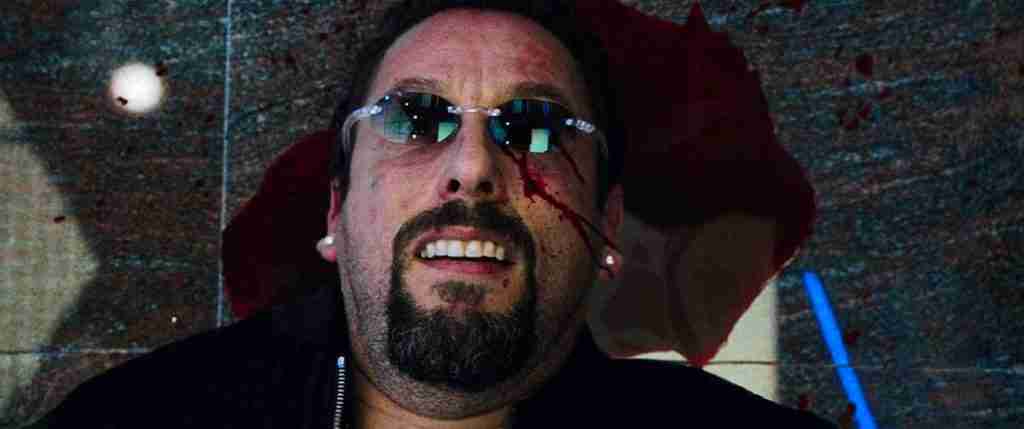
This Uncut Gems screenplay breakdown centers on Howard’s dopamine-driven life, highlighted by his ecstatic “I’m gonna cum” at 18m seeing the opal. Furthermore, his “This is how I win” at 107m frames his risky ways as a superpower. However, the film cautions that addiction brings ruin, evident in his euphoric peak at 125m and immediate death at 126m.
The Illusion of Value and Cosmic Connections
Perceived worth emerges in the opal’s low appraisal at 87m ($155k–$225k) against Howard’s dreams. He sells it to KG around 20m as “old-school, Middle-earth shit” from Ethiopian Jewish roots, casting his hustle as mystical inheritance that boosts value beyond reality. Additionally, Jewish identity and suffering surface at the Seder (74m), linking personal plagues to fate. Finally, the wound zoom at 129m echoes the inner universe, merging cosmic and biological.
Uncut Gems Screenplay Breakdown: Character Arcs and Lessons
| Character | Arc & Description | Screenwriting Lesson |
|---|---|---|
| Howard Ratner | Desperate hustler to “prophetic” winner to corpse. | A character’s “superpower” (risk-taking) is often their fatal flaw. |
| Julia De Fiore | Mistress/employee to Howard’s sole reliable ally. | Use a B-story to ground a frantic A-story in genuine emotion. |
| Kevin Garnett | Skeptic to opal-obsessed dominant winner. | Use real-world figures to add “verisimilitude” and high stakes. |
| Arno | Patient brother-in-law to victim of enforcer’s rage. | Professional distance fails in “family” business; blood doesn’t stop greed. |
| Dinah | Tolerant wife to completely done. | A protagonist needs a “normal” foil to show how out of control their world is. |
| Phil | Annoying goon to agent of Howard’s fate. | Establish a “bomb” (temper) early for an earned explosion. |

Uncut Gems Screenplay Breakdown: Plot and Real-Life Roots
Plot Summary
The tale starts at 1m with the opal discovery, shifting to Howard’s colonoscopy at 5m symbolizing internal chaos. Inciting incidents strike at 6m with debt collectors and opal arrival at 16m. Howard lends the opal to KG at 23m, pawns the ring for bets, and places the parlay at 27m. Tensions peak with the personal low at 59m (Julia cheating), failed auction at 92m, and rock bottom at 97m. KG buys the opal at 105m, sparking the final gamble at 117m. Howard wins huge at 125m, yells “I love you, I love you, I love you!” then dies shockingly at 126m, ending with the cosmic wound zoom at 129m.
Behind-the-Scenes Insights
The Safdie brothers drew from their father’s Diamond District experiences and stories about his mentor. Development took a decade from 2009, initially post-Daddy Longlegs, though Sandler passed on an early 2012 draft. They cast real district non-actors for authenticity. Moreover, their Jewish upbringing influenced Seder scenes, weaving personal heritage into themes of suffering and fate.
SAVE THE CAT BEAT SHEET: UNCUT GEMS STRUCTURE ANALYSIS
This Uncut Gems screenplay breakdown shows tight adherence to Blake Snyder’s Save the Cat! beats, delivering high-energy pacing while deepening Howard’s spiral.
ACT I
The first act establishes Howard’s chaotic world, debts, family issues, and the opal as potential salvation.
| # | Sequence/Beat (Save the Cat!) | Key Event / Description |
|---|---|---|
| 1 | Opening Image | [1m] The Welo mine vs. the interior of Howard’s colon; the “universe” within. |
| 2 | Set-Up | [6m] Howard’s chaotic shop KMH, his debts, his mistress, and his crumbling marriage. |
| 3 | Theme Stated | [20m] Howard: “They say you can see the whole universe in opals.” It’s about the search for value. |
| 4 | Catalyst | [16m] The opal arrives. This is the “gem” that could solve all his problems or destroy him. |
| 5 | Debate | [22m] Howard debates whether to let KG borrow the opal; he decides to use KG’s ring to gamble. |
ACT II
Howard plunges into escalating risks with mounting reversals.
| # | Sequence/Beat (Save the Cat!) | Key Event / Description |
|---|---|---|
| 6 | Break Into Two | [27m] Howard places the massive parlay. He has fully committed to a “win-all” strategy. |
| 7 | B-Story | [32m] Howard’s relationship with Julia; his “home team” and source of affection. |
| 8 | Fun and Games | [37m] Howard dodging collectors, dealing with the auction house, and chasing KG to Philly. |
| 9 | Midpoint | [59m] Howard catches Julia with The Weeknd; his personal life collapses in a shattering low point. |
| 10 | Bad Guys Close In | [75m] Arno and goons confront Howard at the Seder; the threats become physical and constant. |
| 11 | All Is Lost | [94m] The auction fails to reach the desired price; Howard loses the opal and KG’s interest. |
| 12 | Dark Night of the Soul | [100m] Howard sobbing in his office. “Everything I do is not going right.” He feels worthless. |
ACT III
The finale brings brief triumph and tragic fall, looping back to opening imagery.
| # | Sequence/Beat (Save the Cat!) | Key Event / Description |
|---|---|---|
| 13 | Break Into Three | [105m] KG buys the opal for cash. Howard sees the “light” and chooses to bet it all one last time. |
| 14 | Finale | [113m] The “Vestibule Trap.” Howard forces his enemies to watch his destiny manifest on TV. |
| 15 | Final Image | [129m] Howard dead with a smile; the camera enters his wound to find the “universe” again. |
CONCLUSION: WHAT UNCUT GEMS TEACHES SCREENWRITERS
This Uncut Gems screenplay breakdown highlights the script’s enduring influence.
Key Strengths and Lessons
Authentic dialogue and layered themes shine, with Howard’s arc showing how flaws fuel narrative drive. Integrating real figures like KG boosts credibility.
Practical Applications
Apply these by crafting tension via settings and emotional B-stories. Therefore, dive into this Uncut Gems screenplay breakdown to create addictive, tragic protagonists.