Tombstone Analysis: How Doc Holliday Stole the Movie
Tombstone (1993) centers on Wyatt Earp. This Tombstone analysis is about the man standing next to him.
Ask a room of fans for a favorite line and the answers come back as Doc Holliday — “I’m your huckleberry,” “You’re no daisy,” the drunk two-gun boast — long before anyone quotes the film’s actual protagonist. That gap, between whose story this is and whose performance people carry out of the theater, is the most useful thing the movie has to teach a writer. Checked against Kevin Jarre’s original screenplay (fourth draft, March 15, 1993) and the finished film, the record shows a screenplay that builds a supporting character to take the picture, and a production that kept handing him more to take.
The entrance, and why people are here
Doc arrives late and second. Wyatt comes first — the reluctant former lawman looking to make money in a boom town. Doc doesn’t appear until the Bailey card game roughly fifteen pages into Jarre’s script, and even then the narration stops to single him out with a short biographical aside that no other character receives. The screenwriter flags the magnetic one on the way in.
The audience has been agreeing ever since. Across the fan videos and threads, one sentiment recurs on every channel: the Academy robbed Val Kilmer of an Oscar. The factual record is narrower than the feeling — the Academy never nominated Kilmer, and that year’s Best Supporting Actor went to Tommy Lee Jones for The Fugitive — but the feeling is the data point that matters here. Since Kilmer’s death, the same comment sections read as grief. People do not enter this film through Wyatt Earp. They enter through Doc.
Whose movie is it, structurally
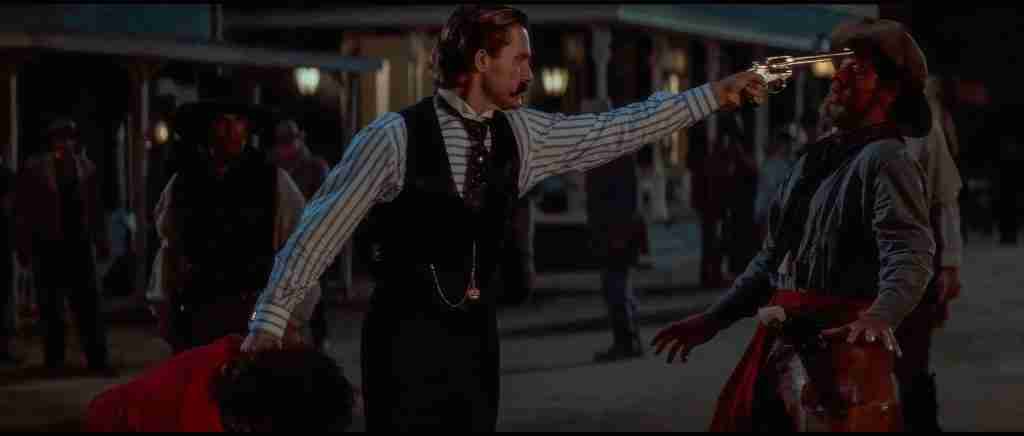
By every structural measure, the film belongs to Wyatt. He opens its world, he carries the plot’s engine — the badge, the killing of Fred White at 52m, the O.K. Corral at 72m, the vendetta — and he gets the resolution: the dance in the snow at 121m. Doc enters late, orbits Wyatt, and dies before the ending. That is the shape of a lead and a supporting player.
The theme, though, belongs to Doc.
The film states its philosophy once, plainly, at Doc’s deathbed at 117m: “There’s no normal life, Wyatt. There’s just life.” Wyatt’s answer is a question — “Then what do I do?” Jarre’s script runs the speech longer, with Doc telling Wyatt there is no happiness and no normal life, only life, and “the rest is relative,” before pointing him toward Josephine. The lead asks; the supporting character answers, then hands him his next move. A protagonist can drive the plot while a secondary character carries the meaning. That inversion is the craft lesson, and it lives on the page rather than in a template laid over it.
The dark mirror: Doc and Ringo
The film’s cleanest structural idea is the pairing of Doc with Johnny Ringo — two educated, doomed, lethally precise men, each the other’s reflection. This is not a reading laid over the film. Jarre writes it into Doc’s mouth. Watching Ringo, Doc says he reminds him of himself, and lands on that as the reason he hates him.
Their first meeting at 38m is the Latin exchange, and it is where secondhand information has done the most damage.
What the film actually contains
The finished film never subtitles the Latin. The subtitle track carries only the surrounding English — Wyatt’s “not in any language” and Doc’s “That’s Latin, darlin’,” followed by his verdict that Ringo is an educated man and that he now really hates him. The Latin lines never reach the track. That single choice is why every translation of this scene online comes reconstructed by ear, and why the reconstructions disagree.
The Latin scene, translated: Doc and Ringo
| Speaker | Latin (as commonly transcribed) | Common translation | What Jarre’s script shows |
|---|---|---|---|
| Doc | In vino veritas | In wine, there is truth | — |
| Ringo | Age quod agis | Do what you do | — |
| Doc | Credat Judaeus Apella (non ego) | Let the Jew Apella believe it, not I | Script reads only Credat Judaeus Apella — the film adds the “non ego” |
| Ringo | Iuventus stultorum magister | Youth is the teacher of fools | Script reads Eventus — “the outcome is the teacher of fools” |
| Doc | In pace requiescat | Rest in peace | Subjunctive — “may he rest,” aimed at Ringo |
The fourth line is the correction worth making. Popular transcriptions, the long-running Latin-forum thread, and most every “Tombstone Latin translation” page render Ringo’s line as Iuventus stultorum magister — “youth is the teacher of fools.” Jarre’s screenplay reads Eventus stultorum magister. Eventus is a documented proverb: the outcome is the teacher of fools — fools learn only from the consequence. And Ringo pats his gun as he says it. Read as “the outcome will teach the fool,” the line is a direct threat: experience — the coming gunfight — is about to school Doc. Read as “youth,” it is a lighter jab. The primary source points to the sharper meaning.
The honest boundary, stated so the correction holds up: this is Jarre’s fourth draft, and what fans transcribe is the delivered audio, where Michael Biehn’s pronunciation drifts toward an “iuventus”-sounding vowel. The page reads Eventus; the ear hears something closer to Iuventus; the two carry different meanings. The evidence sits in the open — the reader can decide which one they heard.
How the scene reads
The final line stays unsettled in the public discussion, and legitimately so. In pace requiescat is subjunctive — “may he rest in peace” — which reads less as a blessing than as Doc telling Ringo where this ends. The scene supports at least three documented readings: a literal one in which two men simply trade Latin aphorisms to prove their educations; a conceptual paraphrase in which the exchange maps to a full spoken threat (“you’re drunk / drinking’s what you’re best at / it’s your funeral”); and a hostile-literal reading in which each phrase is a measured insult. The scene works under all three. That is the strength of the writing, not a flaw in it.
“I’m your huckleberry,” twice
The line everyone quotes is a setup and a payoff, thirty minutes apart, and the film rewards viewers who notice.
It lands first at 79m, in the saloon, when Ringo howls for someone with the guts to play for blood and Doc answers from off-screen — “I’m your huckleberry. That’s just my game.” Curly Bill breaks the fight up before it starts. It returns at 109m, at the duel, when Ringo assumes he is facing Wyatt and Doc steps out of the shadows instead: “Play for blood, remember?” The first scene plants the debt; the second collects it. In Jarre’s script both entrances carry the same stage direction — Doc “smiling that Cheshire cat smile” — a detail the writer reuses precisely because it is the thing that steals the scene.
The phrase also carries the film’s most durable myth. It circulates widely that Doc says “huckle bearer” — a pallbearer, one who carries the casket. He does not. Jarre’s screenplay reads “huckleberry” in both places, Kilmer’s own memoir confirms the word, and fact-checkers have run the “huckle bearer” claim down and rejected it as folklore. “Huckleberry” was period slang for the right man for the job — name the task, and I’ll oblige. The double meaning fans want is already there in the plainer word.
What the script reveals: how the film tilted toward Doc
Holding Jarre’s fourth draft next to the finished film shows the picture leaning toward Doc scene by scene — the kind of thing only a two-source comparison surfaces.
The clearest case is the finale’s most-quoted flourish. When Doc says “the last charge of Wyatt Earp and his immortals” at 112m, it plays as his line — a dying man’s grace note over the vendetta ride. In Jarre’s script it is not dialogue at all. It is narration: an action line describing the four of them riding off north, four abreast. Somewhere between draft and screen, the film moved a line of stage direction into the scene-stealer’s mouth. The words that once described the moment became the words Doc uses to name it.
The hypocrisy motif shifts the same direction. Jarre’s draft carries “hypocrisy only goes so far” in an earlier scene, and keeps the sanatorium beat where Doc allows that his hypocrisy “knows no bounds” (115m in the film). The finished film relocates “my hypocrisy goes only so far” to the aftermath of the Ringo duel at 112m — placing it at Doc’s largest moment, immediately after he reveals he was never as sick as he let on. That move loads Doc’s most-remembered scene.
The register of the writing points the same way before a single line is moved. Jarre describes Doc as “gaunt, elegant”; he returns to the “Cheshire cat smile”; he stages the duel entrance as a “DARK SILHOUETTE” resolving into the light. Wyatt gets functional description, the language of blocking and action. Jarre describes Doc the way a script describes its star. The performance did not invent the theft. The page set it up, and the edit finished it.
The gunfight at the O.K. Corral
The gunfight is the film’s structural hinge and the scene the whole legend rests on. It arrives at 72m, after Virgil pins on the badge and bans guns in town, and it plays as the collapse of Wyatt’s plan for a quiet life. The lawmen walk into the lot in tight formation; Virgil calls for the Cowboys to throw up their hands, then tries to wave it off — “That’s not what I want!” — a half-second before it goes off anyway. What follows runs about thirty seconds on screen, close to the real thing.
Even here, in Wyatt’s set piece, watch where the film puts its weight. The disarming turns, a man cries that he has no gun and runs, shots start, and a voice calls “Doc, behind us!” — he is in the middle of it. Then the scene delivers the line it builds toward, and it is his: a Cowboy levels a gun with “I got you now, you son of a bitch,” and Doc answers, at 73m, “You’re a daisy if you do.” The exit line of the most famous gunfight in the Western belongs to the supporting character. That is the whole film in miniature.
Movie versus history
The scene is also the film’s largest myth, and the primary record corrects it cleanly. The gunfight did not happen at the O.K. Corral. It happened in a narrow vacant lot on Fremont Street beside C.S. Fly’s photography studio, six doors from the corral’s rear entrance. It lasted about thirty seconds and roughly thirty shots. Three Cowboys died — Billy Clanton and Tom and Frank McLaury. Ike Clanton, unarmed, grabbed Wyatt and ran, which the film preserves in the man shouting that he has no gun. The fight wounded Virgil, Morgan, and Doc; only Wyatt walked away untouched. Virgil handed Doc that shotgun to hide under his coat, taking Doc’s walking stick in trade; Doc killed Tom McLaury with it and then drew a nickel-plated revolver.
The larger correction is the framing. The clean line of good guys against bad guys is Hollywood’s, built up over decades starting with the 1931 biography that cast Wyatt as a spotless lawman. The record reads grayer: the Earps were not saints, the Cowboys were not cartoons, and a judge cleared the lawmen only after a month-long hearing, ruling them “fully justified in committing these homicides.” Tombstone tells the legend beautifully. The legend is not the history.
Who was really in charge
The legend the movies inherited put Wyatt at the center. The record puts Virgil there. As both Deputy U.S. Marshal and town marshal, Virgil ran the day and made the call to disarm the Cowboys, with Wyatt and Doc serving under him as temporary deputies. Stuart Lake’s 1931 biography magnified Wyatt into the central figure, and the films followed. The same pull that drags the spotlight off the man in charge and onto the more magnetic one runs straight through the movie — from Virgil to Wyatt in the history, and from Wyatt to Doc on screen.
One detail cuts the other way. The film hired a historical consultant, Jeff Morey, who weighed the partisan and neutral testimony and judged that the Earps’ account of the fight held up. The location is wrong and the halos are Hollywood’s, but the thirty seconds themselves sit closer to the evidence than the film’s reputation as a myth machine suggests.
Wyatt’s collapse, the arc underneath
None of this makes Wyatt incidental. His is the film’s actual arc, and it is a hard one. He comes to Tombstone wanting money and quiet; the badge finds him after Curly Bill kills Fred White at 52m; the corral drags him the rest of the way in. Then the film takes everything: the retaliation that murders Morgan at 89m breaks him, and the man who wanted no part of a badge rides out for a reckoning, promising it at the river at 94m and naming it — “It’s a reckoning” — at 98m. He earns the quiet he came for only at 121m, in the snow, in a dance.
That is a complete protagonist’s journey, anchored to the film’s own timeline rather than to any template’s beat numbers. The machinery of Tombstone is Wyatt’s. The voltage is Doc’s. A film can run on both.
Myths the record lays to rest
A short field guide to the claims that circulate as fact, and what the sources actually show:
The huckle-bearer reading (covered above) fails against Jarre’s screenplay, which reads “huckleberry.”
“Val Kilmer caught real tuberculosis for the role” is a running joke that spreads as trivia; it is not true. The sourced detail runs the other way: Kilmer filled his own deathbed with ice to sharpen the shaking in Doc’s final scene, a choice he described in the 2021 documentary Val. One viral “fact” collapses on contact; the quieter, stranger one holds up because it has a source.
Doc’s historical last words, “This is funny” — reportedly spoken as he looked at his bare feet, having always expected to die with his boots on — come from a bedside account, not from the film. Tombstone does not stage the line. It ends Doc in the sanatorium instead, which makes the anecdote a clean movie-versus-history contrast rather than a scene the film claims to depict.
The takeaway for writers
A supporting role can carry the theme, own the entrances, and outlive the lead in memory — but only when the writing gives it the cleanest philosophy and the best lines, and only when the film is willing to route its weight there. Tombstone is the case study for exactly that, and the proof is not in the acting alone. It is in Jarre’s page, where Doc gets the elegant description and the theme speech, and in the film’s own edits, where a line of narration became his to say. Wyatt Earp’s name is on the story. Doc Holliday walked off with it.