Deep SHT: Chinatown — The Character Files
Who is Noah Cross Based On? The Robber Baron Connection
Four robber barons in one white hat — and the detective who couldn’t read it
Noah Cross
John Huston
Screenplay
Robert Towne
Director
Roman Polanski
Costume design
Anthea Sylbert
There’s a shot early in Jake Gittes’s visit to Cross’s ranch on Catalina Island that tells you everything the rest of the film will spend two hours proving. Jake is looking through his windshield at an old man flanked by men in western hats, standing beside a horse in the California sun. He’s looking at the architecture of American power, and he doesn’t recognize it.
Any serious Noah Cross character analysis has to start here — not with what Cross does, but with what he looks like when Jake first sees him. And any real Chinatown film analysis has to reckon with the fact that the movie — through John Huston’s performance and every stitch of wardrobe on his back — is telling you who this man is before he speaks a single word.
The ranch, in four numbers
$5,000
Per man, to ride with Cross
What the sheriff’s gold posse pays for proximity to real power. Cross finds it amusing.
4
Robber barons in one man
Rockefeller’s monopoly, Stanford’s labor, Frick’s enforcer, Morgan’s parallel government.
~70
Years old in 1937
Born in the late 1860s. He came of age while the West was being divided up by men with capital.
1
Resource he needs
In a city built on desert, whoever controls the water controls everything.
On this page
- What was Noah Cross’s plan in Chinatown?
- Who is Noah Cross really based on?
- The Gilded Age DNA of Noah Cross
- The Noah Cross robber baron parallels — the composite
- The enforcer and the parallel government
- The sheriff’s gold posse and the architecture of power
- What Noah Cross’s costume tells you
- The builder and the thief
- What Jake doesn’t see
- Noah Cross: questions readers ask
- Go deeper into Chinatown
The plan
What was Noah Cross’s plan in Chinatown?
Noah Cross’s plan is to own the future of Los Angeles by controlling its water. He manufactures a drought, drives the valley’s farmers off land gone worthless without irrigation, and has agents buy it cheap under borrowed names. Then the city builds the dam, annexes the valley, and the water Cross controls makes that land worth a fortune — a crime the public pays to commit. The plan works because no single piece of it looks like a crime.
The mechanics hide in plain sight
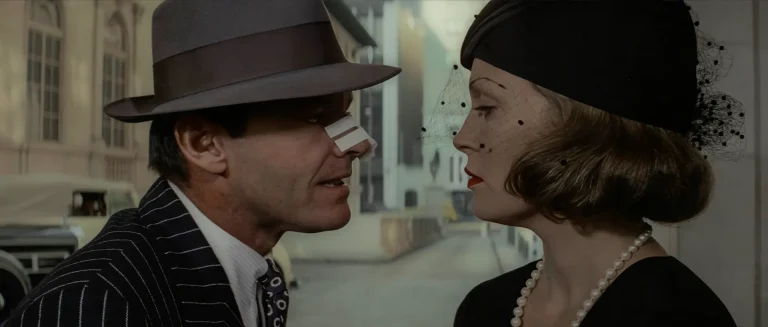
The film shows them before it explains them. The L.A. River is bone-dry in a drought — yet a drunk drowns in it under Hollenbeck Bridge (“We got water out of him. He drowned!”). A boy on horseback gives Jake the answer: he’d told Hollis Mulwray the same thing days before he died — the water “comes in different parts of the river. Every night a different part.” It’s being run off at night through the runoff channel — the thing Jake stumbles onto when he loses his nose — to keep the valley parched and its farmers desperate to sell. Hollis traced it and refused to build the dam. So Cross had him drowned.
The source
Who is Noah Cross really based on?
The standard answer to who Noah Cross is based on points to William Mulholland and Frederick Eaton — the real engineer and developer behind the Los Angeles water wars. But that’s the source material for Hollis Mulwray, not Cross. When Towne was asked about Cross’s inspiration in a 2009 interview, he pointed toward the Chandler family and Harrison Gray Otis — the newspaper dynasty and land speculators who ran Los Angeles through institutions like the Tuna Club and the California Club. ‘I’m not sure who he was based on,’ Towne said. ‘I was probably thinking of the Chandler family and Harrison Gray Otis, people like that… They ran the city like an oligarchy.’ That reading points not to engineers but to a power class. And the film tells you exactly which power class through Cross’s costume, his staging, and his relationship to the men around him.
“You’ve got a nasty reputation, Mr. Gitts. I like that.”
Noah Cross, hiring the man he intends to use — and getting the name wrong on purpose
The era
The Gilded Age DNA of Noah Cross
Cross is roughly seventy years old in 1937, which means he was born around the late 1860s and came of age during the Gilded Age — the era of John D. Rockefeller, Leland Stanford, Henry Clay Frick, and J.P. Morgan. These were the men who conquered the American West not with guns but with resources, labor exploitation, and purchased law. They were called robber barons, though some preferred the softer label “captains of industry.” The distinction depended on whether you admired what they built or remembered what they destroyed to build it. Most Chinatown 1974 analysis focuses on the water scandal. But the water is just the instrument. The man holding it is the story.
Towne never names them
Robert Towne’s screenplay doesn’t name any of these men. It doesn’t need to. The film supports a reading of Noah Cross as their fictional amalgamation — a composite of everything the robber baron era produced, compressed into one man with a white hat and a terrifying appetite. It’s the Noah Cross character analysis the film is begging you to make.
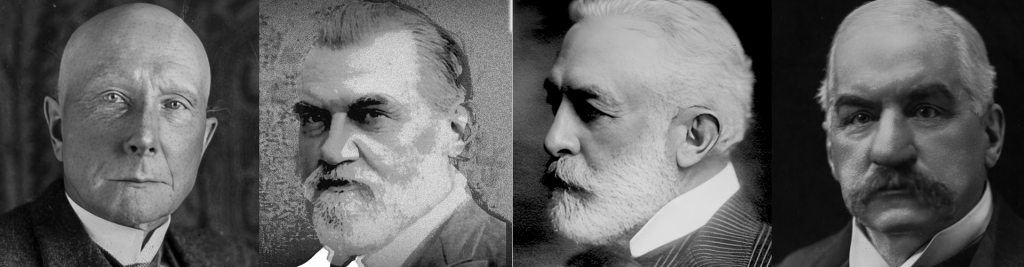
The composite — four men, one white hat
The Noah Cross robber baron parallels
Four Gilded Age men. Four things each one owned. Read them as parts, and watch them assemble into the man on the horse.
Baron 01 — the resource
Rockefeller: the monopoly
Start with Rockefeller. His empire was built on monopolizing a single resource that every person and every industry needed: oil. Cross does the same thing with water. In a city built on desert, whoever controls the water controls everything — agriculture, real estate, political power. Cross doesn’t just profit from water. He manufactures the shortage that makes it priceless, then quietly buys the land that the next supply will have to reach. Rockefeller would have recognized the playbook.
The Cross version
Water, not oil. Manufacture the shortage; buy the land the next supply must reach.
Baron 02 — the labor
Stanford: the labor
Then there’s Leland Stanford, who built the Central Pacific Railroad on the backs of exploited Chinese immigrant labor — men who worked for less, lived in worse conditions, and died in greater numbers than any other group on the line. Cross’s world is saturated with Chinese labor and culture. Evelyn Mulwray’s entire household staff is Chinese. The film’s climax unfolds in Chinatown itself. Towne didn’t set his film’s final act there only for metaphorical resonance. He set it there because that’s where the labor was, and where the power structure deposited the people it used.
The Cross version
A household staffed by the people the power structure used — and a final act set where it deposited them.
The composite, continued
The enforcer and the parallel government
Baron 03 — the enforcer
Frick: the enforcer
Henry Clay Frick was the enforcer — the man who hired Pinkertons to break the Homestead Steel Strike of 1892, a decision that left workers dead. Cross has his own enforcer: Claude Mulvihill, the former sheriff’s deputy who now works private for Cross. When Jake sees Mulvihill, he knows the kind of man he’s dealing with. “Isn’t that something?” Frick’s Pinkertons wore badges too.
The Cross version
Claude Mulvihill. A lawman’s badge, working private for Cross.
Baron 04 — the parallel government
Morgan: the parallel government
And J.P. Morgan, who functioned less as a businessman than as a parallel government — a man who bailed out the U.S. Treasury, decided which banks would survive panics and which would fail, and operated with an authority no elected official could match. Cross functions as a one-man city. He owns the police, as Evelyn tells Jake in a moment of desperate clarity: “He owns the police!” He controls the water. He controls the land the water flows to. And he funds the men who fund the sheriff.
The Cross version
A one-man city. The police, the water, the land the water flows to — and the men who fund the sheriff.
Assembled
All four, in one white hat
The monopoly, the labor, the enforcer, the parallel government. Towne’s screenplay names none of these men, and it doesn’t have to. Put the four parts together and what stands there is an old man in a guayabera, beside a horse, in the California sun — the thing Jake is looking at through his windshield and cannot read.
It doesn’t hide. It puts itself on display.
American power, as Chinatown stages it — and counts on you not knowing what you’re looking at
The ranch
The sheriff’s gold posse and the architecture of power
GITTES
You didn’t see Mulwray much, did you?
CROSS
No.
GITTES
When was the last time?
Cross starts to reply, then there’s the SOUND of a MARIACHI BAND and some men in formation clear a bluff about a hundred yards off. They are dressed like Spanish dons on horseback. For the most part they are fat in the saddle and pass along in disordered review to the music.
CROSS
Sheriff’s gold posse… bunch of damn fools who pay $5,000 apiece to the sheriff’s re-election. I let ’em practice up out here.
Customers, not equals
That line is one of the most revealing in the film. Those men riding Cross’s horses around his property aren’t his equals — they’re customers. They pay five thousand dollars for the privilege of proximity to real power, and Cross finds it amusing. They’re paying retail for something Cross gets wholesale. He doesn’t buy elections. He owns the infrastructure that makes elections possible. This is Noah Cross as robber baron in his purest form — and it’s a layer of Chinatown movie analysis that almost nobody talks about.
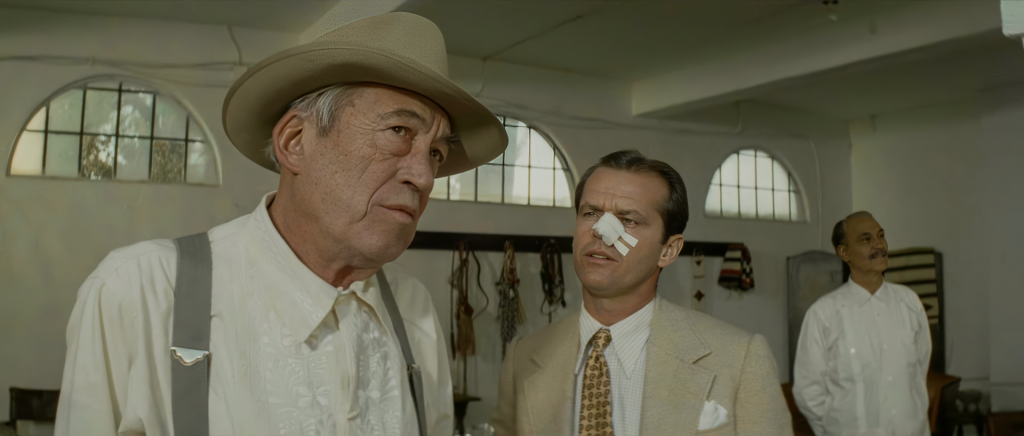
The wardrobe
What Noah Cross’s costume tells you: Anthea Sylbert’s Chinatown design
None of this would land without the costume. Anthea Sylbert — who also designed the wardrobes for Rosemary’s Baby and Shampoo — custom-made every piece in the film. The Noah Cross costume on the ranch is not an accident — and it’s where Chinatown screenplay analysis and visual design converge. He wears an embroidered guayabera shirt with grey suspenders, a red sash at the waist, and a silverbelly hat. This is the costume of a plantation owner — a man who rules land and the people who work it. The guayabera places him in the tradition of hacienda culture. The red sash signals frontier authority. The silverbelly hat says landed wealth, not working ranch. In a photograph glimpsed earlier in the film, the younger Cross wears brown corduroy and what appears to be a Norfolk suit — the uniform of the English hunting and shooting class, adopted by wealthy Americans in the late 1800s.
Huston wears it like fifty years
Sylbert is dressing Noah Cross in the visual language of inherited and conquered power. Every piece communicates a man who came of age when the American West was being divided up by men with capital and connections, and who never stopped operating by those rules. John Huston understood this instinctively — his performance never fights the costume. He wears it like a man who’s been wearing it for fifty years.
The duality
The builder and the thief
The term “robber baron” itself has always been contested. The men it describes built the railroads, the oil infrastructure, the financial systems that made modern America possible. They also crushed competition, exploited labor, bought legislatures, and operated above the law in all but name. Noah Cross as robber baron embodies that same duality. He and Hollis Mulwray built the water system that made Los Angeles viable as a city. Then Cross stole it back. The builder and the thief were partners — and eventually, the thief was all that was left.
Plainview, told forward
Robert Towne wrote Noah Cross in 1973. More than three decades later, Paul Thomas Anderson created Daniel Plainview in There Will Be Blood — a character who functions as Cross’s origin story told forward. Both men build empires on a single resource everyone needs, use the language of civic progress to mask private acquisition, and operate in a moral universe where appetite is its own justification. The difference is scope: Anderson follows Plainview from hunger to madness across a full lifetime, while Polanski drops us into the endpoint — a man who already owns everything and has moved on to acquiring people. Cross is where Plainview ends up — the version that won, and learned to smile about it.
The future, Mr. Gitts. The future.
Noah Cross, asked what he can buy that he can’t already afford
The limits of seeing
What Jake doesn’t see
And Jake Gittes? He’s looking at all of it through the windshield as he pulls up to the ranch. The costume, the horses, the men in hats, the land stretching out to the ocean. He sees it and doesn’t understand it. That’s not just a character flaw — it’s the key to any Noah Cross character analysis worth its name. It’s the film’s thesis about how American power actually operates. It doesn’t hide. It puts itself on display and counts on people not knowing what they’re looking at.
Capable of anything
GITTES
Then why are you doing it? How much better can you eat? What can you buy that you can’t already afford?
CROSS
(a long moment, then:)
The future, Mr. Gittes. The future. Now where’s the girl?… I want the only daughter I have left… as you found out, Evelyn was lost to me a long time ago.
GITTES
(with sarcasm)
Who do you blame for that? Her?
Cross makes a funny little cock of his head.
CROSS
I don’t blame myself. You see, Mr. Gittes, most people never have to face the fact that at the right time and right place, they’re capable of anything.
Honest, to his face
Cross says it right to Jake’s face. He’s not being evasive. He’s being completely honest. Jake just doesn’t have the framework to hear it. That gap between what’s displayed and what’s understood is what makes this more than a Chinatown film analysis exercise — it’s a movie about the limits of seeing. It’s one thread of the complete Chinatown analysis — the same blindness runs through every character in the film.
Questions readers ask
Noah Cross: questions readers ask
The plan and the water
What was Noah Cross’s plan in Chinatown?
To own the future of Los Angeles by controlling its water. Cross manufactures a drought, runs water off at night to keep the valley dry, drives the farmers off land gone worthless without irrigation, and has agents buy it cheap under borrowed names. Then the city builds the dam, annexes the valley, and the water Cross controls makes that land worth a fortune. No single piece of it looks like a crime.
Why did Noah Cross have Hollis Mulwray killed?
Hollis traced the night water releases and refused to build the dam the scheme depended on. He was the one man who understood the plan and could stop it.
The man in the white hat
Who is Noah Cross based on?
Not William Mulholland — that’s the source material for Hollis Mulwray. Asked in a 2009 interview, Towne pointed to the Chandler family and Harrison Gray Otis, the newspaper dynasty and land speculators who ran Los Angeles like an oligarchy. Cross is a power class, not one man — and the film supports reading him as a composite of the Gilded Age robber barons.
Who plays Noah Cross in Chinatown?
John Huston. His performance never fights Anthea Sylbert’s costume — the guayabera, the red sash, the silverbelly hat — and wears it like a man who has been wearing it for fifty years.
Go deeper
Go deeper into Chinatown
The character files
The daughter. The woman noir was trained to convict — and who was innocent of every cue.
The character files
The man looking through the windshield. Why his momentum lands on the wrong person.
The ending
Polanski vs. Towne — who fired the shot, and why Cross walks away with the girl.
The genre
How one screenplay turned the femme fatale convention against its audience.
The timeline
The other half of the crime’s design — she is the same age Evelyn was.
The screenplay
How Towne built the locked point of view — why you only ever see what Jake sees.
Or start from the top: the complete Chinatown analysis.