Deep SHT: Chinatown — The Character Files
Evelyn Mulwray: The Woman Noir Was Trained to Convict
She carried every cue the genre ever built — and was innocent of all of them
Evelyn Mulwray
Faye Dunaway
Screenplay
Robert Towne
Director
Roman Polanski
Released
1974
Evelyn Mulwray is the curve ball Robert Towne threw at thirty years of film noir. The genre had spent three decades training audiences to convict the woman with secrets. Towne wrote a woman carrying every cue the tradition ever built — then made her innocent of all of it. In 1974, nobody saw it coming. Nobody could. The training was the trap this Evelyn Mulwray character analysis dives into.
For two hours, the film hands you the case. Black dresses. A dropped lawsuit. Cryptic answers. A hidden girl. Lies about her sister. Thirty years of conditioning does the rest. You convict her. Jake convicts her. The convention convicts her. Then the truth arrives at the cost of five slaps, and the case you built collapses with it.
This Evelyn Mulwray character analysis is about what she was actually doing while Jake — and the 1974 audience watching through his eyes — built the wrong case against her.
The case, in four numbers
30
Years of genre training
Three decades of noir taught audiences to convict the woman with secrets.
2
Investigations running
The film shows you Jake’s. Evelyn’s runs the whole time, unseen.
5
Slaps before the truth
Sister. Daughter. The sentence comes out one syllable at a time.
15
Her age when Cross raped her
Katherine is the same age when he comes back for her.
On this page
The character file
Who is Evelyn Mulwray?
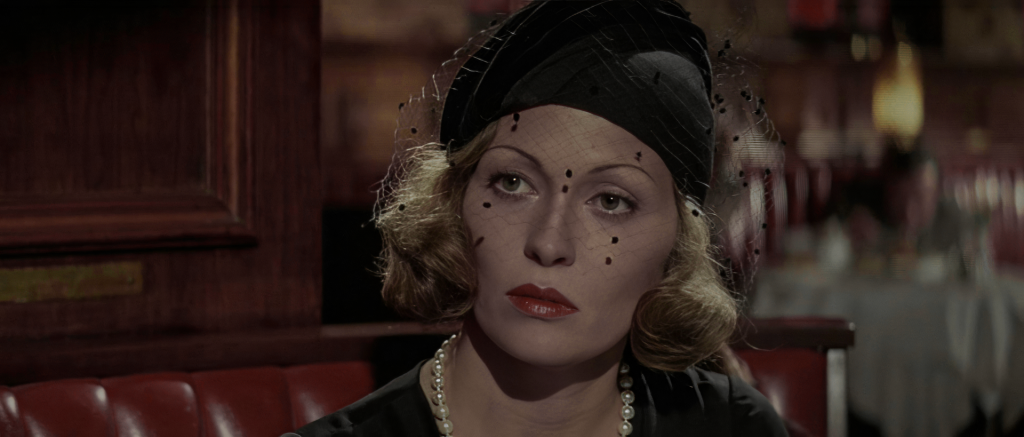
Evelyn Mulwray (Faye Dunaway) is the widow of Hollis Mulwray, chief engineer of Los Angeles Water and Power. She is also the daughter of Noah Cross — the man who raped her when she was fifteen. The child of that rape is Katherine, the girl Evelyn has spent her adult life hiding from her father. When Hollis turns up drowned in a reservoir, Evelyn is left running two operations at once. She has to steer a private detective toward her father’s crimes. And she has to get her daughter out of the country before her father finds her.
She is not the femme fatale. She is the femme fatale’s victim — a woman destroyed by everyone’s certainty about what a woman like her must be. Any Evelyn Mulwray character analysis has to start there: not with what she seems to be, but with what she is running from.
The overturned reading
Every cue, read twice
How Chinatown split the genre — the femme fatale convention turned against the audience that trusted it — is its own story. This article is the other half of that inversion: what every cue actually meant from Evelyn’s side while the convention was reading it against her. Run the list twice.
The lawsuit, then the abrupt drop
The genre’s reading
A schemer covering her tracks.
From Evelyn’s side
A firewall, thrown up to keep her father from studying the girl in the photographs. Once a murder makes it useless, she dismantles it.
The cryptic answers
The genre’s reading
Deception.
From Evelyn’s side
The speech of a woman for whom the truth is unsayable in any room Jake is standing in.
The lies about her sister
The genre’s reading
The genre’s oldest tell.
From Evelyn’s side
The one lie in noir that is also the truth.
The hidden girl across town
The genre’s reading
A witness being silenced.
From Evelyn’s side
A daughter being saved.
The chain-lit cigarette
The genre’s reading
The nerves of a guilty woman.
From Evelyn’s side
A survivor bracing every time the conversation turns toward her father.
Concealment reads as guilt. That is what Jake’s profession trained him to see, and what the genre trained the audience to see. The film deploys every cue at full strength and lets you hang her with them.
Film scholars have a term for what Evelyn actually is: a femme attrapée — a trapped woman. Every signal that says guilty is, read correctly, a signal that says hunted. The film never tells you which reading is true. It waits for you to choose the wrong one, the way Jake does, and then it shows you the cost.
Watching with 1974’s eyes
One thing has changed since 1974, and it matters for how you watch. A first-time viewer today may clock Noah Cross in his first scene. The charming old patriarch is now a recognized predator archetype — and that suspicion is Chinatown‘s own legacy. Fifty years of films built on its lesson taught you the read. A 1974 audience had no such training. John Huston played as the genial grandee, scenery in a detective picture, while the genre pointed every suspicion at the woman in black. To feel the film at full force, you have to borrow 1974’s eyes. The film is built to lend them to you — that’s what the locked point of view is for.
Every signal that says guilty is a signal that says hunted.
The femme attrapée — the trapped woman
Two women, one identity
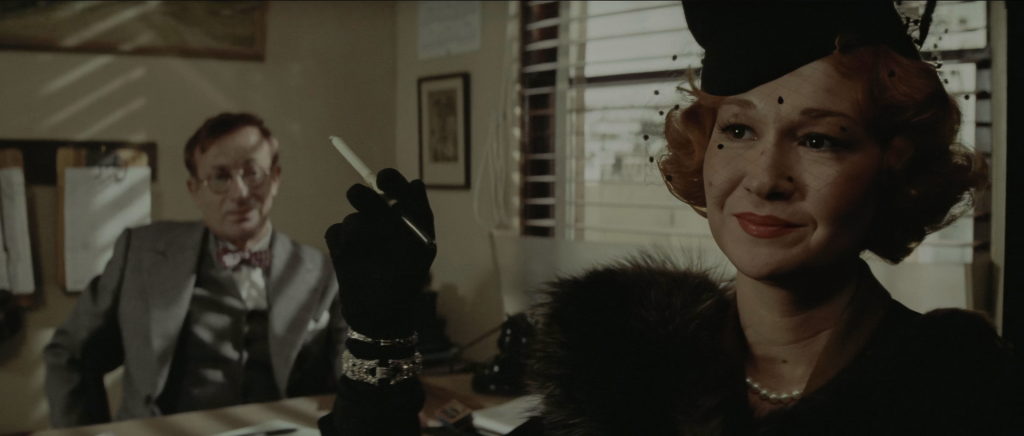
The fake Evelyn
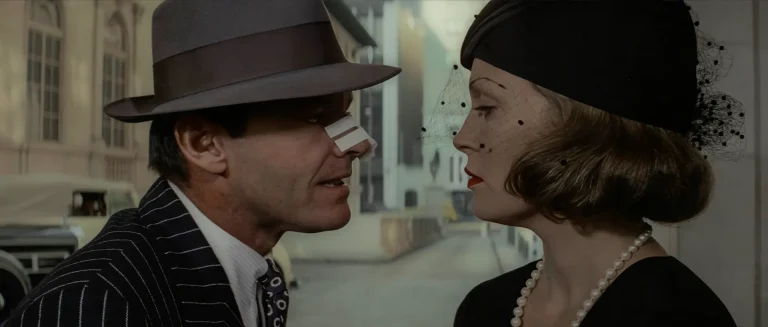
The first Evelyn Mulwray in the film is a fraud. A woman walks into Jake’s office, names herself Mrs. Mulwray, and hires him to follow her husband. The photographs Jake takes destroy Hollis in the morning papers. Days later Hollis is dead, and the real Evelyn Mulwray walks into the same office with her attorney and one devastating introduction: she is Mrs. Mulwray — so who was the woman who hired him?
Who hired Ida Sessions?
The impostor was Ida Sessions, a working actress hired by Cross’s people to set the photographic chain in motion. Two women, one identity, and the fake one is a manufactured instrument — built for a single afternoon’s use, then discarded. When Ida understands what she helped cause, she calls Jake to say she never expected anything like what happened to Mr. Mulwray. The next time he sees her, she’s dead on her kitchen floor. Cross’s machine destroys the woman it built right alongside the woman it was built to expose. The genuinely damaged one, the one with fifteen years of surviving rape and hiding her child from a predator, is Evelyn. The film spends its running time letting you mistake which of the two women is the lie.
The unseen operation
The investigation you couldn’t see
The film follows Jake’s investigation. Evelyn is running her own, and the camera never shows it to you. Towne and Polanski locked the point of view to Jake on purpose, so her strategy registers only as behavior Jake doesn’t understand. (How Towne built that restriction is the screenplay’s deepest craft lesson.)
Read her actions from her side and they reorganize. The lawsuit isn’t spite; it’s a firewall — it reframes the photographs as a corrupt PI’s fabrication before her father can study the girl in them too closely. Dropping the lawsuit isn’t caprice; it’s recruitment. She has watched Jake react to being framed, and she has seen the fire in him — the wounded pride of a man made a fool of in print. That fire could be aimed at Cross. Cross owns the police. He does not own Jake.
“It’s possible.”
Evelyn, asked if her father could be behind it all — the closest thing to a confession she can afford
The fire cuts both ways
But the same fire could expose Katherine. Jake’s job is to push past concealment, and the most carefully concealed thing in the case is a fifteen-year-old girl. Every conversation Evelyn has with him is a calculation. How much does he need to keep helping? What will get him killed? And how much can she give him without handing over the one fact that destroys everything? She feeds him the Albacore Club. She tells him her father is a dangerous man — that Jake doesn’t know how dangerous, how ruthless he can be. When he asks if Cross could be behind it all, even Hollis’s death, she gives him the truth in the only register she has left: it’s possible. He hears evasion. It is the closest thing to a confession she can afford.
Her trust is coerced
And here is the part most readings miss: her trust in Jake is not naïve. It is coerced. The alternative is the police, who answer to her father. She has no third option. A woman with no alternatives handing a dangerous man the truth in pieces is not a woman who trusts. She is a woman who has run out of other moves.
The bedroom scene
Recognition, not love
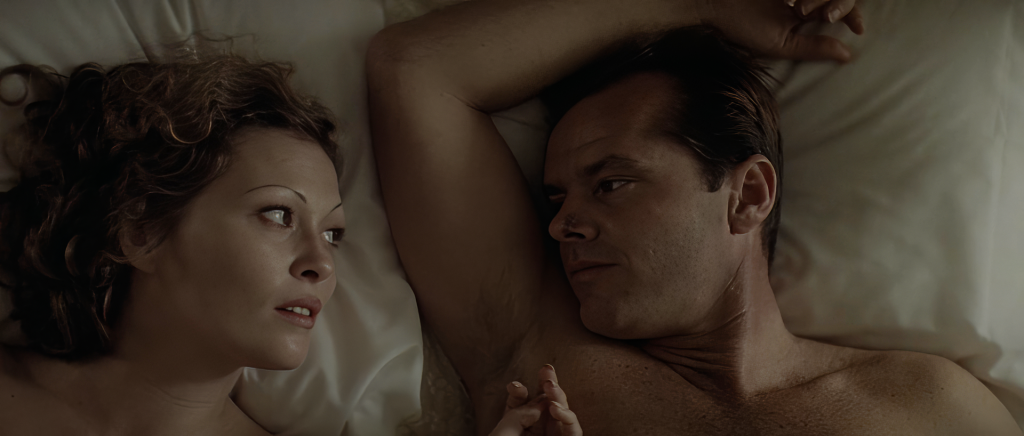
The bedroom scene is the only sustained tenderness in the film, and it is routinely misread as the love story arriving. What actually passes between them is narrower and more honest. Evelyn has told Jake directly that staying close to anyone is something she can’t do — she doesn’t see anyone for very long; it’s difficult for her. Her father broke that wiring at fifteen. Jake’s wiring is broken too, differently sourced, identically shaped: his vanity needs insulation that real vulnerability would breach.
The flaw in her iris
Two people with the same incapacity, produced by different violations, recognizing the damage in each other across the small distance of a shared bed. The film’s most intimate gesture isn’t the sex. It comes earlier, in the bathroom, while she cleans the wound on his nose. He sees the flaw in the green of her iris. Instead of turning away, she names it for him — a sort of birthmark. She lets him look. The agreement to be looked at is the new thing.
Then it closes. She offers him a piece of her worst — her father, the Albacore Club — and learns Jake spent the morning on Cross’s payroll without mentioning it. She covers herself. The opening she allowed is already shutting, and what follows from Jake is not patience but pursuit. He tails her through the night. He kicks out her taillight to follow her in the dark. And he keeps pushing toward the hidden thing, because pushing toward hidden things is what he is.
Her father’s version of that ended in rape. Jake’s ends in a slap.
The slap scene
Violence and the truth
The slap scene happens at the house on Canyon Drive where Katherine is hidden. Jake arrives with a complete theory and a pair of bifocals fished from the Mulwrays’ saltwater pond: Evelyn killed her husband, and the girl is a witness she’s keeping quiet. Then he asks who Katherine is, and the answer comes apart one syllable at a time. Sister. Slap. Daughter. Slap. Each lie answered, until both words come out in a single breath and he slaps her twice for the pair. Then he throws her into the sofa, and the sentence she has carried for fifteen years comes out at full volume: she’s my sister and my daughter.
The widest gap in the film
The gap between what Jake was certain of ten seconds earlier and what he has just heard is the widest in the film. And in 1974, the audience fell into it with him. They heard the sentence at the same instant he did, with the same wrong theory collapsing in their heads — the twist landed on the theater exactly as it landed on the man. He has been beating an incest survivor on the theory that she was a murderer. So, in their conviction, had they. (Why his hands, specifically, is the Jake question. The slap is where his vanity-driven momentum finally lands on the one person who didn’t deserve any of it.)
The shake of the head
What follows is the most precise piece of writing about survival in 1970s Hollywood. Jake asks quietly: he raped you? And Evelyn shakes her head — no. Not denial. Not complication. It’s the protectiveness survivors of childhood incest carry into adulthood, the child’s instinct to shield the parent even from the truth of what the parent did. She fled to Mexico at fifteen; Hollis followed her there and took care of her; she has never once said the word rape about any of it. She is not going to start now, in front of this man, with her face still hot from his hand. In Towne’s third draft she delivered a long speech humanizing her father’s collapse into grief and need. Polanski cut it. The shake of the head replaced it, and the film is better for giving the audience nothing to forgive Cross with.
Katherine’s age is the other half of the crime’s design — she is the same age Evelyn was. The full timeline is here.
She’s my sister and my daughter.
Evelyn Mulwray — the one lie in noir that was also the truth
The verdict
The cues did exactly what they were built to do
After the truth, the reversal: Jake believes her, hides her, and spends the last act of the film trying to get her and Katherine to a boat. He thinks he is saving her. He doesn’t understand that she has handed him a job with no winning move on the board. The same convention that taught him to suspect her has already delivered her to the people it always serves.
She trusts him anyway, because she still has no one else. She runs anyway. The horn sounds on Alameda Street. Cross walks past her body and takes Katherine. (Who actually fired the shot — and why the ending had to land this way — is here.)
Everyone got her wrong
Everyone in the film got her wrong. Jake misread her through the divorce-work lens. The cops misread her as a suspect. The 1974 audience convicted her through thirty years of genre training. Even her killer misread her — a father who took decades to register his daughter as a person rather than a possession. The flaw was never in her iris. It was in the convention trained to spot a flaw, and it found one in the only woman in the picture who didn’t deserve to be looked at that way.
Chinatown didn’t revise the femme fatale. It put her on trial and revealed that the wrong party had been in the dock for thirty years. Evelyn Mulwray is the evidence. Watch the film again and you’ll see her conducting her whole doomed defense in plain sight — the second viewing is where she finally gets her hearing. She’s one figure in the complete Chinatown analysis — and the film’s whole design comes into focus once you’ve seen each piece.
Questions readers ask
Evelyn Mulwray: questions readers ask
The two Mrs. Mulwrays
Who hired Ida Sessions in Chinatown?
Noah Cross’s people hired Ida Sessions, a working actress, to pose as Evelyn Mulwray and hire Jake Gittes — setting in motion the photographs that destroyed Hollis Mulwray in the morning papers. When she understood what she had helped cause, she called Jake to say so. The next time he saw her, she was dead on her kitchen floor.
Was Evelyn Mulwray originally intended for Ali MacGraw?
Yes — producer Robert Evans developed Chinatown with his then-wife Ali MacGraw in mind for Evelyn. By the time the film was made, the marriage had ended — MacGraw left Evans for Steve McQueen — and the role went to Faye Dunaway.
The woman and the ending
Is Evelyn Mulwray the femme fatale in Chinatown?
No — she is the femme fatale’s victim. She carries every visual and behavioral cue of the archetype, and every one of them, read correctly, marks her as hunted rather than guilty. Film scholars call the figure she actually is the femme attrapée — the trapped woman. How Chinatown turned the convention against its audience is its own analysis.
What happens to Evelyn at the end of Chinatown?
She runs for the boat out with Katherine, because she has no one else and no other move. The horn sounds on Alameda Street, and Cross walks past her body and takes Katherine. Who actually fired the shot — and why the ending had to land this way — is covered here.
More Deep SHT: Chinatown
Go deeper into Chinatown
The character files
The father. The man who owns the police — and thinks he owns the future.
The character files
Why his hands, specifically. The man whose momentum lands on the wrong person.
The genre
How one screenplay turned the femme fatale convention against its audience.
The ending
Polanski vs. Towne — who fired the shot, and why it had to land this way.
The timeline
The other half of the crime’s design — she is the same age Evelyn was.
The screenplay
How Towne built the locked point of view — the screenplay’s deepest craft lesson.
Or start from the top: the complete Chinatown analysis.