Deep SHT · Llewelyn Moss: The Hunter, the Money, and the Deal He Never Takes
Llewelyn Moss in No Country for Old Men: Competence Is Not a Plan
The most capable man in the film, and why capable was never going to be enough
Llewelyn Moss is the man the audience follows, roots for, and expects to survive. He reads a landscape better than anyone else in the film. He finds the money, finds the transponder hidden inside it, fights Anton Chigurh to a draw in the street at Eagle Pass, and walks back into the United States in a hospital gown by answering one question correctly. Then he dies off-screen, shot by men who have nothing to do with the killer he swore to make his special project. Every skill he has is real. The film spends two acts certifying them. None of them is a plan.
“A Good Clean Boy”: What the Coens Were Looking For
On the Charlie Rose program, the Coens described a casting search they expected to be easy. It was an everyman part, they thought; a hundred actors could play it. The phrase they kept repeating to each other was that all they needed was “a good clean boy.” What made the part hard was that most of it is nonverbal. In their words, a lot of it is just process: you are watching the character do his thing physically, and you need someone who is compelling to watch doing it. Josh Brolin got the role after an audition tape shot by Robert Rodriguez on a Genesis camera during Grindhouse, which, as Brolin tells it, prompted the Coens to ask who lit it before they asked about the actor.
That casting note is the character’s specification. Moss is built out of procedure. What the film asks the audience to admire is not what he says but how he does things, and the argument of this analysis is that the Coens certify that competence at length, through a hostile professional witness, so that its failure means something. The failure is not a skill he lacks. It is a deal he cannot bring himself to take.
Llewelyn Moss by the numbers
2 tours
Vietnam, August 1966 to July 1968. The only biography the script gives him
$2.4M
In the satchel. His reaction is one flat line: That’ll be the day
1 deal
Offered to him, by phone, after a gunfight. He answers with a threat
0 frames
Of his death on screen. The protagonist is removed, not defeated
Written & directed by
Joel Coen & Ethan Coen
Llewelyn Moss
Josh Brolin · Carla Jean Moss: Kelly Macdonald
From the novel by
Cormac McCarthy (2005) · Film released 2007
In this analysis
The specification
Who Is Llewelyn Moss? Process Before Psychology
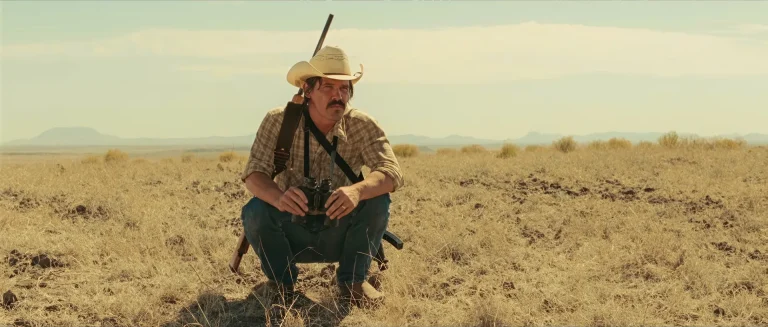
The screenplay introduces Llewelyn Moss without a name, an age, or a line of backstory. The camera is an extreme telephoto lens on an arid plain. A pan finds a herd of antelope. Reverse on a man in blue jeans and cowboy boots sitting on his heels, elbows on knees, binoculars up, a heavy-barreled rifle slung across his back. The script’s entire introduction is four words: “This is Moss.” Then he lowers the binoculars, unslings the rifle, finds the herd in the sight, and mutters the first thing he says in the film: “Hold still.”
The “Hold Still” Rhyme
Thirty seconds earlier, on a highway, Chigurh has said almost the same words to a motorist he is about to kill: “Would you hold still please, sir.” The film rhymes its two hunters before either has a name. One says it to a man, politely, with a bolt gun. The other says it to an animal, under his breath, and then rolls his head off the sight to give himself stereo and thumbs the range dial. The difference is not that one is a killer and the other is not. Both are. The difference is procedure. Everything the audience will come to trust about Moss is in that dial adjustment, and the Coens put it in the first minute so the trust is banked before the plot starts spending it.
The Crime Scene, Read as a Hunter Reads It
He wounds the animal and loses it, and tracking the blood is what walks him into the drug deal. What follows is the character’s method rendered as staging. He does not react to the trucks and the bodies. He reads them. The one man still alive asks him for water in Spanish, and Moss answers in the plainest sentence in the film: “I ain’t got no agua.”
Then he asks the question a hunter asks: where is the last one? “Last man standing. There must’ve been one.” He follows the ground to the shade because that is where a wounded man would stop, and he talks it through out loud, half to the dead man and half to himself: if the last man stopped and watched his backtrack, Moss is about to get shot; but if he stopped, he stopped in the shade. The satchel is under the tree. His response to two point four million dollars is one line, delivered flat: “That’ll be the day.”
Brolin’s Enumeration
Josh Brolin, asked on Peter Travers’s program to say who he plays, gave the whole plot in one breath: a guy who lives in a trailer park with his lovely wife, out hunting one day, who runs into a drug deal gone bad, finds 2.4 million dollars, and decides to keep it. That is the enumeration this analysis keeps returning to, because it is complete and it is missing something. Every clause in it is something Moss does well. None of the clauses is a plan for what comes after.
The Water Jug: Decency as Instinct
That night he cannot sleep. The script puts him at the kitchen sink filling a gallon jug from the tap, and gives him the line that is his motivation testimony in full: “I’m fixin’ to do somethin’ dumber’n hell but I’m goin’ anyways.” Carla Jean asks what he is going to do. He tells her that if he does not come back, tell Mother he loves her. Your mother’s dead, Llewelyn. Well then, he says, I’ll tell her myself.
The jug run is a moral act and the film does not hedge it. A bad man would not have gone back. But watch how he goes: at night, on foot, with a pistol, over ground he walked that morning. He performs the moral act by conviction and plans it like a patrol. The conviction is instinct; the planning is tactics; and the two never trade places, which is the shape of everything he does from here on.
The patrol is flawless. It is also what gets him caught, because it puts him back on that ground at the hour the men who own the money come back for it, and it leaves his truck on the ridge with his name on the inspection plate. His goodness exposes him. His competence gets him out of the river alive. Neither one is the same thing as knowing what he is now in.
The run
How Llewelyn Moss Almost Wins: Del Rio, the Hotel Eagle, and Eagle Pass
The middle of the film is a demonstration. Moss sends Carla Jean to her mother’s, checks into a motel in Del Rio, and hides the satchel in the air duct above the room. When he needs it back from a different room, he buys tent poles and duct tape, screws the poles together end to end, and fishes the case out through the vent. The Coens shoot this at the length of a heist. There is no dialogue to cover it. It is process, which is what they said they cast him for.
The Transponder
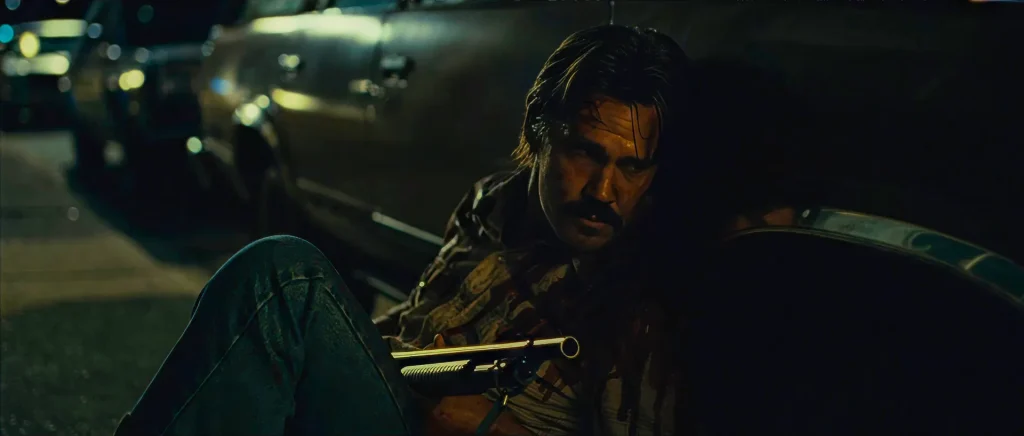
In Eagle Pass he buys a shotgun at a sporting goods counter, checks into the Hotel Eagle, wedges the gun in a drawer, and hacksaws the barrel. Then he goes through the money and finds what Chigurh has been following: a transponder, packed in with the bills. Most protagonists learn they are being tracked when the tracker arrives. Moss learns it by inventory. He turns off the lights, sits on the bed with the shotgun, and waits for the man he now knows is coming. That is the character at full competence, and the film lets the audience sit in the dark with him long enough to feel it.
Eagle Pass: The Draw
The gunfight that follows, through the hotel and out into the street at Eagle Pass, is the only time anyone in the film fights Anton Chigurh and lives. Moss is hit. Chigurh is hit. Both men crawl away to repair themselves, Moss across the bridge into Mexico and Chigurh into a pharmacy he empties by blowing up a car. Call it a draw, because that is what it is, and then notice what the film does with it. A draw against the thing that cannot be reasoned with is the best result any character achieves. It changes nothing. Moss wakes up in a hospital across the river with a man in a suit sitting beside the bed, and the man has come to explain to him what he is.
The diagnosis
Carson Wells, the Phone Call, and the Deal Moss Won’t Take
Carson Wells is the hostile witness the film calls to certify Moss. He tells Moss he is not cut out for this, that he is just a guy who happened to find those vehicles. Moss takes the exam like a man who has already passed it. Maybe Chigurh is the one who should be worried, he says. About me. Wells: he isn’t. Then Wells makes his offer, a phone number and a promise that Moss can keep a little of the money, and Moss answers with the sharpest line he has: “If I was into cutting deals, why wouldn’t I just deal with this guy Chigurh?”
It is a good question and it is the wrong one. Wells tells him why: you can’t make a deal with him. Even with the money he would still kill you. “He’s a peculiar man. Might even say he has principles. Principles that transcend money or drugs or anything like that.” Moss hears a description of an opponent. It is a description of a rule. The whole scene is a professional explaining that the game Moss is winning is not the game being played, and Moss, who has never lost a round of the game he is playing, declines to switch.
The Phone Call: Two Lives, Priced Separately
Then the phone rings in the hospital and it is not Wells. Chigurh asks whether Moss knows how this is going to turn out. No. I think you do too, Chigurh says, and proposes the only trade in the film, money for a life: bring me the money and I’ll let her go. Otherwise she’s accountable. Same as you. That’s the best deal you’re going to get. “I won’t tell you you can save yourself because you can’t.”
Read the terms the way Moss should have. Chigurh prices the two lives separately. Carla Jean’s is purchasable. Moss’s is already spent. The deal is an invitation to the one thing Moss never does on screen: accept that he is dead and spend what remains buying his wife out. Every certified tactical fiber in him makes that unsignable, because it is not a tactic. It is a surrender, and the film has spent an hour showing that Moss does not have the muscle for surrender. So he answers the way the hunter answers. Yeah, I’m going to bring you something, all right. “I’ve decided to make you a special project of mine. You ain’t going to have to come look for me at all.”
The Promise He Never Keeps
It is bravado, and it is also a promise, and the film’s cruelest structural decision is that he never gets to keep it. What the Coens did with that promise is the subject of the Bell page: the Rambo expectation the film loads and refuses.
“I’ve decided to make you a special project of mine.”
Llewelyn Moss to Anton Chigurh, by phone from a hospital bed · 85m. The answer to the only deal he is ever offered
The inventory
The Kit
Everything Llewelyn Moss carries through the film, and what each object buys him. Every piece works. The last slot is the one he never fills.
The rifle
Heavy-barreled, slung across his back in the first frame he occupies. “Hold still.” It buys him the audience’s trust before the plot begins.
The binoculars
Raised again and again in the script before he touches the money. He reads the trucks, the dogs, the shade. It buys him the satchel.
The water jug
A gallon, filled at the kitchen tap at night. The one object he carries for someone else. It buys a dead man nothing and costs Moss his truck, his cover, and his home.
The tent poles
Bought with duct tape, screwed together end to end, fed up an air duct. They buy the satchel back from a room he can no longer enter.
The sawed-off shotgun
Bought over a counter in Eagle Pass, cut down with a hacksaw in a hotel room. It buys him a draw against Chigurh, the best result anyone gets.
The transponder
Not his. Found in the money by a man who counts what he is carrying. It buys him the dark room and the shotgun across his knees before the knock.
The overcoat
Bought off a stranger’s back on the bridge, worn over a hospital gown. “I got an overcoat on.” With the service record, it buys him the country.
The deal
Offered once, by phone. The money for her life, his already forfeit. Never picked up. It would have bought the only thing the rest of the kit could not.
Lay the kit out and the shape of the character is visible without the argument. Seven objects, each of them handled correctly, each of them buying exactly what it was for. The eighth slot is not a skill. It is a reckoning, and no amount of procedure produces one.
The border
Llewelyn Moss’s Age, the Border, and What the Screenplay Gives Instead
The No Country for Old Men screenplay never states how old Llewelyn Moss is. McCarthy’s novel does: thirty-six. The Coens cut the number and put a service record in its place, and the scene where they do it is the film’s plainest demonstration that Moss is built from what he can recite, not what he is.
The Catechism at the Gate
He walks back into the United States in a hospital gown, boots, and a coat bought off a stranger on the bridge. The official at the gate, whom the screenplay describes as looking like a marine drill instructor, runs him through a catechism designed to be failed. Sensible answers get you into America; the other kind does not. How did he come to be out here with no clothes? “I got an overcoat on.” Are you jackin’ with me? No sir. The hostility survives every civilian answer Moss gives. Then one question changes category. Are you in the service? No sir, I’m a veteran. Nam? Yes sir, two tours. What outfit? “Twelfth Infantry Battalion. August 7th 1966 to July 2nd 1968.” The official stares at him, chewing, and calls for someone to help this man get into town.
The scene resolves on the dates. Not on the wound, not on the money, not on anything Moss has done in the film. The one credential the gate accepts is the one he brought in from before the film started, and it is the only biography the script ever gives him. What that service record meant to McCarthy, and why the Coens pulled the Vietnam layer out of the film everywhere except here, belongs to the Sheriff Bell page.
How Old Is Llewelyn Moss? What the Film and Script Actually Say
The year is 1980. Chigurh tells the gas station proprietor the coin is dated 1958 and has been traveling twenty-two years, and the screenplay puts the same year on the gravestone at the funeral of Carla Jean’s mother. Against that, the script gives Moss a man roughly a dozen years out of his war and nothing more precise. The closest either version comes to an age on screen is the old man who gives him a ride in a station wagon, shaking his head at the road: “Even a young man like you.” It is the film’s title in one line of dialogue, and it is the only age Moss is ever given.
Llewelyn Moss age: the short answers
How old is Llewelyn Moss in No Country for Old Men?
The film and the screenplay never say. In McCarthy’s novel he is thirty-six. What the script gives instead is his Vietnam service, two tours from August 1966 to July 1968, set against a story that takes place in 1980.
Does the No Country for Old Men screenplay give Llewelyn Moss’s age?
No. The script introduces him through action rather than description, and the only biographical fact it states is the service record he recites at the border. The one reference to his age in the film is another character’s: an old man calls him “a young man.”
Is Llewelyn Moss a Vietnam veteran?
Yes, in both the novel and the film. He tells the border official he served two tours with the Twelfth Infantry Battalion, August 7, 1966 to July 2, 1968. The film keeps this and cuts nearly every other trace of the novel’s Vietnam framing.
What year does No Country for Old Men take place?
1980. Chigurh’s coin is dated 1958 and has been traveling twenty-two years, and the screenplay dates the gravestone at the funeral of Carla Jean’s mother 1922 to 1980.
“Just lookin’ for what’s comin’.”
Llewelyn Moss at the motel pool, El Paso · 95m. “Yeah, but no one ever sees that.”
The death
Why Llewelyn Moss Dies Off-Screen
The last plan Moss makes is the one he makes for his wife. He calls her from the road and tells her to meet him at the Desert Sands motel in El Paso, because he is going to give her the money and put her on a plane. She says she will not leave him in the lurch. No, he tells her, this works better: with her gone and the money gone, Chigurh can’t touch him. “But I can sure touch him. And after I find him I’ll come and join you.”
The plan is protective and it is loving, and it is love executed entirely in the grammar of assets and leverage. Move the money, move the wife, remove the hostage, then hunt. It is a good plan against a man. It is not a response to what Chigurh told him on the phone, which was that his life was already spent and only hers was for sale. Moss heard that and built a plan in which he survives. That is the reckoning he never has, and the film is about to make the point for him.
The Pool: “Waiting on My Wife”
His last scene is small and the Coens play it in hard light. A woman sunbathing at the motel pool calls him Mr. Sporting Goods and offers him beers in her room. He holds up his left hand to show the ring. Waiting on my wife. Is that who he keeps looking out the window for? Half. What else, then? “Just lookin’ for what’s comin’.” Yeah, she says, but no one ever sees that. The line is the film’s thesis delivered by a stranger with a beer, and it is the last thing anyone says to Moss on screen. A plane climbs overhead. Sheriff Bell, driving a commercial strip somewhere nearby, hears the tock of distant gunfire. Then Bell arrives, and Moss is a body on a motel room floor, and the men driving away are not Chigurh.
The film denies him a death scene, a last stand, and the confrontation it spent ninety minutes setting up. The cartel kills him in a drive-by that is everything Chigurh would not have done. What the Coens do with Bell at that motel, and why the sheriff does not chase the truck, is owned by the ending page and the Bell page. What matters here is the verdict the structure passes on the character: the protagonist is removed, not defeated. He was not outfought. He was never in the fight he thought he was in.
Instinct and Reckoning
Moss’s decency is real and the film never doubts it. The water jug is a moral act. The ring at the pool is a moral act. But his decency operates as instinct, and his deliberation operates as tactics, and the two never trade places. He never sits down with the fact that he is dead and asks what a dead man owes his wife. The one character who arrives at that question is Carla Jean, in a refusal the film gives her and the novel does not. She gets there because she has nothing left to plan with. What she does with the far side of hope is her page, and it is the answer to his.
The craft lesson
The Screenwriting Takeaway: Competence Is Not a Plan
Go back to Brolin’s enumeration. A guy in a trailer park with his lovely wife. Out hunting one day. Runs into a drug deal gone bad. Finds 2.4 million dollars. Decides to keep it. Runs into major obstacles, finally of mythological proportions. Every clause is something the film certifies Moss can do, and the certification is the craft: a hostile professional witness whose exam he passes, a gunfight he draws, a border he talks his way across. Most thrillers assert their protagonist’s competence. This one proves it, at length, so that the failure cannot be mistaken for a skill deficit.
Then look at what the enumeration does not contain. There is no clause for the deal. There is no clause for the moment a capable man accepts that capability has run out and asks what is still purchasable. The screenplay puts that moment on a hospital phone, states its terms plainly, and lets Moss answer with a threat. Everything after is the bill.
The Real Lesson
If you are writing a protagonist the audience is meant to trust, certify the trust in process, not in dialogue, and certify it early. Then locate the failure somewhere the process cannot reach. Not in a mistake he makes with his hands. In a category he cannot see, so that the audience, who has been admiring the hands, misses it too and feels the floor go out from under them at the same moment he does. The Coens built Llewelyn Moss to be the most competent man in the film so that his death would prove something competence cannot. That is why he dies off-screen. There was nothing left for his skills to do.
Every character in the film gets a page in this series. The map is the No Country for Old Men screenplay analysis hub.