
Deconstructing the Reverse Narrative
The structural brilliance of Memento (2001) is clear, driven by its reverse chronological narrative. However, the film’s powerful emotional structure adheres perfectly to the fundamental functional beats of dramatic storytelling. The result? This table maps the story’s core movements onto the Save the Cat! methodology’s 15 standard beats.
Act One: Setup (Beats 1-5)
Leonard’s memory system and his core mission are established, leading up to the shocking climax of shooting Teddy.
| The Beat | Plot & Function (MEMENTO Focus) |
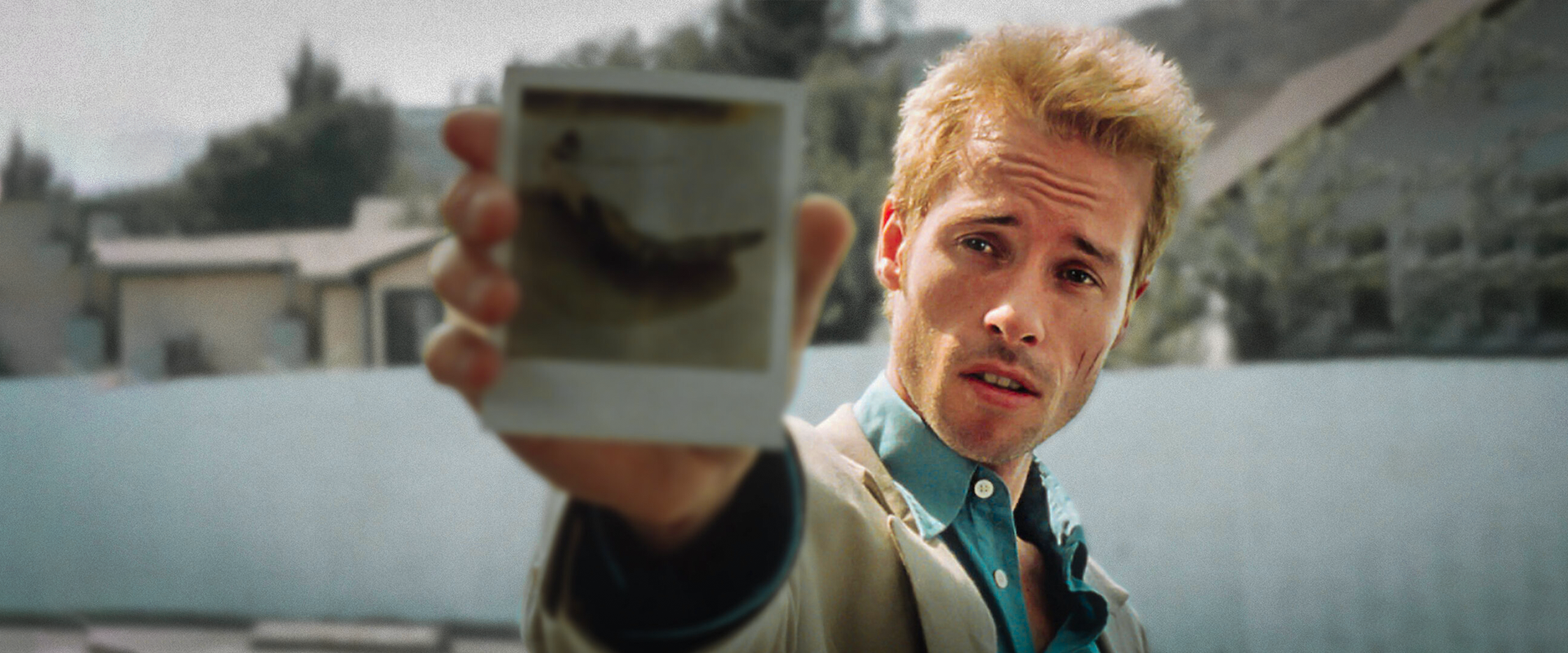
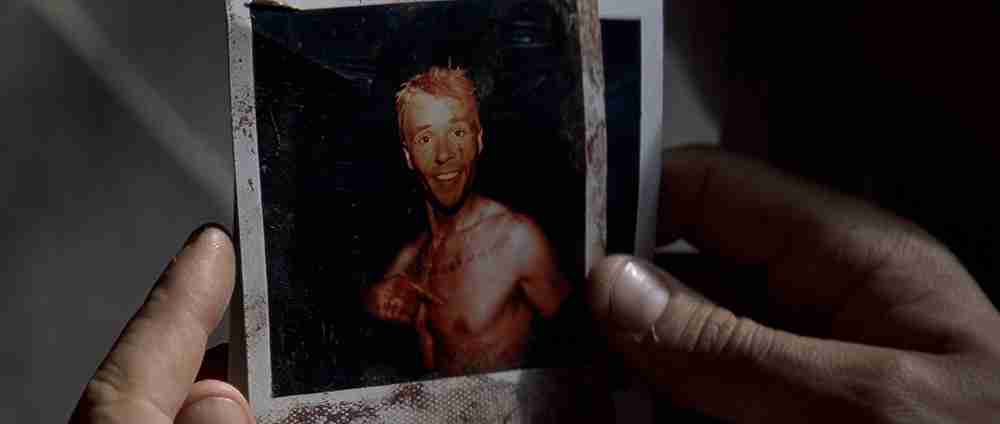
| Opening Image (m. 1-2) | We see the final moments of a Polaroid photo of a dead body. Leonard Shelby holds the picture. It fades into an undeveloped blank. This establishes the film’s central visual metaphor for memory loss and reverse-chronological structure. |
| Theme Stated (m. 6) | In the first Black & White interstitial, Leonard explains his condition and system. Furthermore, he draws a contrast with Sammy Jankis. This sets up the theme: “We create our own reality” via systems and discipline. |
| Set-up (m. 2-10) | Leonard wakes up confused in a hotel room. He uses his notes, Polaroids, and body tattoos to establish his system. He confirms his condition is short-term memory loss. His External Goal is finding and killing “John G,” the man who killed his wife. |
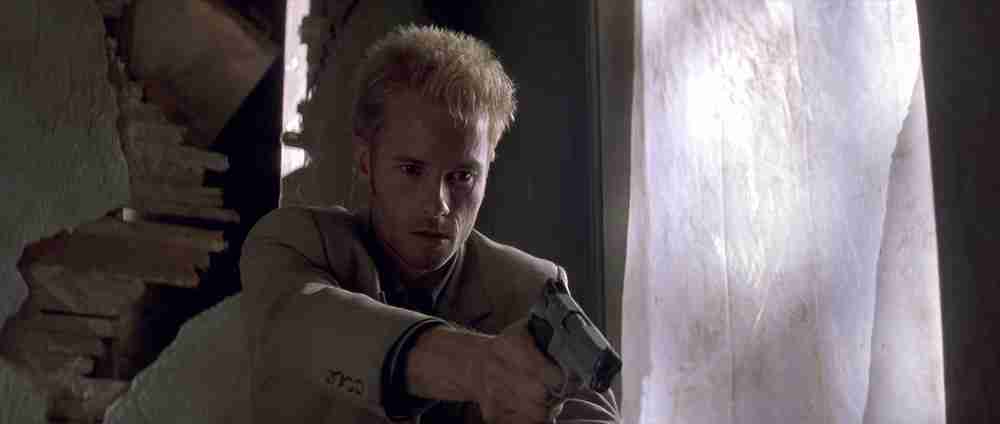
| Catalyst (Inciting Incident)(m. 5-6) | Leonard pulls his gun on Teddy and shoots him. This shocking action is the very end of the main Color timeline. It establishes the Central Dramatic Question: Why did Leonard shoot Teddy? |
| Debate (m. 6-27) | Leonard navigates his confusion. He answers phone calls, consults his notes, and meets with Teddy and Natalie. Meanwhile, the audience watches him debate who to trust. They watch him figure out how to get information. They question whether his system is reliable. |
Act Two, Part A: Action and Midpoint (Beats 6-10)
Leonard is manipulated by those around him as he executes his revenge quest, while the B-Story reveals the tragic truth about his past.
| The Beat | Plot & Function (MEMENTO Focus) |
| Break Into Two(m. 27-28) | Leonard wakes up next to Natalie in her house. This shifts the dynamic from simply gathering clues. Instead, he becomes an active participant in a revenge plot against Dodd. Natalie‘s manipulation begins the journey into the second act’s “upside-down” world. |
| B Story(m. 6, 16, 27) | The Black & White interstitials fully take over as the B Story. They tell the story of Sammy Jankis. This was an insurance fraud case Leonard investigated. Specifically, it runs parallel to the main color plot. It represents the internal struggle and the flawed nature of memory. |
| Fun and Games(m. 33-53) | This section covers Leonard‘s determined pursuit and capture of Dodd. This occurs at Natalie‘s manipulative behest. As a result, it demonstrates his Skill as a detective. It shows his ingenious, though compromised, system of clues. He successfully tracks and dispatches Dodd. |
| Midpoint(m. 54-56) | Leonard visits the abandoned construction site. He attempts to burn his wife’s few remaining items (“I can’t remember to forget you”). However, this is a False Victory; he finds temporary emotional closure. It’s also a True Defeat; he fails to let go of the pain or obsession. |
Act Two, Part B: Despair and Payoff (Beats 11-13)
| The Beat | Plot & Function (MEMENTO Focus) |
| Bad Guys Close In(m. 57-86) | Both Teddy and Natalie apply increasing pressure. They reveal their true manipulative intentions. To illustrate, Teddy warns Leonard about Natalie. Then Natalie sets up Leonard‘s next target, Dodd. She tests his condition, confirming she can exploit him. |
| All Is Lost(m. 87-90) | The Sammy Jankis narrative culminates here. Sammy‘s wife dies from repeated insulin injections. Immediately, a flash frame shows Leonard in Sammy‘s place. This finalizes the tragic possibility that Leonard may be the real killer of his wife. Sammy would then be his self-serving Substitution. |
| Dark Night of the Soul(m. 90-97) | Leonard grapples with his memory’s instability. He faces the potential horror of his past. He begins to take actions not based on notes. He gets a tattoo of Teddy’s license plate. He immediately tries to justify this. This leads him to his next ‘John G.’ |
| Break Into Three (m. 97) | Leonard arrives at the industrial location. He kills Jimmy Grants. He believes Jimmy is his final target. This action completes the cycle of revenge. It sets the stage for the Climax—the truth about his past—to be revealed. |
Act Three: Resolution (Beats 14-15)
The final confrontation forces Leonard to choose between the painful truth and a necessary self-deception to keep living.
| The Beat | Plot & Function (MEMENTO Focus) |
| Climax(m. 100-108) | Teddy arrives and reveals the Truth: Leonard already killed the true “John G” a year ago. In addition, Teddy, a real cop (John Edward Gammel), has been helping him perpetuate the search. Nevertheless, Leonard consciously rejects the truth. He manipulates his own clue system to frame Teddy as his next ‘John G.’ |
| Final Image(m. 109-110) | Leonard drives off in Jimmy‘s Jag. He secures his next target (Teddy) with a tattoo reminder. Finally, he states: “We all need mirrors to remind ourselves of who we are. I’m no different.”The image shows him actively choosing his desired reality. |
Why The MEMENTO Beat Sheet is Essential for Writers
The Unique Structural Challenge
The Memento beat sheet is a masterclass in structural innovation. It rests on a classical framework. The film faced a unique structural challenge. It solved the inherent difficulty of a reverse chronological story. This was done while still maintaining dramatic tension and character empathy. The non-linear structure could easily confuse the audience. However, screenwriter Christopher Nolan’s design of the emotional action aligns perfectly with the Save the Cat! framework.
A Universal Solution for Narrative Structure
For instance, the All Is Lost moment hints that Leonard is potentially his wife’s killer. Nolan ensured the audience always felt invested in Leonard‘s quest, regardless of the timeline order.
Studying the Memento Beat Sheet offers a universal solution for writers of Mystery, Psychological Thriller,and Non-Linear Narrative. The analysis first clearly demonstrates a key principle. The order in which the audience receives information (the story) can be fragmented. Yet, the function of that information (the plot beats) must remain intact. This satisfies the fundamental architecture of a successful story.
The Power of Emotional Peaks
Writers gain powerful insight from this beat sheet. They learn how to inject core dramatic reveals—like the B Story payoff at All Is Lost—at maximum impact points. This allows structural complexity to serve narrative clarity, not sabotage it.


First page to visit after watching the movie.Very well written.Thank you :D
Thanks, Sriraj. Check out our Nolan book for a detailed analysis of Memento. We also have a chronological map, as well as the one you see above. Here’s a sample:
http://actfourscreenplays.com/wordpress/wp-content/uploads/2013/02/Story-Maps-Nolan-eBook-Sample.pdf
As a deep fan of Chris Nolan, i like this article but as a aspiring filmmaker,i love this work guys and i have already started to check your other works which i hope to getting help from it to write my script as much quality as professionals. Thank you and keep up.
Great. Thanks for the kinds words. Good luck with your work.
I watched memento more than 10 times..big brain behind script..
Mesmerizing storytelling.
It’s the constant nagging of a persons mind, in every day situations.
It’s full of dread, anxiety, stress, doubt, paranoia , hope, disappointment, anger, frustration.
Insecurity. Profound self conflict.
It’s a little piece of everyone’s life in one form or another.
I recently viewed the film ‘Memento’ in chronological order just to try dissect it even more.
I have never took the time to comment on anything but I have to say Christopher Nolan is the best movie director screen writer in the biz I loved memento inception the uh one about the magicians all superior movies best I’ve seen in the new century keep up the good work
Thanks, Eddie. I completely agree.