Deep SHT · The Complete Analysis
Angel Heart (1987): The Complete Film & Screenplay Analysis
A detective is hired to find a missing man. The missing man is himself, and every essay in the Angel Heart screenplay analysis, in one place.
Written and directed by
Alan Parker
From the novel
Falling Angel (1978) by William Hjortsberg
Starring
Mickey Rourke · Robert De Niro · Lisa Bonet · Charlotte Rampling
Released
March 1987 · TriStar Pictures
Set in
New York and New Orleans, 1955
Cinematography
Michael Seresin
The case, in brief
Angel Heart in ninety seconds
New York, 1955. A client who calls himself Louis Cyphre hires Harry Angel, a small-time Brooklyn private detective, to find Johnny Favorite: a pre-war crooner who vanished from a private hospital upstate without honoring a contract. The trail runs from a morphine-addicted doctor on Staten Island to the jazz clubs, bayous and voodoo ceremonies of New Orleans, and every witness Harry questions turns up dead. So the police begin to suspect him, and Harry has no idea why.
How Angel Heart ends
The missing man is Harry. Johnny Favorite sold his soul for stardom, and on New Year’s Eve 1943 he tried to dodge the bill: he murdered a young soldier named Harold Angel in a ritual, ate his heart and took his name. War injuries wiped the memory, so he has lived as Harry Angel for twelve years believing it. Cyphre, in other words, is the Devil, the investigation is his collection, and every killing was Harry’s own hand during a blackout. Then Harry finds the soldier’s dog tags, looks in a mirror and sees Johnny Favorite. The last shot is an elevator going down.
On this page
- The film under the detective story
- The structure: a detective story that hunts its own detective
- The contract: one soul, five clauses
- Louis Cyphre
- Harry Angel
- Epiphany Proudfoot
- Falling Angel vs Angel Heart: what Parker changed
- The ending, explained
- What Angel Heart teaches screenwriters
- Quick answers
- Go deeper: the five essays
So why does the twist still land when you clocked the name Louis Cyphre in the first ten minutes? Everything below, then, is the Angel Heart screenplay analysis proper: how Alan Parker built a detective story whose detective is hunting himself, and the five essays that take it apart.
12
Years the Devil waited
New Year’s Eve 1943 to the winter of 1955.
5
Dead by Harry’s hand
Fowler, Toots, Margaret, Ethan, Epiphany. Every one during a blackout.
4
Scenes with Louis Cyphre
Roughly fifteen minutes of a 113-minute film. The rest of the film is his work, too.
1
Missing person, found
Harry finds him in a mirror.
The real subject
The film under the detective story
On the surface Angel Heart is a missing-person case, and a good one: a forged hospital file, a doctor paid to keep a dead man alive on paper, a chicken foot in a nightclub bathroom, a heart on a lace tablecloth. Every clue pays off, too. That is why the film rewards a second viewing more than most twist pictures do.
But the case is a machine, and the machine belongs to the client. Cyphre, after all, doesn’t need Johnny Favorite found. He needs Favorite to find himself, because the soul contract requires the debtor to know who he is when the bill comes due. So every witness Harry questions is a fragment of his own past, and every interview ends in a death he cannot remember. In short, the detective genre, which trusts its detective by definition, is the trap.
The secret Parker gave away on purpose
Louis Cyphre is transparently Lucifer, and Parker treated the pun as a feature rather than a flaw. Spot it in the first ten minutes and you feel clever, stop looking, and miss the twist that matters: the detective and the criminal are the same man. One secret was sacrificed to protect the other, and the sacrifice is what makes the real reveal feel both impossible to see coming and inevitable in retrospect.

Structure
A detective story that hunts its own detective
The screenplay runs on two tracks. One track is the investigation Harry thinks he’s conducting; the second is what is happening: a man questioning pieces of his own history, then killing them during blackouts he doesn’t know he’s had. The audience sees the visions, the descending elevator, the ceiling fans, but it never sees the violence. Instead, the murders happen in the gaps of the edit.
As a result, Harry is an unreliable protagonist of an unusual kind. He isn’t lying to us; he’s lying to himself, sincerely, and the film gives us just enough more than he has to feel the dread without solving the case on his behalf.
The trap built into the first scene
Cyphre sits above Harry in a raised chair in the Kingdom Mission and talks about a contract and collateral. Harry notices the nails and the ring, but takes the job anyway. So nothing that follows is a lead. It is a route, and Cyphre drew it. The hub page maps every beat of that route, act by act, with the timing of each blackout and each fan.
Signature: the terms
The contract: one soul, five clauses
Read the investigation as a debt collection. Cyphre doesn’t need a detective; instead, he needs the debtor to sign for the debt. Here is the contract as the film executes it, one clause at a time, with the essay where each clause is read in full.
Memorandum of terms · Angel Heart, 1955
Between the party of the first part and the party of the second part, who is also the subject of the search.
Clause I
The parties
Louis Cyphre, creditor, of no fixed address; Mephistopheles, he says, is a mouthful in Manhattan. Johnny Favorite, debtor, currently trading as Harry Angel and unaware of it. The creditor appears four times in 113 minutes and never raises his voice, because the account is already settled in his favor.
Read in full: Louis Cyphre: the Devil in four scenes
Clause II
The consideration
Stardom, delivered in advance. Price: one soul, payable on demand. On New Year’s Eve 1943 the debtor attempted to void the agreement by ritual, with a soldier named Harold Angel, a pentacle, a dagger and a heart. The evasion failed. War injuries then erased the memory of the attempt, not the debt.
Read in full: The complete analysis and beat sheet
Clause III
The term
Twelve years, New Year’s Eve 1943 to the winter of 1955. Collection requires the debtor to acknowledge the debt by name; amnesia does not discharge it but only delays it. The creditor therefore commissions an investigation, lets the debtor conduct it, and wipes his memory of each killing until the last.
Read in full: How Parker planted the twist
Clause IV
The collateral
Epiphany Proudfoot, seventeen, the debtor’s daughter by Evangeline Proudfoot, and the only person in the agreement who tells the truth in every scene. Used twice: first by the creditor, who fathered her son at a ceremony, then by the debtor, who did not know whose daughter she was. Seized last, after acknowledgment, as the price. Hers is also the one death the debtor is permitted to remember.
Read in full: Epiphany Proudfoot: the only honest character
Clause V
The instrument
First drafted by William Hjortsberg in Manhattan, 1959, and closed with an arrest. Redrafted by Alan Parker in New Orleans, 1955, with new dialogue, a visual language in place of the novel’s narrator, a child for Epiphany, and an ending that goes down instead of stopping.
Read in full: How Falling Angel became Angel Heart
Executed in the name of ANGEL, HAROLD R., by the man who took it.
The detective solved the case. The case was himself.
Every essay in the series is one clause of the same contract.
The Devil
Louis Cyphre: the Devil in four scenes
Robert De Niro is on screen for roughly fifteen minutes, yet dominates a film he is mostly absent from. The design is structural rather than theatrical. Cyphre doesn’t react to the investigation; the investigation is his plan, running before the story starts, and each of his four visits arrives at a hinge, adjusts the direction, and ends. The Devil as project manager.
Where the menace lives
What makes him frightening is what he doesn’t do. He never threatens, never loses his temper, never demonstrates anything supernatural until the final scene. Instead he addresses Harry by his surname, with the formality of a banker reviewing a delinquent account. The menace lives in objects instead: the silver-topped cane De Niro found in a Paris shop, the pentagram ring, the egg, and fingernails that grow imperceptibly longer across the four scenes, so that by the reveal they read as inhuman and the audience has been prepared three times without noticing.
The detective
Harry Angel: the man who hired himself
Parker chose Mickey Rourke for a physicality outside movie-star behavior, and in turn got a completely spontaneous actor whose performance changed on every take. That instability is right for a man whose surface confidence sits on a fault line he cannot perceive. Harry begins as a recognizable noir detective, cynical and underpaid, and Rourke gives him a vulnerability that turns devastating once the truth arrives. We root for him, and the twist only hurts because we do.
The body that remembers
His body knows things his mind doesn’t. He throws spilled salt over his shoulder in front of the Devil. A thing about chickens plays as a joke until you know what chickens were for on New Year’s Eve 1943. Then he gives his birthdate as February 14th and doesn’t understand why Margaret Krusemark flinches. Each is the buried Favorite personality leaking through, and the film lets every one land as comedy the first time and confession the second.
The witness
Epiphany Proudfoot: the only honest character
Every other witness hedges or lies: Fowler about the money, Margaret about the boy born on Valentine’s Day, Ethan about the ritual, Toots about everything. Epiphany, by contrast, a seventeen-year-old voodoo priestess in Thibodaux with a child and a dead mother, answers every question straight. She never met anyone called Favorite. He was her father. Johnny never came back from the war. All true, yet every true thing she says lands on Harry as a fact about a stranger.
The fixed point
Her honesty is a structural device rather than a personality trait. When everyone lies, the audience has nowhere to stand; she is the fixed point that makes Harry’s drift measurable. The camera looks at her more than the film listens to her, an imbalance later critics have been right to name, and the screenplay answers the camera with authority: she is the one person in Louisiana Harry cannot bully, buy or out-talk. She dies last because she is not a witness to the crime but its consequence, and hers is the one death Cyphre doesn’t wipe.
And the Devil got to her first. Her son was conceived at a ceremony well before Harry reached Louisiana, and the film’s last look at the boy gives him Cyphre’s eyes. Then Cyphre delivered her own father to her yard. What starts as a love scene turns violent as the rain turns to blood, and when the memory comes back Harry has to hold all of it: the hotel room, the murder, a grandson who is the Devil’s son. The soul was always owed. This is the punishment.
The novel
Falling Angel vs Angel Heart: what Parker changed
Hjortsberg’s 1978 novel is a wintry Manhattan noir told in the first person, and the narrator was the problem. On the page you can sit inside Harry’s head and still keep the secret. On screen, interiority has to become image, and the lead has to stay sympathetic once you know what he did. Every large change Parker made is a solution to that one problem, and each one forced the next.
The city moved
The novel never once leaves New York. Parker gave the second half to New Orleans, a city where voodoo, Catholicism and the occult coexist as daily life, so the supernatural could be photographed instead of narrated.
The year moved
1959 leaned toward the sixties, whereas 1955 still belonged to the 1940s, kept the noir palette intact, and left the 1943 ritual close enough to feel immediate: twelve years, not sixteen.
The ending moved
The book ends with Harry under arrest, whereas the film ends on an elevator going down, an image that grew in the cutting room until it became the last thing the audience sees.
The fans, the mirrors, the darkening wardrobe, Epiphany’s son and most of the dialogue, meanwhile, are Parker’s, not the novel’s. What he kept was the skeleton and what he calls the heart of the piece.
The last five minutes
The Angel Heart ending, explained
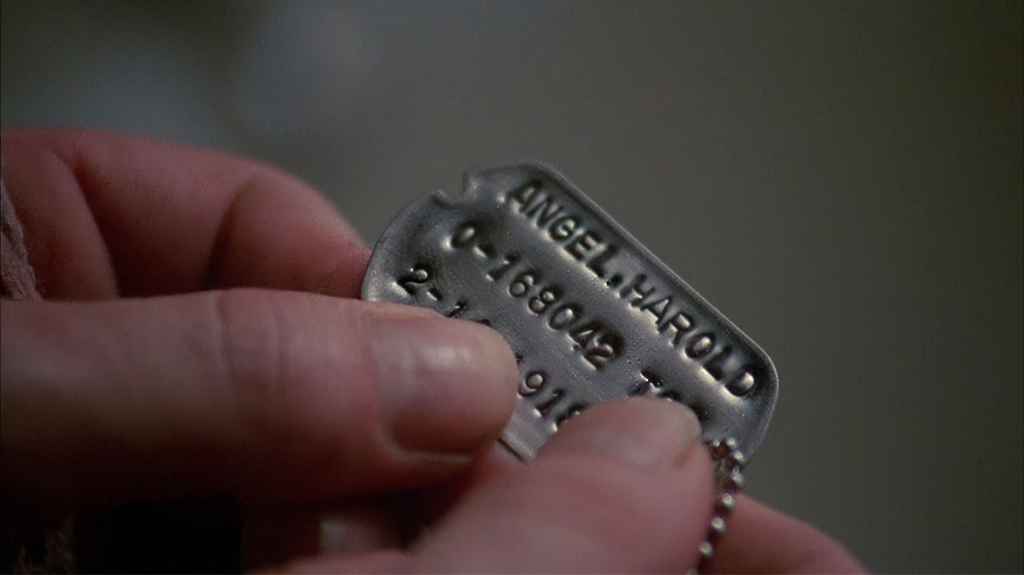
Harry smashes a white vase in Margaret Krusemark’s apartment and finds army dog tags: ANGEL, HAROLD R. Cyphre, meanwhile, is in the corner, hair down, nails at their longest, and tells him the truth: every killing was by Harry’s own hand, guided by Cyphre. Then Harry looks in the mirror and sees Johnny Favorite. He runs back through the rain to his hotel, and Epiphany is dead on his bed with his dog tags on her body. This time, though, he remembers.
The common objection, why the Devil waited twelve years, has a textual answer. Cyphre never lost track of Favorite; rather, the contract required conscious acknowledgment, and amnesia prevented exactly that, so Cyphre built an investigation that would strip the amnesia away one witness at a time. That reading resolves every apparent hole: why he is unsurprised by each murder, why he keeps pushing Harry deeper, why he reveals himself instead of simply collecting.
What the foreshadowing was doing
Five systems run under the plot, none of them in the novel: ceiling fans before every act of violence, mirrors in which Johnny looks back at Harry, an elevator that only descends, blackouts that hide the murders in the edit, and a chain of chicken, egg and heart that names the crime three ways. A sixth, the hooded figure scrubbing blood at every murder site, is Cyphre himself, and what he is cleaning is Harry’s memory rather than a crime scene. The twist feels inevitable in retrospect because the clues were on screen from the first frame.
“You’ve been living on borrowed time and another man’s memories.”
Louis Cyphre to Harry Angel · the revelation scene
Craft
What Angel Heart teaches screenwriters
Most twist films protect one secret. Angel Heart, by contrast, sacrifices one to protect another, and the lesson is in how the protection is built.
Sacrifice a secret to protect the real one
The Cyphre pun is solved in seconds, by design, because an audience that has figured something out feels finished and stops looking, which is exactly when the deeper twist can hide in plain sight.
Plant the twist in a different channel
Fans, mirrors and elevators carry the truth while the plot runs on dialogue and investigation. The audience processes the channels separately, so the visual clues never spoil the narrative surprise.
Let the genre do the lying
In a detective story we trust the detective, so Parker hid the killer inside the one role the audience polices least, so the genre contract itself becomes the misdirection.
The film sits where two traditions meet, the hardboiled detective story and supernatural horror, and it takes the conventions of the first as seriously as the theology of the second. Then read it beside Chinatown, another detective whose solved case is the thing that destroys everyone in it.
Questions
Angel Heart screenplay analysis: quick answers
The story
What is Angel Heart about?
In 1955, Brooklyn private investigator Harry Angel is hired by a client named Louis Cyphre to find Johnny Favorite, a pre-war crooner who disappeared before honoring a contract. The trail runs from Harlem to New Orleans, every witness dies, until Harry discovers that the missing man he is hunting is himself.
Who is Johnny Favorite in Angel Heart?
A singing star who sold his soul to the Devil for fame. On New Year’s Eve 1943 he murdered a young soldier named Harold Angel in a ritual, ate his heart and stole his identity to escape the contract. War injuries caused amnesia, and he has lived as Harry Angel ever since, unaware of who he is.
What does the last shot of Angel Heart mean?
The elevator is going down, and it does not stop, because the contract is complete: Harry has acknowledged who he is, and the descent is his damnation. Parker also says the image grew far larger in the edit than he had planned when he wrote the script.
Is Angel Heart based on a book?
Yes: William Hjortsberg’s 1978 novel Falling Angel, set entirely in New York in 1959. Parker moved the second half to New Orleans, shifted the year to 1955, and removed the novel’s ambiguity about whether Harry was framed. The adaptation breakdown takes the changes one by one.
The details
Who is the Woman in Black in Angel Heart?
The hooded figure scrubbing blood at every murder site is Louis Cyphre in disguise; De Niro’s face is visible beneath the hood outside Harry’s hotel in the final minutes. The scrubbing isn’t literal, since the police find every body as Harry left it. Instead, Cyphre is wiping Harry’s memory of each killing. The twist and foreshadowing analysis maps every appearance.
Why is Harry Angel afraid of chickens?
Chickens are sacrificed in voodoo ritual, and chicken blood was central to the ceremony in which Favorite murdered the real Harry Angel. So the phobia is the buried personality recoiling from the tools of its own crime. It plays as a joke on first viewing and a confession on the second.
Whose child is Epiphany’s son?
The film’s final image of the boy shows his eyes glowing like Cyphre’s. Epiphany says he was conceived at a ceremony while she was possessed; the Devil fathered him. On rewatch, the child’s screaming at the sight of Harry plays like recognition, though Parker says the crying was an accident they kept. The Epiphany Proudfoot analysis covers her household in full.
Why was Angel Heart rated X?
The MPAA objected to roughly seven seconds of the blood-rain sex scene between Rourke and Bonet. Parker appealed, lost, and then cut about ten seconds, mostly shots of Rourke’s backside. Rourke publicly questioned whether the scene’s interracial dimension drove the decision. Home video later restored the full version.
The full essays
Go deeper
Every section of this Angel Heart screenplay analysis has a full essay standing behind it. Five pages, one contract.
The hub
Angel Heart explained: the full analysis and beat sheet
Johnny Favorite, the Faustian mechanism, every witness as a piece of Harry’s past, and the beat sheet with every blackout timed.
Twist and foreshadowing
Six foreshadowing systems, the blackout structure, and every hooded Cyphre appearance mapped.
Antagonist design
Louis Cyphre: the Devil in four scenes
How fifteen minutes of restraint dominates a two-hour film, and what the egg scene is built from.
Character design
Epiphany Proudfoot: the only honest character
A priestess, a daughter, a witness: every word she says is true, and the film destroys her for it.
Adaptation
How Falling Angel became Angel Heart
Five decisions, each forcing the next: the city, the year, the motifs, the child, the elevator.
The books
Be there when the books ship
Deep SHT is the book series behind these pages: full-length structural analyses built from screenplay drafts, commentary tracks and the finished film. Deep SHT: Chinatown goes out to the launch list first, pay-what-you-want. One email when it ships, and the occasional piece of analysis worth your time. Nothing else.


