Deep SHT / No Country for Old Men / Beat Sheet
No Country for Old Men Screenplay Beat Sheet: Where the Act Breaks Fall
All 15 beats with the shooting-script page and the film minute for each one
Adapted screenplay by
Joel Coen and Ethan Coen (2007)
Based on the novel by
Cormac McCarthy (2005)
Starring
Tommy Lee Jones, Javier Bardem, Josh Brolin
117
Pages in the shooting script
116m
From fade-in to “Then, I woke up”
p.99
The page the protagonist dies on, at 96m
20m
The film still runs after he is dead
The argument
How the No Country for Old Men Screenplay Is Built
Every tentpole on schedule
The No Country for Old Men screenplay is a 117-page shooting script, and for 99 of those pages it behaves like the thriller it looks like. The protagonist takes the money on page 10, and then the men who want it back find him on page 14. He discovers the transponder on page 58, almost exactly halfway, and the man carrying its receiver is at the door one page later. The phone call that tells him the hunt has moved to his wife lands later, on page 84. Every one of those positions is where a classical three-act structure would put it, and the film, in fact, keeps them minute for minute.
Then page 99 arrives, the page a thriller reserves for its final confrontation, and the protagonist is already dead on a motel threshold, killed between scenes by men who have no lines. The script spends its last eighteen pages, and the film its last twenty minutes, on Sheriff Bell, a character the first two acts never asked anything of. This beat sheet maps the film’s story onto the 15 beats of the Save the Cat! framework, with the shooting-script page and the film minute for each beat, so the hand-off can be read as structure rather than described as a feeling.
Two clocks: page and minute
Page numbers come from the Coens’ shooting script, which runs 117 pages before ending inside Bell’s dream. Minutes come from the film as screened, counted from the first frame; the last line of dialogue, “Then, I woke up,” plays at 116m. The two clocks track each other closely for most of the runtime, which is in fact a finding: the Coens shot what they wrote, in the order they wrote it. Where they part, the beat says so. The novel’s third clock belongs to the Book vs. Movie comparison, which this page points to rather than repeats.
On this page
- The Three Lanes: Who Holds the Story at Each Tentpole
- Act One: Setup (Beats 1-5)
- Act Two, Part A: The Hunt and the Midpoint (Beats 6-9)
- Bad Guys Close In (Beat 10)
- Act Two, Part B: All Is Lost to the Threshold (Beats 11-13)
- Act Three: Bell’s Film (Beats 14-15)
- Where the No Country for Old Men Script and the Film Part
- What the No Country for Old Men Beat Sheet Teaches Writers
- No Country for Old Men Screenplay: FAQ
Note: Each beat carries the page (p.) where it falls in the shooting script and the minute (m) where it plays in the film. Where a beat is dialogue-free, the minute is bracketed by the lines on either side of it. Page numbers are the script’s own.
Signature structure
The Three Lanes: Who Holds the Story at Each Tentpole
Read each station across: three lanes, one per character, lit only when that character holds the camera at that structural position. Then read the Moss lane down. It carries the story from the Act One turn to All Is Lost and goes out one station before the climax. Then read the Bell lane down, and it does the opposite: voice at the top, dark through the middle, lit at the two stations where the other lanes are dark. That shape, in short, is the screenplay’s argument.
p.1 / 0m
Station 1: Opening image
Moss
Not yet on the page.
Chigurh
In handcuffs in the back of a cruiser, face unseen.
Bell
Voice only. The old-timers, the boy at Huntsville, the chips he will not push forward.
p.14 / 16m
Station 2: Act One turn
Moss
Goes back to the basin with water. Two men on the ridge by his truck. The chase begins.
Chigurh
Off the page since the roadside killing on p.5.
Bell
Not yet investigating. First scene with Loretta is p.27 / 28m.
p.58 / 57m
Station 3: Midpoint
Moss
Finds the transponder in the money. Two columns of dark under the door.
Chigurh
The shadow under the door. The lock cylinder on p.60.
Bell
Off the page. Last seen leaving the Desert Aire trailer on p.36.
p.84 / 85m
Station 4: All is lost
Moss
On a hospital phone across the river, hearing the terms.
Chigurh
Answers Wells’s phone over Wells’s body. The hunt moves to Carla Jean.
Bell
In his office with Wendell, p.70 / 86m, asking about a lock cylinder punched out at the Del Rio motel.
p.99 / 96m
Station 5: Break into three
Moss
Dead on the threshold of the El Paso motel room. The killing is off-screen.
Chigurh
On the road, p.95-97, buying a car with a killing. Arrives after the fact.
Bell
Arrives at the gunfire. Finds the body. Takes the story.
p.116 / 114m
Station 6: Final image
Moss
Gone twenty minutes.
Chigurh
Limped out of frame on p.114 / 113m.
Bell
The breakfast table, two dreams, the fire in the horn.
What the lanes show
Bell is lit at the opening and the close and at the one middle station, All Is Lost, where he is asking Wendell about a punched-out lock cylinder while Moss hears Chigurh’s terms across the river. Those three stations are the three positions a protagonist cannot be absent from, while Moss holds the other three, which are the positions a chase needs. The script assigns the thriller’s beats to one man and the story’s beats to another, and the hand-off at station five is the only place the two lanes touch: Bell walks up to a doorway with Moss’s boots sticking out of it.
Act One
Act One: Setup (Beats 1-5)
A sheriff’s voice, a killer in handcuffs, and a hunter who finds two million dollars and goes back for a dying man.
Beat 1 / p.1 / 0m – 2m
Opening Image
Snow in a mountain pass at night, then West Texas landscapes with no people in them, under Sheriff Bell‘s voice: sheriff at twenty-five, grandfather and father lawmen before him. The script’s first slugline is EXT. MOUNTAINS – NIGHT, and then its last one, on p.116, returns to it. The movie is a ring, and the script says so in its own stage direction.
Beat 2 / p.2 / 2m
Theme Stated
Still in voice-over, Bell tells of the boy he sent to Huntsville for killing a fourteen-year-old girl, and says he does not want to push his chips forward and go out and meet something he does not understand. The theme, then, is a man naming the one thing he will not do. The next hundred pages make him do it, and the last two show what it cost.
Beat 3 / p.3 – 9 / 3m – 10m
Set-Up
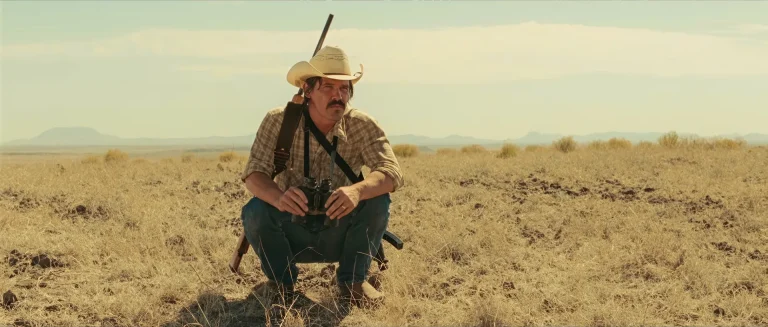
Two set-ups run back to back, so the beat belongs to two men. Chigurh strangles the deputy with his own cuffs (p.3-4), then pulls over a motorist and kills him with the air tank the deputy had just described on the phone (p.4-5). Llewelyn Moss is introduced glassing a herd on the arid plain (p.5), follows a wounded dog’s trail to the shot-up trucks in the basin (p.7), and leaves a dying man who asks him to close the door against the wolves (p.9 / 10m). Both men are established by the same means, though: what they do with someone who cannot fight back.
Beat 4 / p.10 / 12m
Catalyst (Inciting Incident)
Moss tracks the last man standing to a tree on the rock shelf, finds him dead, and drags a boxy leather document case away from the body and opens it (p.10). He takes it. The scene has no dialogue, so the minute is bracketed: it plays between his last line at the trucks (11m) and his first line in the trailer (14m). His External Goal is set here and never changes afterward: keep the money and stay alive, in that order.
Beat 5 / p.11 – 13 / 14m – 16m
Debate
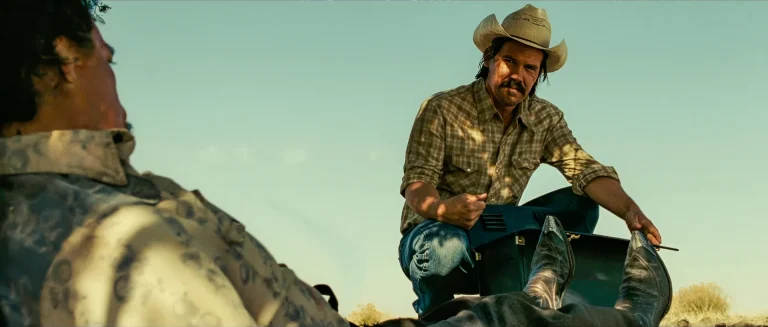
The trailer at Desert Aire. Carla Jean asks about the pistol and the money but gets no answers. Moss lies awake, fills a jug of water, and tells her he is fixing to do something dumber than hell but is going anyway (p.13 / 16m). The Debate in this script is one man arguing with himself for two pages and losing. So he goes back for the dying man, and the story goes with him.
Act Two, Part A
Act Two, Part A: The Hunt and the Midpoint (Beats 6-9)
Moss runs, the men with the receiver follow, and the sheriff starts arriving after the fact. Halfway through, the hunted man finally learns the rules of the hunt.
Beat 6 / p.14 – 16 / 16m – 20m
Break into Two
Moss returns to the basin at night with the water jug, but the man in the truck is dead, and two silhouettes stand on the ridge beside Moss’s own truck (p.14). The chase runs through the river gorge to the river at dawn (p.16-17), where he shoots the dog and crawls out on the Texas side with nothing but the pistol. The break is not the money; it is the truck he leaves behind in the basin, the one Bell will trace to a fella named Moss on p.30. From here on, then, the hunt has a name.
Beat 7 / p.27 – 32 / 28m – 31m
B Story
Sheriff Bell gets his first scene on the page at p.27: Loretta, the horse, and a deputy named Wendell waiting by a burned-out car. He then rides into the basin (p.29), reads the ground, and names the truck’s owner (p.30). In a conventional thriller, at least, the B Story is the love interest who carries the theme. Here, instead, it is the investigator who carries the theme and never catches anyone. It runs alongside the chase, always a scene behind it, until the chase ends and it is the only story left.
Beat 8 / p.18 – 53 / 20m – 55m
Fun and Games
The promise of the premise is two hunters working the same ground, and the script delivers it as alternation rather than collision. Chigurh flips a coin for a gas station owner’s life (p.18-23 / 20m-25m) and is handed the receiver by the men who hired him (p.26 / 27m). Moss, meanwhile, sends Carla Jean to Odessa (p.24 / 25m), takes a bus to Del Rio, and hides the case in a motel air duct (p.39). Chigurh follows the signal to the same motel, kills the three Mexicans waiting in Moss’s first room (p.50-53), while Moss, in the room next door with his shotgun on the bed, fishes the case out of the duct with tent poles and leaves in the dark (p.47-53 / 44m-52m). Carson Wells is hired in a Houston office on p.54, and the section then closes on him counting the building’s floors (55m).
Beat 9 / p.58 – 60 / 57m – 60m
Midpoint
The Hotel Eagle in Eagle Pass. Moss lies down, then sits up and says there just ain’t no way (p.58 / 57m). He upends the money, finds the packet that binds, and inside it, finally, a sending unit the size of a Zippo lighter. The script then spends a page and a half on sound and a line of light under a door: the beeping that approaches and stops, two columns of dark, the light going out, the stamping sound of the cattle gun and the lock cylinder landing in his lap (p.59-60). It is, in fact, a False Victory on the page’s own terms. He has solved how they found him, and the solution arrives with the man it explains.
There just ain’t no way.
Llewelyn Moss, page 58, minute 57. The midpoint, in five words, before he finds the transponder.
Act Two, the long middle
Bad Guys Close In (Beat 10)
Twenty-two pages in which everyone who might stop Chigurh is hurt, bought off, or killed, and Moss recovers in the wrong country.
Beat 10 / p.61 – 83 / 60m – 83m
Bad Guys Close In
The street fight spills from the hotel sidewalk to a pickup and then to the bridge (p.60-65). Moss is hit, then buys a coat off three boys on the Rio Grande bridge, throws the case into the cane on the riverbank, and wakes in a Mexican hospital (p.65-73 / 64m-75m). Chigurh, meanwhile, hit in the leg, blows up a car outside a pharmacy to steal what he needs and sews himself up in a motel bathroom (p.68-70 / 68m-70m). Carson Wells finds Moss’s bed and offers a deal he cannot deliver (p.73-77 / 75m-78m), goes back for the case, and then meets Chigurh on the stairway of the Hotel Eagle (p.80-83 / 80m-83m).
The rule Wells followed
On p.81, at 83m, Chigurh asks Wells what use his rule was if it brought him to this room. It is the beat sheet’s clearest statement of what Bad Guys Close In means in this story: not that the villain is winning, but that every system a character trusted, professional or legal or marital, has delivered him to a chair opposite the man with the gun. Wells is the first to hear it spoken, while Bell, two acts later, is the one who has to answer it.
Act Two, Part B
Act Two, Part B: All Is Lost to the Threshold (Beats 11-13)
The money then stops being the stake. Moss comes back across the border to trade it for his wife, but the trade never happens.
Beat 11 / p.84 / 85m
All Is Lost
Moss calls the number Wells gave him, and Chigurh answers instead. The offer is on p.84: bring the money and she goes free; otherwise she is accountable, same as he is. Moss then says he will make Chigurh his special project. Both men mean it, and neither gets to do it. In a conventional beat sheet All Is Lost is a defeat the hero eventually recovers from. Here, instead, it is the moment the stakes transfer from the man holding the money to the woman who never touched it.
Beat 12 / p.86 – 98 / 87m – 95m
Dark Night of the Soul
Twelve pages of people moving toward El Paso. Moss talks his way through the border shack (p.86 / 87m), recovers the case from the cane, and then calls Carla Jean from the Del Rio bus station to tell her to meet him at the Desert Sands motel (p.89-90 / 89m). Chigurh kills the man who hired him, then asks the accountant whether he sees him (p.91-92 / 91m). Carla Jean, meanwhile, tells Bell where her husband is headed (p.93-95 / 92m-93m). Chigurh then kills a man for his El Camino (p.95-97 / 94m). And Moss, leaning on a veranda post at the Desert Sands, tells a woman by the pool that he is looking for what’s coming (p.98 / 95m). The Dark Night, then, is not a scene in which he doubts. Rather, it is the one in which he says, out loud, that he knows.
Beat 13 / p.98 – 99 / 96m
Break into Three
The script hands the camera to Bell on p.98 and keeps it there until the end. He is driving a commercial strip, looking for the motel, when the tock of distant gunfire turns his head. He hits the siren. A pickup with roof lights then roars out of the motel street. In the courtyard a Mexican in a guayabera is crawling toward the street, a woman is belly-down at the lip of the pool, and an open room door has booted feet sticking out of it. Moss is face-up, mostly inside the room, gun in hand, still (p.99 / 96m). The protagonist’s death is the break into the third act, so the third act belongs to the man who found him.
Lookin’ for what’s comin’.
Llewelyn Moss to a stranger by a motel pool, page 98, minute 95.
Act Three
Act Three: Bell’s Film (Beats 14-15)
Eighteen pages, twenty minutes, no protagonist in the thriller’s sense. Instead, a sheriff visits a motel, an uncle, and a breakfast table.
Beat 14 / p.100 – 114 / 97m – 113m
Climax
The Climax is spread across four scenes, and none of them, surprisingly, is a fight. Bell sits with the El Paso sheriff over coffee (p.100-103 / 97m-99m), then drives back to the motel very late, finds the lock cylinder punched hollow, and nudges the door with his boot while the script places Chigurh on the other side of it, holding his shotgun, watching the sheriff’s reflection in the brass (p.103-105). Nothing happens, so Bell sits on the bed and looks at an open vent.
He then drives to his uncle Ellis‘s cabin and is told what he has is nothing new (p.106-110 / 102m-107m). Chigurh keeps his word to a dead man in Carla Jean‘s bedroom (p.110-112 / 108m-111m) and is T-boned at an intersection a minute later (p.113-114 / 112m-113m). The script’s climax is a man declining to walk through a door, and the film’s is a woman declining to call a coin. Neither, though, is resolved by anyone winning.
Beat 15 / p.115 – 117 / 114m – 116m
Final Image
Bell, retired, tells Loretta about two dreams at the breakfast table. Both had his father in them, though Bell is older now than his father ever was by twenty years. In the second, his father rides past him through a mountain pass at night, carrying fire in a horn, going on ahead to make a fire in all that dark and cold. The script cuts to EXT. SNOWY MOUNTAIN PASS – NIGHT and names it in the stage direction as the image the movie began with; the rider recedes, the horn bearing fire goes last, and the page reads THE END.
The film stays on Bell’s face at the table, gives him one more line, “Then, I woke up,” and cuts to black at 116m. What those four words change is the subject of the Ending Explained page. What the beat sheet records is simply that the screenplay ends inside the dream while the film ends outside it.
Page against screen
Where the No Country for Old Men Script and the Film Part
The Coens shot their No Country for Old Men script in order and nearly in full, which is why the page clock and the minute clock run so close together above. The differences are few, small on the page, but large in effect. Four of them, though, bear on structure.
The door Bell does not draw on
On p.104-105 Bell’s hand comes to his holstered gun, rests there through a long beat, and drops; he toes the door open and enters unarmed. In the film, however, he draws and goes in with the revolver up, the only time he draws in the picture. The script’s version is the stranger one: the sheriff chooses not to meet what is behind the door armed, and the script lets the reader know, from inside the room, exactly what is behind it.
A coin that is not in the script
The Carla Jean scene on p.111-112, surprisingly, has no coin in it. Chigurh gives his word, she says she knew what was in store for her, and then he says things fall into place. The coin toss, her refusal to call it, and the line about the coin having no say all arrived between the shooting script and the screen. The Carla Jean Moss page, rather than this one, traces where they came from.
An answer the film withholds
On p.92 Chigurh asks the accountant whether he sees him; the film cuts away before any reply is heard. The page question, then, has an answer written under it. The screen question does not, so the Anton Chigurh page takes up what that cut does to him.
The last four words
The screenplay’s final page is a rider receding into snow with a horn of fire going last. The film’s, instead, is Bell at a breakfast table saying he woke up. One ends in the dream the father is riding through; the other ends in the kitchen the son is sitting in. Every reading of the ending turns on which of those two images is the last one, and the beat sheet’s job is only to record that the Coens wrote one and shot the other.
For writers
What the No Country for Old Men Beat Sheet Teaches Writers
Keep the schedule, break the promise
The lesson is not that the Coens ignored structure; in fact, the page numbers above show the opposite: catalyst on p.10, break into two on p.14, midpoint on p.58, all is lost on p.84, break into three on p.99. Those are textbook positions, so the audience feels them as a thriller’s rhythm. What the script withholds, though, is the single beat the rhythm exists to pay off, the confrontation between the two men the first ninety pages have been pointing at each other. The audience’s sense that something has gone wrong at the El Paso motel is a structural effect before it is a thematic one. The beat is missing because the schedule promised it.
The B Story can be the story
Bell enters on p.27 and is off the page for most of the second act, which is, after all, where a B Story is supposed to live. The script gives him the opening voice-over and the last three pages, and the title. A writer can run the theme through a character the plot never needs, and then, when the plot’s character dies, discover that the theme was the plot all along. The condition is that the theme character has to be on the page early enough, and often enough, that the hand-off on p.98 reads as a return rather than a replacement.
Write the beat as sound
The midpoint on p.58-60 is a page and a half of stage direction with one line of dialogue in it. A dull chug. A seashell hiss under a door. A beeping that approaches and stops. A shadow that resolves into two columns of dark. The light going out. The script is scoring the scene in the absence of a score, and every one of those sounds is still in the finished film. For a writer, the page is a model of how to make a reader hear a scene the camera will mostly hold still for.
Questions readers search
No Country for Old Men Screenplay: FAQ
The script and its pages
How long is the No Country for Old Men screenplay?
The shooting script runs 117 pages, with THE END at the bottom of p.117, and the title page credits it as an adapted screenplay by Joel Coen and Ethan Coen, based on the novel by Cormac McCarthy. The film as screened runs to its last line of dialogue at 116 minutes, so the page-a-minute rule of thumb holds almost exactly for this one.
How old is Llewelyn Moss in the screenplay?
The screenplay never gives his age, in fact. He is introduced on p.5 as a hunter on the arid plain with no description of his years, and no later page supplies one. The number people search for comes from somewhere other than the script, and the Llewelyn Moss page deals with where it comes from and whether it holds.
Where does the midpoint of No Country for Old Men fall?
On p.58 of a 117-page script, at 57 minutes of a 116-minute film: the Hotel Eagle room in Eagle Pass, where Moss finds the transponder in the money and, on the next page, hears the beeping stop outside his door. It is, in short, as close to the arithmetic center as a midpoint gets.
The structure
Who is the protagonist of No Country for Old Men?
By the beat sheet, Moss holds the catalyst, the break into two, the midpoint and All Is Lost, which are the protagonist’s positions in a thriller. Bell, meanwhile, holds the opening image, the theme, and the final image, which are the protagonist’s positions in a story. The script gives the thriller to one man and the story to the other, and the hand-off between them is the break into three on p.99.
Does Moss die on screen in the screenplay?
No. On p.98-99 the script cuts from Moss at the pool to Bell driving, and Bell hears the gunfire from the road. By the time he reaches the courtyard the pickup is leaving and Moss is face-up in his doorway, still. The film shoots it the same way, so neither the page nor the screen shows the killing.
Does the screenplay end the same way as the film?
Not quite. The script ends on p.117 inside the second dream, on the image of the rider and the horn of fire receding into snow, with no line after it, while the film ends at the breakfast table on Bell’s “Then, I woke up,” and cuts to black. The Ending Explained page is about what that difference means; the Book vs. Movie page is about how the novel ends.
Go deeper
The Rest of the No Country for Old Men Series
Series hub
No Country for Old Men: Complete Screenplay Analysis
The map of the series: structure, character, adaptation, and what the Coens and McCarthy are arguing.
Ending
No Country for Old Men Ending Explained
The coin refusal, the two dreams, and what the four words the script does not contain do to them.
Adaptation
No Country for Old Men Book vs. Movie
Novel, screenplay, and film read against each other, including the third clock this beat sheet leaves to it.
Beat sheets
The full library, from Casablanca to The Dark Knight, minute by minute.