
Quentin Tarantino’s 1992 independent heist film Reservoir Dogs revolutionized cinema with its nonlinear storytelling, razor-sharp dialogue, pop culture references, profanity, and unflinching violence. Written and directed by Tarantino in his feature-length debut, the movie stars Harvey Keitel as Mr. White, Tim Roth as Mr. Orange, Michael Madsen as Mr. Blonde, Steve Buscemi as Mr. Pink, Chris Penn as Nice Guy Eddie, and Lawrence Tierney as Joe Cabot.
This Reservoir Dogs screenplay breakdown explores the script’s structure, dialogue, character arcs, themes, and legacy. Moreover, it draws on influences like Stanley Kubrick’s The Killing, Ringo Lam’s City on Fire, and classic noir. Consequently, Tarantino crafted a pressure-cooker story that deliberately omits the heist to focus on betrayal, loyalty, and paranoia.
QUICK FACTS
| Detail | Insight |
|---|---|
| Writer / Director | Quentin Tarantino |
| Release Year | 1992 |
| Length | 99 minutes |
| Budget / Box Office | ~$1.5 million budget; $2.9 million domestic gross (cult success post-Pulp Fiction) |
| Structure | Non-linear (flashbacks + real-time warehouse) |
| Logline | After a botched diamond heist, color-coded criminals unravel in a warehouse amid accusations, torture, and revelations of an undercover cop. |
| Core Concept | 90% dialogue, 10% action — heist never shown |
| Most Famous Scene | Mr. Blonde’s ear torture to “Stuck in the Middle with You” |
| Accolades | 90% on Rotten Tomatoes; Empire’s “Greatest Independent Film”; Sundance breakout |
TABLE OF CONTENTS
- Script Overview
- The Non-Linear Structure Explained
- Reservoir Dogs Dialogue Analysis: The Tipping Debate
- Reservoir Dogs Scene Breakdown: Save the Cat! Beat Sheet
- Colors Without Souls
- Themes Explained
- Ending Explained: Mr. White’s Tragic Choice
- Production Insights & Legacy
Script Overview
Tarantino originally planned a $30,000 black-and-white shoot with friends. However, Harvey Keitel’s involvement as co-producer raised $1.5 million. As a result, the script jumps between pre-heist camaraderie and post-heist chaos. Additionally, flashbacks provide ironic contrast and build suspense. Influenced by The Killing and City on Fire, it transforms a simple heist premise into a brutal exploration of trust in the criminal world.
The Non-Linear Structure Explained
Tarantino hides the robbery for both budget reasons and dramatic effect. Therefore, he immerses the audience in the characters’ paranoia. In fact, we piece together the failure through accusations and flashbacks, mirroring the survivors’ experience. Sunny past moments—such as diner banter or color assignments—heighten the agony when intercut with warehouse violence. Ultimately, this approach isn’t merely a gimmick. Instead, it serves as the perfect delivery system for the film’s thesis: broken trust in this world is irreversible, and the past only intensifies present pain.
Reservoir Dogs Dialogue Analysis: The Tipping Debate
The opening diner scene features eight criminals debating Madonna’s “Like a Virgin” and tipping. Although it advances zero plot, this sequence defines Tarantino’s voice: profane, pop-culture-obsessed, and deeply revealing.
Why This Opening Works So Well
First, Joe’s “Like a Virgin” monologue instantly brands the film. Meanwhile, the casual setting captures false brotherhood before everything shatters. Furthermore, dialogue alone reveals eight distinct personalities. Consequently, it plants the central conflict of loyalty versus self-interest.
The Tipping Argument Breakdown
Mr. Pink (4m) declares: “Uh-uh, I don’t tip.” This line exposes his paranoia and rejection of unearned obligation. By contrast, Mr. White defends tipping out of fairness and empathy for waitresses’ hard work.
The Delicious Irony and Foreshadowing
Mr. Pink’s principled stand against social “loyalty” ironically contrasts his later pure self-preservation. Conversely, Mr. White’s decency foreshadows his fatal personal loyalty. Thus, a trivial debate cleverly maps the film’s entire tragic arc.
Iconic Quote: (35m) Mr. Blonde: “Are you going to bark all day, little doggy, or are you going to bite?”
Reservoir Dogs Scene Breakdown: Save the Cat! Beat Sheet
Act I – The Last Breakfast (Setup & False Camaraderie)
The film opens with the criminals sharing a casual diner breakfast, debating Madonna and tipping, then receiving their color-coded aliases. The heist has already failed off-screen, and we immediately see Mr. White driving a gut-shot Mr. Orange to the warehouse, where the first suspicions of a rat surface.
| Sequence | Beat (Save the Cat!) | Key Event / Description |
|---|---|---|
| 1 | Opening Image | (1m) Criminals at breakfast; the illusion of a cohesive group. |
| 2 | Set-Up | (8m) Credits walk; establishes the “cool” criminal archetype. |
| 3 | Inciting Incident | (10m) The heist has already failed; Orange is bleeding out. |
| 4 | Debate | (16m) Pink and White argue over whether a rat exists and if Orange should get medical help. |
| 5 | Break into Two | (38m) The arrival of the kidnapped cop shifts the focus from escape to interrogation. |
Act II – The Warehouse Pressure Cooker (Rising Paranoia & Violence)
The survivors gather in the warehouse, hiding diamonds, accusing one another, and torturing a kidnapped cop. Flashbacks reveal Mr. Orange’s undercover training, Mr. Blonde’s prison loyalty, and the chaotic heist. Tension explodes when Mr. Blonde tortures the cop and Mr. Orange kills him to protect his cover.
| Sequence | Beat (Save the Cat!) | Key Event / Description |
|---|---|---|
| 6 | B Story | (67m) Flashbacks showing Freddy/Orange’s journey to becoming a “great actor.” |
| 7 | Fun and Games | (40m) Flashbacks of the planning phase and Blonde’s release from prison. |
| 8 | Midpoint | (24m) Pink has the diamonds; the goal (money) is secured, but the team is fractured. |
| 9 | Bad Guys Close In | (56m) Blonde’s torture of the cop pushes the group’s morality to the limit. |
| 10 | All Is Lost | (61m) Orange kills Blonde; the internal group structure is irrevocably destroyed. |
| 11 | Dark Night of the Soul | (88m) Nice Guy Eddie arrives to find a dead Blonde and a “lying” Orange. |
Act III – The Mexican Standoff (Mutual Destruction)
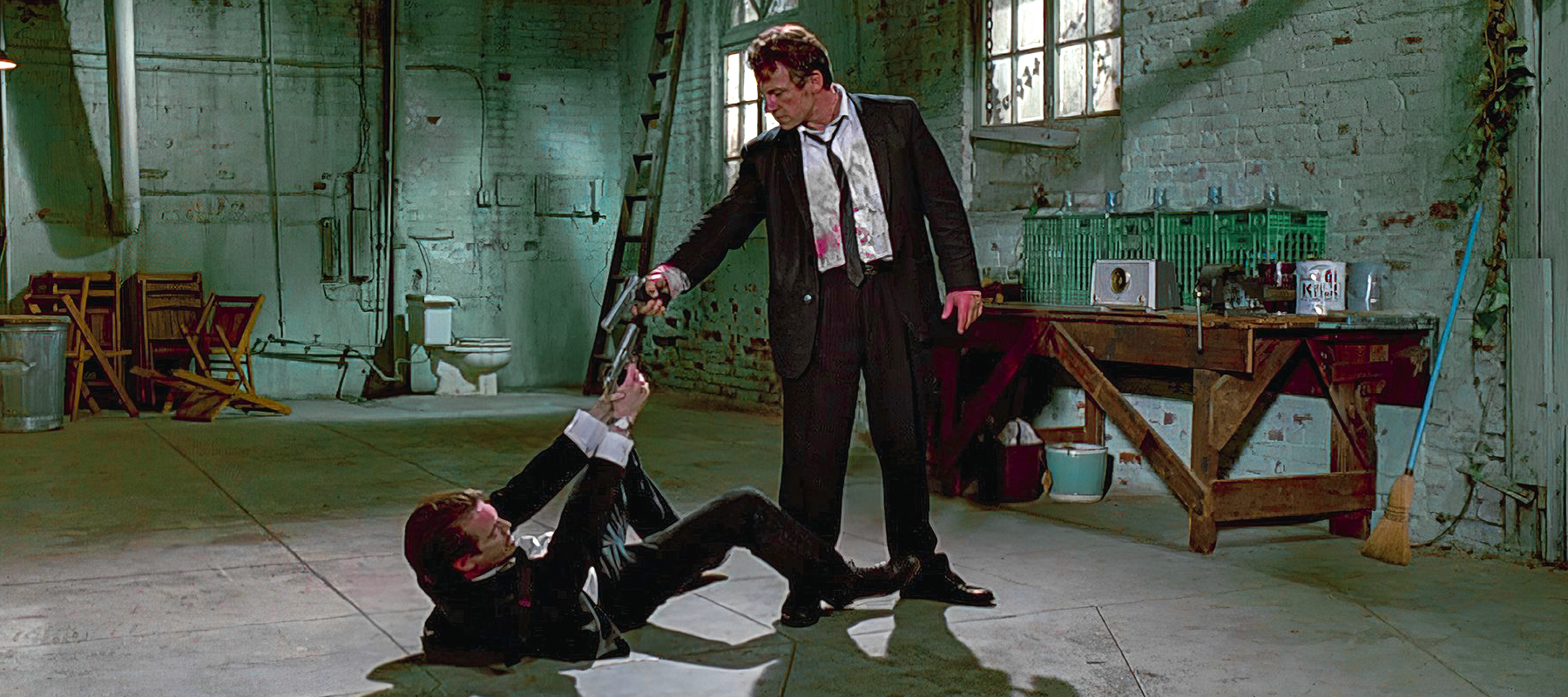
Joe Cabot arrives and names Mr. Orange as the rat. White defends him, triggering a deadly Mexican standoff. After the shootout leaves Joe and Eddie dead, Orange confesses he’s a cop. White mercy-kills him just as police storm the warehouse.
| Sequence | Beat (Save the Cat!) | Key Event / Description |
|---|---|---|
| 12 | Break into Three | (90m) Joe Cabot arrives; the “Godfather” has the answer to the rat mystery. |
| 13 | Finale | (92m) The Mexican Standoff; everyone pays for the lack of “professionalism.” |
| 14 | Final Image | (95m) White cradles Orange, executes him, and is killed by police. |
Colors Without Souls
- Mr. White (Larry): The “Mentor” who lets emotion cloud his judgment. Lesson: Professionalism and personal attachment are mutually exclusive in crime.
- Mr. Orange (Freddy): The “Actor” who becomes the role. Lesson: Deep-cover work requires a total loss of self, leading to inevitable tragedy.
- Mr. Pink: The “Survivor” who follows the rules. Lesson: The “rationalist” is often the only one who walks away.
- Mr. Blonde (Vic): The “Loyalist” psychopath. Lesson: Past loyalty doesn’t excuse present volatility.
- Nice Guy Eddie: The “Son” trying to maintain order. Lesson: Blind loyalty to family/legacy can lead to a literal dead end.
- Joe Cabot: The “Mastermind” whose system fails. Lesson: A plan is only as strong as its weakest human element.
- Mr. Brown: The “Philosopher.” Lesson: Minor characters provide the “texture” that makes a world feel lived-in.
- Marvin Nash: The “Victim/Stoic.” Lesson: Character is defined by what you endure in silence.
Themes Explained
- Professionalism vs. Emotion: Mr. White’s paternal instinct for Orange clashes with the “rules.” (Example: (31m) White defends his choice to give his name).
- Identity and Performance: Criminals play “roles” with stage names. (Example: (68m) The Commode Story flashback).
- Loyalty: Joe feels debt toward Blonde. (Example: (40m) Joe thanking Blonde for prison loyalty).
- Masculinity and Honor: Posturing dominates the standoff. (Example: (92m) Refusal to back down).
- The Banality of Evil: Murderers casually debate Madonna and tipping. (Example: (1m) Opening breakfast).
Ending Explained: Mr. White’s Tragic Choice
At (90m), Joe identifies Orange as the rat. However, White refuses to believe it, triggering the Mexican standoff (92m). After the shootout kills Joe and Eddie, Orange confesses at (94m): “Larry… I’m a cop.” Cradling the dying Orange, White executes him in mercy and despair. Finally, police gunfire ends White (95m). Thus, misplaced paternal loyalty destroys the last shred of honor.
Production Insights & Legacy
The film was shot in a former mortuary. Meanwhile, Lawrence Tierney’s volatility nearly derailed production. Although controversial for its violence—the ear scene prompted walkouts, even from Wes Craven—it premiered at Sundance. Initially, it had modest box office success. Yet, it gained massive influence after Pulp Fiction. Empire named it the Greatest Independent Film ever, and it holds a 90% Rotten Tomatoes score.
This Reservoir Dogs screenplay breakdown demonstrates how Tarantino’s bold choices—dialogue-driven narrative, omitted action, and ironic structure—launched the 90s indie revolution. In turn, they forever redefined crime films.