Character study / Three Billboards Outside Ebbing, Missouri
Is Dixon Redeemed in Three Billboards?
A dead man’s letter, three instructions, and the one Jason Dixon never follows
Officer Jason Dixon
Sam Rockwell
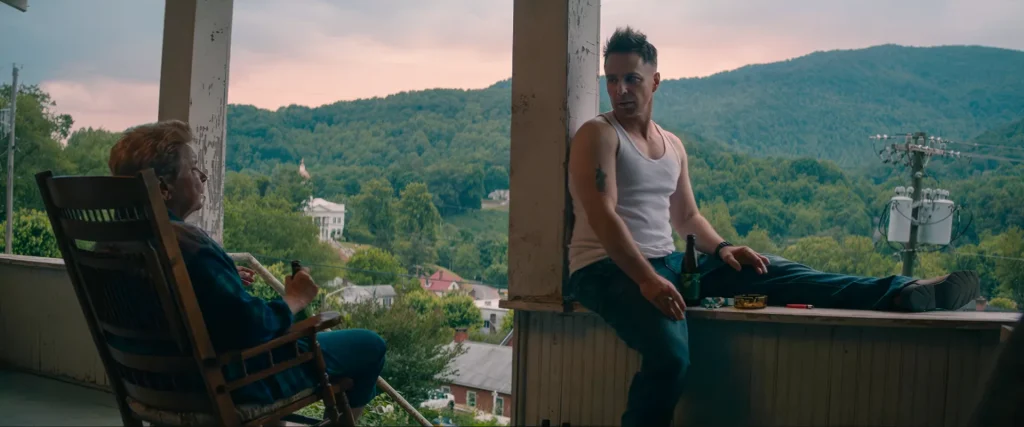
Momma
Sandy Martin
Written and directed by
Martin McDonagh
The short answer
Is Dixon redeemed in Three Billboards Outside Ebbing, Missouri? Not by the final frame, and Martin McDonagh has said as much. What the film gives Officer Jason Dixon instead is a set of instructions. Chief Willoughby’s posthumous letter tells him what a good cop needs — love, then calm, then thought, and no gun and no hate. The second half of the film watches Dixon try those steps, out of order, until the last scene puts a shotgun in the car.
This page follows Dixon in Three Billboards from the household that made him to the drive toward Idaho: what the screenplay and the film show, what McDonagh and Sam Rockwell have said about him, and where the long argument over his redemption stands. For the plot-level answer to the last scene, see Three Billboards Outside Ebbing, Missouri ending explained.
35
Dixon’s age in the screenplay
3
Years on the force, by Momma’s count
1
Letter from Willoughby
0
Badges by the last scene
Momma
The household that made Jason Dixon
The screenplay introduces Dixon as thirty-five, driving up on the billboards the night they go up. He lives with his mother. Willoughby’s letter supplies the only history the film gives him: the anger started when his dad died and he had to go look after his mom. Everything the film shows of that house fits the sentence.
Dixon’s mother and the household that produced him
Momma, played by Sandy Martin, is not a passive presence. When Dixon complains that Mildred won’t back down, Momma hands him a strategy:
MOMMA: You know, why don’t you fuck her friends over? Bring her around that way. She got any friends you can fuck over?
Momma to Dixon, on the couch
The next time Mildred walks into the station, her coworker Denise Watson is in a cell for two marijuana cigarettes, and Dixon tells her he asked the judge not to give Denise bail. Momma is the strategist; Dixon is the instrument. After he is fired she offers to go down to the station and talk to them for him, and runs the numbers on his severance: three years on the force, five at the academy, six counting the year he was held back.
The film’s last look at the two of them is Dixon home from the bar beating, locking himself in the bathroom while Momma begs at the door and calls him her baby boy. He tells her through the door that it’s all gonna be all right, and goes back to work on the DNA under his fingernails.
Hamlet, then Coriolanus
Asked in the Academy Conversations Q&A what made Dixon the way he is, McDonagh and Rockwell traded guesses rather than backstory: probably a father who beat him, and a bond with his mother somewhere between Hamlet and Coriolanus — Shakespeare’s tragedy of a soldier whose violence is raised and aimed by his mother. The film settles the father question the other way. The dad is dead, and the son stayed home.
Rockwell put the dynamic in practical terms on Charlie Rose: Momma is Dixon’s weak spot. Any time he squares up to Mildred, she brings up his mother, and the fight is over.
Cut from the same cloth: McDormand on Mildred and Momma
In the same Charlie Rose interview, McDormand described Mildred and Momma Dixon as Missouri women cut from the same cloth, and singled out how naturally Rockwell and Sandy Martin played mother and son. Same cloth, opposite directions. Mildred aims her force outward, at the institution that failed her daughter. Momma aims hers through her son.
On the page and on screen
What Dixon’s racism is, on the page and on screen
The argument around Three Billboards in 2017 and 2018 fixed on Dixon as a racist cop handed a redemption. Both sides of that argument tend to cite the same few lines. The film gives more specific evidence than that, and it is worth laying out before deciding anything.
The household racism belongs to Momma
After the firing, Momma tells Dixon to get the department to get rid of “that black guy,” meaning Abercrombie, the new chief. Dixon’s answer is an objection, but a practical one: nobody is going to listen to some guy’s mother asking them to get rid of some black guy, and things have moved on in the South. Momma’s reply locates the house’s politics: “Well, it shouldn’t have!”
Dixon’s own position shows up earlier, when Mildred taunts him at the station with a slur. He corrects her vocabulary to the newer phrase and explains that he told Momma she can’t use the old word anymore. What he has learned is which words are no longer allowed, not that the thing they describe is wrong.
The torture-in-custody backstory the film never depicts
The incident that drives the film’s racial framing is never shown. A cop tells Willoughby, “He tortured a guy in custody, Bill,” and Willoughby answers that there was no real evidence to support it. Red Welby needles Dixon on Main Street that he thought Dixon only took out Black people. On television Mildred accuses the department of torturing Black citizens; to her face, Dixon says he didn’t torture nobody.
Willoughby’s defense of keeping him on puts Dixon at the department’s baseline rather than outside it: get rid of every cop with vaguely racist leanings and you’d have three cops left. Critics pointed out the cost of keeping all this offscreen. The man Dixon is said to have tortured never appears, so the film never has to show what Dixon did to him.
Who Dixon hurts on screen
Dixon’s worst on-screen violence is against Welby: he walks across Main Street, beats him, and throws him out of his second-story office window. His on-screen harm to a Black character is the arrest of Denise on Momma’s suggestion, and the bail he asks the judge to deny. His slurs run wider than one target. On the night the billboards go up, he calls one of the Latino workmen pasting the third board a slur before driving on to the second.
Jerome stops the beating
Jerome is the man pasting up the second billboard when Dixon pulls up that first night and demands to know what it is. Months later, in the bar, when two men are stamping on Dixon after he rakes his nails down one of their faces, it is Jerome who stands up and stops it: the guy’s a cop. Dixon, through the blood, says he lost his badge. The film could have given that intervention to anyone in the room. It gives it to Jerome.
Environment or character?
One reading of this evidence is that Dixon’s racism is environmental: a racist house, a department Willoughby describes as racist at baseline, and a man who repeats both without much thought of his own. His violence, on that reading, is undisciplined contempt for everyone more than a racial program. The other reading, the one critics pressed during awards season, is that calling it environment is exactly the problem. It lets the film skip the people Dixon is said to have hurt and spend its sympathy on him.
Neither reading redeems him. They disagree about what the film is asking. One says the question is whether a man formed by that house and that department can be displaced from it by other people. The other says the film asked the audience to care about that question at the expense of the people the department hurt.
Three letters
The Willoughby pivot: where Dixon’s story turns
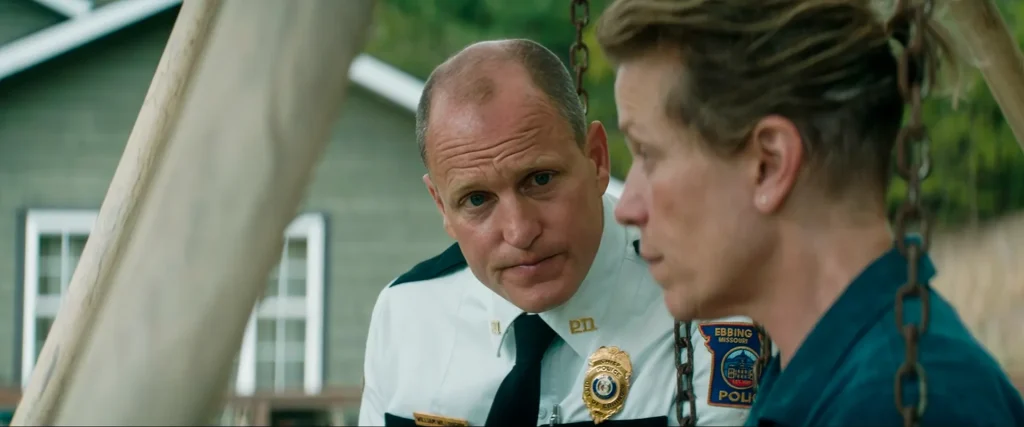
Willoughby’s first line about Dixon in the film is a defense: when another cop asks why he keeps the man on, he says Dixon is a good man at heart. His last line about Dixon is the same claim, written down. In between, Willoughby, dying of pancreatic cancer, writes three letters and shoots himself in his stable.
Three letters, three redirections
To his wife Anne he writes private grief. The letter to Mildred calls the billboards a great idea, reveals that he has paid the next month’s rent on them himself, and wishes her luck finding Angela’s killer. Only the letter to Dixon tells its reader what to do.
Paternal address from a corpse
It opens with a joke — Willoughby is dead now, sorry about that — and then says what he never said alive: Dixon has the makings of a really good cop, because deep down he’s a decent man. It names the problem, too much anger, and its source, his dad’s death and the years of looking after his mom. What a detective needs, it says, is love, because through love comes calm, and through calm comes thought. Two prohibitions follow. He doesn’t even need a gun, and he definitely doesn’t need hate.
Structurally it is a father’s letter to a son, written by a dead man to a man whose own father is dead. The only adult male voice in the film that tells Dixon how to be a man reaches him after the speaker has shot himself, and while Dixon is reading it, Mildred’s firebombs come through the window.
Deep down you’re a decent man.
Willoughby’s letter to Dixon
The staircase
Love, calm, thought: the steps Dixon takes
The letter gives an order — love, then calm, then thought — and a prohibition: no gun, no hate. Dixon in Three Billboards takes the steps in the order the film puts in front of him, not the order Willoughby wrote them. He gets three of the four.
Step 1 / 81m
Calm: the fire
Trapped in the burning station with the letter still in his hands, he says the word three times. Then, in the screenplay, he tucks Angela Hayes’ case file inside his shirt and jumps through the flames. The file lands clean. He doesn’t.
Step 2 / 85m
Love: the hospital
Bandaged past recognition, he apologizes to the man he threw out a window. Welby says he doesn’t care, tells him to stop crying, then limps back with a glass of orange juice and a straw. The love in this step is received, not given.
Step 3 / 90m
Thought: the bar
He overhears a man bragging about raping a woman and setting her on fire, writes down the truck’s plate, and works out how to get DNA: rake his nails down the man’s face and keep his fists tucked in while he takes the beating. It is the first piece of detective work the film shows him doing.
Step 4 / 110m
No gun: not taken
DNA clears the man for Angela. The shotgun goes from Dixon’s lips, to his bed, to the back of Mildred’s station wagon. The step that reads as a prohibition is the only one he never climbs.
Three steps attempted, the fourth refused. That is the shape of the arc: not a redemption, a man partway through a dead man’s instructions.
The night before Idaho
The shotgun: where Dixon’s arc stops
Easy to miss in Dixon’s story is what he is holding when he calls Mildred to tell her the DNA didn’t match.
The shotgun against his lips
The screenplay is explicit. Dixon watches his mother asleep on the couch, dials Mildred, and carries the phone into his mother’s bedroom, “and we now see that he has a shotgun in his hand.” While he gives Mildred the news, he idly taps the shotgun against his lips. By then he has been fired, burned, beaten in a bar, and told that the one piece of real police work he has done was no help to the woman he did it for. Earlier he slid his badge across the table to Abercrombie.
McDonagh never writes what Dixon is weighing in that room. The staging invites the darkest reading: a man alone with a gun at his mouth, and a phone call as the only thing in the room besides it.
The shotgun in the car
Then he floats Idaho, and Mildred says she’s driving there in the morning. He asks if she wants company. She says sure. He puts the phone down, looks at the gun in his arms, and leaves it on the bed. At dawn the same gun goes into Mildred’s car, wrapped in a blanket in the screenplay, beside a thermos, sandwiches and Doritos.
The shotgun travels with Dixon’s intent. Alone, it was at his mouth. With Mildred, it is in the car. The weapon is the same; what it is for changes with whether Dixon is by himself. Read that way, what stopped Dixon in the bedroom was finding someone to go and maybe kill someone else with — the one instruction in Willoughby’s letter he hasn’t followed.
The argument
Is Dixon redeemed? The argument
Whether Dixon is redeemed was the film’s biggest argument during awards season. Wesley Morris in The New York Times and other critics objected to what read as a redemption arc for a racist, violent cop. McDonagh answered in Entertainment Weekly: “I don’t think his character is redeemed at all.” By the end, he said, Dixon has only seen that he has to change. Sonny Bunch in The Washington Post went further, reading the film as a story of damnation rather than redemption.
Rockwell’s own answer moved. On Charlie Rose in 2017 he said he thinks Dixon does find some redemption on the journey. By awards season he had qualified it: on Colbert, backstage at the BAFTAs and again after his Oscar win, he said neither Dixon nor Mildred is redeemed by the end of the film, that both have a lot of work to do, and that they probably need a lot of therapy. Clarke Peters, who plays Abercrombie, put it closer to the staircase: in his telling, Dixon is trying from the very beginning, and trying again at the end in a different sense.
What McDonagh said he was building
McDonagh has said he wrote Dixon with Rockwell’s voice in his head, because Rockwell could go to the dark places the part needed without softening it, and because Rockwell’s own warmth would make any change in the character believable. He has called Dixon a pretty horrible piece of work at the start, and said the point was to peel back the layers rather than judge the type the way a Hollywood movie would — to see why a man behaves like this and whether he can change.
On DP30 he added a craft note: the change can’t flip like Jekyll and Hyde. It has to be gradual, and the signs have to be there from the start, so that on a second viewing you can see why he might turn out all right. The staircase is that gradualism in miniature, and the shotgun is where it stops.
Chiquitita, then the window
The morning the station learns Willoughby is dead, Dixon is at his desk with earphones in, singing along to ABBA’s “Chiquitita,” the last man in the building to hear. McDonagh has said the ABBA choice was his: Rockwell had been dancing to reggae on set, and the bad dancing to the wrong song was the joke. Minutes later the camera follows Dixon in one unbroken take across Main Street and up the stairs to Welby’s window.
Idaho
What the ending answers, and the question it leaves you with
What the line answers
In the car, Mildred confesses that she burned down the police station, the fire that put Dixon in the burn ward. He asks who else it would have been. Then she asks if he’s sure about this. About killing this guy? Not really. You? Not really. She guesses they can decide along the way.
Read as a statement about Dixon, the exchange is the first time in the film he is asked a real question by someone who will wait for the answer. Momma tells him what to do. Willoughby told him what to do, from the grave. Mildred asks. That is not calm or thought yet, and it is not love in any sense Willoughby meant. It is the nearest the film comes to the first step of the letter.
The question the analysis cannot answer for you
Evidence on one side: McDonagh says Dixon isn’t redeemed but has seen he has to change; the letter’s steps are real, and Dixon takes three of them. Evidence on the other: the gun is in the car, both people in it have a record of hurting whoever is nearest, and they are driving toward a man who is guilty of something, but not of the crime they need him guilty of.
The film doesn’t say what happens in Idaho. Whether Dixon’s last step is the one Willoughby told him not to take, or the one he finally refuses, depends on what you, having seen everything the film shows, decide.
Quick answers
Dixon in Three Billboards: quick answers
Dixon’s arc
Is Dixon redeemed in Three Billboards?
Not by the end of the film. McDonagh told Entertainment Weekly he doesn’t think Dixon is redeemed at all, only that by the end Dixon has seen he has to change. He takes real steps — he saves Angela’s case file from the fire in the screenplay, apologizes to Welby, and gets the DNA — but the film ends with him in a car with a shotgun.
Why does Dixon throw Red Welby out the window?
It happens the morning the station learns Willoughby has killed himself. Dixon walks across Main Street to the man who rented Mildred the billboards, beats him, and throws him out of his second-story office window. Later, both in the same hospital room, Dixon apologizes and Welby brings him orange juice.
Does Dixon kill the man in Idaho?
The film doesn’t say. It ends on the drive, with Dixon and Mildred each admitting they aren’t sure, and deciding to decide along the way.
The backstory
Did Dixon torture someone in custody?
The film never shows it. A fellow cop says he did; Willoughby says there was no real evidence; Dixon denies it to Mildred. The man he is said to have tortured never appears.
Why does Dixon live with his mother?
Willoughby’s letter gives the only explanation in the film: Dixon’s anger started when his dad died and he had to go look after his mom.
What does Willoughby’s letter say to Dixon?
That Dixon has the makings of a really good cop because deep down he’s a decent man; that he’s too angry; and that to become a detective he needs love, because through love comes calm and through calm comes thought. It adds that he doesn’t need a gun or hate.
The film
Who plays Dixon in Three Billboards?
Sam Rockwell, who won the Academy Award for Best Supporting Actor for the role. McDonagh wrote the part with Rockwell in mind.
Who plays Dixon’s mother?
Sandy Martin. McDonagh had cast her in a small part in Seven Psychopaths that didn’t make the final cut, and wrote Momma with her in mind.
Go deeper
More Three Billboards and McDonagh
Ending explained
Three Billboards Outside Ebbing, Missouri Ending Explained
Who the man in Idaho is, who killed Angela, and the three billboards, front and back.
Ending explained
The Banshees of Inisherin Ending Explained
McDonagh’s other ending built on a feud nobody wins.
Analysis
Another brute cop and an unlikely partner, converging after the institution fails them.
Sources
Martin McDonagh’s screenplay for Three Billboards Outside Ebbing, Missouri (the For Your Consideration edition) and the 2017 Fox Searchlight film. McDonagh, Sam Rockwell and producer Graham Broadbent in Academy Conversations; McDonagh, Frances McDormand and Rockwell with Charlie Rose; McDonagh on DP30 with David Poland and in junket interviews; Clarke Peters and the cast in a junket roundtable. Rockwell on The Late Show with Stephen Colbert and in the BAFTA and Academy Awards press rooms, 2018. Wesley Morris in The New York Times; McDonagh in Entertainment Weekly; Sonny Bunch in The Washington Post.