Script vs film · Michael Clayton (2007)
Michael Clayton Script vs Film: The Shooting Script Explained
Tony Gilroy’s Final Shooting Script, dated February 11, 2006, against the finished cut
The script
Final Shooting Script, 2/11/06, 127 pages
The film
116 minutes, released 2007
Written and directed by
Tony Gilroy
127
Pages on the page
116
Minutes on the screen
0
Cabs in the script’s ending
p. 15
Where Gilroy explains the horses
The page and the screen
What the Michael Clayton Script Says That the Film Doesn’t
Tony Gilroy’s Final Shooting Script for Michael Clayton is dated February 11, 2006 and runs 127 pages. The film runs 116 minutes. They match closely, scene for scene, which makes the places they don’t match worth reading. This Michael Clayton script vs film analysis works through those places: an ending that was rewritten, a wall that was a mirror, a horses scene that Gilroy explains in his own action lines, and a handful of lines that reached the screen changed.
The minute marks below are from the Michael Clayton beat sheet; page numbers are the script’s own. For the horses and Realm & Conquest in depth, see the horses scene explained.
On this page
- The three speeches: madness to method
- The ending on the page: Sixth Avenue, no cab
- The horses on the page: a pilgrim in a cathedral
- The mirror, not the wall
- Arthur’s summons and the red cover
- The word “horses” in the alley
- “I’m the guy you buy”: the Hilton speech
- Page-to-screen details
- Michael Clayton script FAQ
Signature element · the three speeches
The Three Speeches: Madness to Method
The script gives Arthur’s rhetoric to Michael in three stages. Read the three panels top to bottom and the transfer is the plot.
1 Madness
“Make believe it’s not just madness, because it’s not just madness”
Arthur Edens, voice-over · p. 1 · 1m
The first words of the script. Arthur is begging Michael, in advance, not to sweep. Michael isn’t listening; he hasn’t appeared yet.
2 Summons
“I’m Shiva the God of death.”
Arthur Edens, holding cell · p. 34 · 31m
Michael answers with a diagnosis: “You’re a manic depressive.” On the page the exchange ends with Michael’s “Let’s get out of Milwaukee and we’ll talk about it.” The talk never happens.
3 Method
“I’m Shiva the God of Death.”
Michael Clayton, Hilton mezzanine · p. 125 · 112m
Same words, one capital letter added. Michael says it walking away from Don Jeffries as the detectives arrive. Arthur’s madness has become a procedure, with a wire.
I’m not a guy you kill! I’m the guy you buy!
Michael Clayton, shooting script p. 121
Sixth Avenue, no cab
The Ending on the Page
The film ends in a cab. Michael hails it outside the Hilton, tells the driver to give him fifty dollars’ worth and just drive, and the camera holds on his face through the credits. None of that is in the shooting script.
On the page, after Karen is taken, Gene asks Michael if he’s okay. The action line says Michael has just torn off his skin, that he is naked to the world. He answers that he needs some air, Gene tells him to stay close, and Michael walks out onto Sixth Avenue at rush hour, toward the park, through what the script calls a sea of people and faces. Arthur’s voice comes up: Michael. Look at me, Michael. Look at me and make believe. The opening voice-over plays again, the Mania Tax and the Insanity Tax and the price of the show, over the tail credits.
What the change does
The scripted ending is a loop. It closes the film with the words that opened it, and it leaves Michael on foot in a crowd, one face among thousands, which is the deserter’s condition from Realm & Conquest. The filmed ending is a portrait. It puts him alone in the back of a car, paying to go nowhere, and it lets the audience watch him decide what he feels. Gilroy traded the structural rhyme for the face.
It also removes Arthur from the ending. On the page Arthur has the last word; on screen the last words are Michael’s, and they are about money: fifty dollars, the first sum in the film he spends on himself with no angle.
Give me fifty dollars worth. Just drive.
The film, 114m. Not in the script.
A pilgrim in a cathedral
The Horses on the Page
The most-asked question about this film has an answer, and it’s in the script’s action lines. The scene is headed EXT. THE FIELD — DAWN and it begins with description: a huge open pasture surrounded by forest, cold mist over the valley, nothing but gray and green. Three horses at the crest, hanging in the fog like ghosts. Michael jumps the fence and walks into the field, the Mercedes running behind him.
Then Gilroy does something screenwriters are told not to do. He tells us what the shot means. We’ll understand later, the script says, all the forces roiling inside this man, but for now the simplest thing to say is that he needs more than anything to see one pure, natural thing, and by some miracle has found his way to this place. The wet grass, the cold, no coat, none of it registers. The line that follows is the one to remember:
He’s a pilgrim stumbling into the cathedral.
Action line, shooting script p. 15
And then, on the page as on the screen: he stops. Just standing there. Empty.
Why it’s invisible on screen
Nothing in that paragraph is filmable. There is no prop for “one pure, natural thing” and no shot for “pilgrim.” Gilroy wrote it for himself, for Clooney, and for Robert Elswit, and then shot a man getting out of a car. The audience gets the fog, the horses and the face, and has to supply the cathedral. That is why the scene is confusing and why it works: the meaning was fully specified and then withheld.
The Act III version, at 114 on the page and 103m on screen, adds Verne and Iker in the tail car arguing over the hill (“he’s stopped” / “gimme the box”) and then the explosion, with the horses already running before Michael can turn.
Shaving cream, not marker
The Mirror, Not the Wall
In the film, when Michael breaks down the bathroom door at 44m, Arthur’s message is on the wall. In the script it’s written on the mirror, in shaving cream, in capitals with an exclamation point:
MAKE BELIEVE IT’S NOT JUST MADNESS!
Written on the mirror, shooting script p. 49
Two things follow. First, the word is just. The line on the page, in the opening voice-over and on the mirror and in the ending, is always “not just madness,” and any version of it without the “just” loses the argument: Arthur isn’t claiming sanity, he’s claiming that the madness is the package and the summons is inside it. Second, a mirror is a better surface than a wall. Michael reads the message with his own face behind it.
The lease call
The scene is also built differently on the page. Michael is on the phone about the restaurant lease, eighty-nine hundred a month, trying to lay off six years of it, and he’s told it’s worth nothing. That call is what he’s numb from when he notices the shower has been running too long. The film keeps the call; the script makes it the reason he’s slow.
Summons to Conquest
Arthur’s Summons and the Red Cover
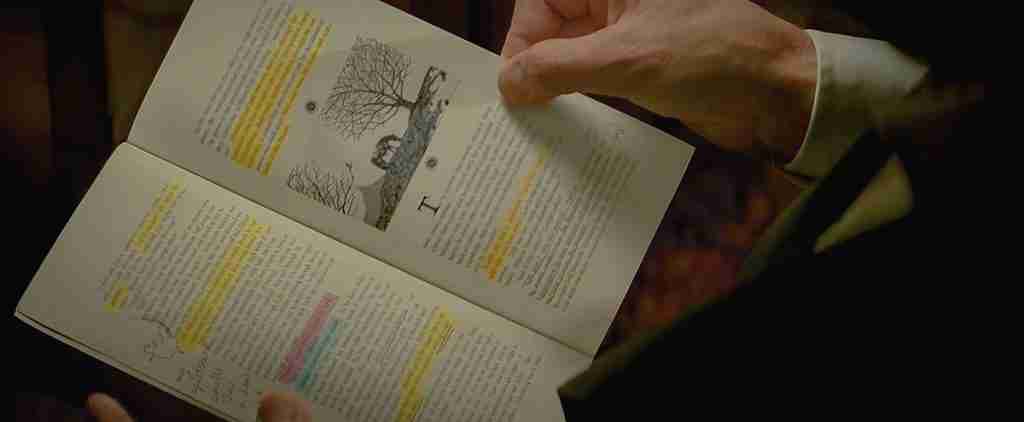
The phone call between Arthur and Henry (36m, p. 40 to 41) is the film’s hinge and the script treats it as one. Henry names the chapter, Summons to Conquest, and says, seriously, that’s the title. Arthur asks the question the whole film turns on: do they know they’re all having the same dream? Henry: no, they all think it’s just them, that maybe they’re going crazy. Arthur: but they’re not crazy, are they? Henry: no, it’s real.
On the page Arthur then asks for the book’s name and the boy’s, and Henry gives him both: I’m Henry, the book is called Realm and Conquest, it’s Book One with a red cover. Arthur says thank you four times, the last two into a dial tone and then into silence. The red cover is why the bound copies of Memorandum #229 at the print shop (91m) look the way they do.
“Be a janitor? Live like this?”
The next scene on the page (41m, p. 46) is the one the beat sheet records as Arthur asking Michael his purpose. The script’s version is sharper. Arthur sits up, defying the sedative, and asks whether this is what Michael wanted: to be a janitor, to live like this, to do what he does. The action line says Michael is caught off-guard, not prepared for clarity. Arthur tells him the burden is that he knows, and then, going fast, that we’ve been summoned. He’s back under before Michael can answer. Michael’s answer, on the page, is to stand at the window, shaken.
A figure of speech, planted
The Word “Horses” in the Alley
Here is a detail that’s easy to miss on screen and impossible to miss on the page. In the alley (62m, p. 73), Arthur lays out why the firm can’t have him committed: no criminal record in New York, and the criterion is danger to self or others. Then:
You think you’ve got the horses for that? Good luck and God bless.
Arthur Edens, shooting script p. 73
Then the line everyone remembers, the last place you want to see me is in court, then I’m not the enemy, then who are you. Arthur uses “horses” as slang for strength, and the word sits in the same speech as the question Michael can’t answer. The script’s action line after Arthur leaves has Michael on the sidewalk holding a baguette, with a great variety of failures arranging themselves around his heart.
The line is in the finished cut, delivered at speed, which is why it slips past. On the page it’s a plant: the thing Michael lacks is named, forty pages before he finds it standing in a field.
The Hilton speech
“I’m the Guy You Buy”: The Hilton Speech
Michael’s confrontation with Karen (111m to 112m, p. 120 to 125) is the scene that reached the screen closest to how it was written, and the script version is worth reading for what it names. Michael tells her she’s lost: she’s got the moves, but she doesn’t hear the music. Then the line on the banner above, and then a list. He’s a fixer, a bagman; he does everything from shoplifting wives to bent congressmen. Does she want a carry permit, a heads-up on an insider-trading subpoena, a name erased from an escort service list?
Then the sentence that is the film’s confession, delivered as a sales pitch:
I sold out Arthur for eighty grand and a three-year contract and you’re gonna kill me?
Michael Clayton, shooting script p. 121
The number, ten, and the walk toward Don Jeffries follow. On the page Michael’s “Shiva” line is delivered while he’s already walking away, and Jeffries is calling for security when Dalberto and two detectives arrive from an empty ballroom. The wire is never shown to the audience before it’s revealed; the script keeps it the same way.
One article
Note the wording of the banner line. The script has “I’m not a guy you kill.” The beat sheet, from the film, has “I’m not the guy you kill.” One article. On the page Michael is describing a category; on screen he’s describing himself.
He’s a pilgrim stumbling into the cathedral.
Gilroy’s action line for the horses, p. 15
Smaller differences
Page-to-Screen Details
Names and numbers
The chemical in Memorandum #229 is spelled Culcitate on the page (United-Northfield, internal research memorandum, dated June 19, 1991, twenty pages). The car is a Mercedes throughout the script. Karen’s mirror rehearsal is set in her Omaha home, cut against the U/North Omaha conference room. Verne and Iker take the job at a Miami golf club, the u/north logo on the bag with the slogan, we grow your world together. Michael’s debt to Zabel is seventy-five; the ask to Marty is eighty grand, and Marty’s first reaction is “I thought you were done with all that.”
The card game that was cut
On p. 74 the script has a scene in Michael’s living room: Henry teaching Michael to play the card version of Realm and Conquest, portraits of orcs and mages spread across a glass table, with the U/North jingle bubbling underneath from the TV. It’s a third Realm & Conquest scene, distinct from the car (18m) and Arthur’s phone call (36m), and it does a lot: it puts the game in Michael’s hands before the apartment search. It was cut before release: the film keeps the car and the phone call and never shows Michael holding a card.
The janitor line, extended
On p. 13 the janitor line continues past where the film’s quotable version stops: so the math on this is simple, the smaller the mess, the easier it is for me to clean up. Mr. Greer asks if the ringing phone is the police. Michael: they don’t call.
Zabel on Timmy
The loan-shark scene at the auction (20m, p. 20 to 21) carries more of Michael’s family on the page. Timmy’s name stays in the book until they’re clear. He’s upstate, in his in-laws’ basement; his wife took him back. Michael was sober six years, Zabel is told, and Zabel’s answer is the film’s theme in a mobster’s mouth: they slip, forget it, it’s everybody else who pays.
Questions readers ask
Michael Clayton Script FAQ
The script
Who wrote the Michael Clayton screenplay?
Tony Gilroy, who also directed. It’s an original screenplay, not an adaptation. The draft analyzed here is the Final Shooting Script dated February 11, 2006, 127 pages.
Is Michael Clayton based on a book or a true story?
No. U/North, Kenner Bach & Ledeen, Memorandum #229 and Culcitate are inventions. The book inside the film, Realm & Conquest, was created for it.
How different is the Michael Clayton script from the film?
Structurally, almost not at all: the flash-forward, the four-days-earlier card and the return to the field are all on the page. One scene was cut (Henry teaching Michael the card game, p. 74); the other differences are in details and in the ending, which on the page has Michael walking up Sixth Avenue under Arthur’s voice-over instead of riding away in a cab.
The ending
Michael Clayton ending explained: what happens in the cab?
Michael has just recorded Karen agreeing to pay him ten million dollars for silence about Arthur’s murder; the police arrest her, and he walks out and hails a cab. He gives the driver fifty dollars and says just drive. The long shot on his face is the film letting him feel what he’s done. On the page the scene doesn’t exist; see the ending on the page.
Does Michael Clayton fake his death?
Yes, after the bomb nearly kills him for real. He throws his watch and ID into the burning car so the firm and Karen believe he died, then reappears at the Hilton wearing a wire.
What does “make believe it’s not just madness” mean?
It’s Arthur asking Michael to grant that his breakdown and his moral awakening might both be real at once. On the page it’s the first line of the film, the message on the mirror, and the last line of the film.
Go deeper
More Michael Clayton
Beat sheet
Seventy-six minute-marked beats, Arthur’s voice-over to the cab, with named beats on real headings.
Scene analysis
Michael Clayton horses scene explained
Why he stops, what Realm & Conquest means, and why the one uncalculated act in the film is the one that saves him.
The series
Deep SHT: deep dives on your favorite movies
Primary-source structural analysis of Chinatown, No Country for Old Men, Angel Heart and more.