Deep SHT / Television / Lanterns (2026)
Lanterns Had a Marine in the House and Never Used Him
Lanterns episode 3, “OutKast,” makes John Stewart a Marine’s son, then builds his childhood from a sports-parent template. A Marine’s kid on the scene nobody wrote.
Series / Episode
Lanterns, Season 1, Episode 3, “OutKast” (HBO, August 30, 2026)
Written by / Directed by
Vanessa Baden Kelly / Stephen Williams
Starring
Aaron Pierre, J. Alphonse Nicholson, Jasmine Cephas Jones, Laura Linney
E-5
Sergeant. The rank in the house.
3
Apples. The father fires, the son can’t, the son chooses.
9 mo.
Alone in Kamchatka, no spotter, no panic button.
~30
His age wearing sergeant major chevrons.
HBO’s Lanterns sold itself as True Detective with a power ring, and the thing True Detective understood is that dread has an address. Episode 3, “OutKast,” is where the show tells us where John Stewart’s fear lives. It puts it in his mother’s ambition. The father is a Marine sergeant. The title he earned the hard way, the one that already knew what to do with fear, barely reaches the page.
What I was looking for
I grew up in a Marine house, the son of a Marine who was the son of a Marine. The Corps is a language I was raised in. That’s said only to establish what I was looking for when the episode walked me through John Stewart’s childhood. I found almost none of it. The Corps is on John’s resume and on his father’s, the episode says so by name and rank, and it has no weight in the home that made him.
On this page
The makers’ account
What the room built
Start with what the makers say they did. Showrunner Chris Mundy told IGN that the origin broke early around one idea: John’s father could have been Hal. The ring found John Sr. first, asked if he was afraid, and he said yes. From there the room asked what separates a Manhunter that’s been programmed from a child who’s been “parented so hard,” and the conditioning plot followed. Writer Vanessa Baden Kelly told TheWrap that Hal’s lore was thick and John’s was “a little thin,” named the versions on the shelf, a Marine father and civil-rights-activist parents, and said they went under all of it to find their John. On HBO’s official podcast she called that thinness a gift, because it let them build an origin grounded in the black American experience.
So this was a choice among strands, not a blank page. The 1971 O’Neil and Adams debut gave John a political voice from his first panel; the later comics gave him the Marines and architecture. The show took the first strand and ran it hard. That’s a legitimate adaptation decision, and anyone calling the race material an import is wrong about the character. The question is what the show did with the strand it set down.

What the show set down
A sergeant in the house
Lianna, the Guardian, asks at the door for Sergeant Stewart. Chavez, the officer who later runs John’s mission, says he was stationed with John Sr. after basic. John tells Lianna he became a Marine because his father was one.
The rank
John’s father is a sergeant, an E-5, the rank that leads a squad face to face. The calendar puts him in the Corps of the early eighties: “ATLiens” is playing in the van when John is about ten, so the night walk is 1996 or later, the ring is around 1986, and a sergeant that night enlisted around 1982, half a decade after Vietnam. That Corps went to Beirut, where a truck bomb killed 220 Marines in October 1983, and to Grenada the same week. If he stayed in, it went to Panama in 1989 and sent 92,990 Marines to the Gulf in 1991, the largest Marine operation in history. The episode never says where he was for any of it, or whether he was anywhere. He is the one character in the hour with a past and no backstory.
John wears that uniform to a meeting that was supposed to be secret, and the first thing his officer says is that he wasn’t supposed to be dressed up. Then the officer who ran him, and who delivers his discharge, calls him Major. Marines will notice. The costume department knew the rank well enough to sew it on and not well enough to know what it takes.

The brake
In the hour that builds John’s childhood, the Marine is not the engine. He’s the brake. She is the engine. The ring breaks him first: lifted out of bed into a green bubble, asked if he’s afraid, he says yes. Then Hal Jordan goes on television and calls himself fearless, and John Sr. shoots the set. The broadcast has just proved the bubble was real; his wife tells him it was a nightmare, takes the pistol out of his hand, and tells him to be gone. By her account to the Guardian he is nearly drinking himself to death every night.
The diamond
When she comes back with the diamond and the plan, the baby asleep in her arms, he asks how you make a Green Lantern, and warns her the boy will hate them. She says so be it. From that night she gives the orders and he carries them out: he fires, he praises the shot, he offers the cheeseburger, and when the apple is on his own head he asks to work up to it and she overrides him. The show gives him one wound, the ring, and lets it cost him the house. What it never asks is the one question a Marine could answer. He’d been trained to feel fear and control it. The ring asked only whether he felt it.

The template
Kelly has been explicit about where the Stewart house came from. To The Hollywood Reporter she named the room’s models: Tiger Woods’s father, the Williams sisters’ father, the Jacksons, Sonya Curry. To TheWrap she said the parents were facing the choice she thinks a lot of black athletes and creatives face, that if they play the game the way they’re told, someone can always pull the rug out, so they sacrifice what others think and go for exceptionalism. Sports parents, and the pressure that makes them. Mundy confirms the scene where John shoots the apple off his mother’s head was her pitch on day one.
The Marine in that house is a broken man who signs on the night his wife finally believes him. She hands him his version of events and a plan in the same breath, and he takes both. That is not a defeat. It is a recruitment.
Off by one test
That model is off by one test. Earl Woods and Richard Williams trained children to perform, to be better than the other kids on the day it counted. The ring doesn’t ask that. It asks one question, and the question is about fear. A Marine house asks a different one. At sixteen my father made me the janitor at the office he managed. The first Saturday I spent seven hours on the place. He walked every room without a word, stopped in the kitchen, ran a finger along the top of the door, and showed me the dust. “Don’t ever let that fucking happen again.” The standard was higher than I’d thought. That’s the Corps’s logic: a man who’ll fail at a door will likely slip up and fail somewhere else, and the inspection exists because you’re hit hardest where you’re weakest. The Stewart yard has a rifle and no standard.
The Marine isn’t the engine. He’s the brake.
The thesis of “OutKast,” stated as structure

First
The fear test
The episode gives John Sr. one explanation for his yes, the bed and the green light, and Bernadette reframes it for him: he was scared to leave the people he loves. Both can be true. Neither is the one a Marine would reach for. A combat veteran asked “Are you afraid?” says yes because it’s the only honest answer, and because the Corps’s entire theory of courage is that fear is the raw material and training is how you convert it.
The institution has said so on the record, in the middle of a scandal about its own cruelty: a Marine veteran writing in the Houston Post in 1976, during the congressional investigation into recruit abuse, defended boot camp on the grounds that its purpose was to train men to be meaner than the men they’d fight. You can reject the ethic and still see what it means for a man raised inside it. The sergeant in this house has already been through a selection. He is the one person in the house who already knows what the word means to a Marine, and the episode never lets him say so.
Second
The training
I distinctly remember my father watching Full Metal Jacket on VHS. He went through boot camp during Vietnam, the exact period of the film. When Private Joker says, “Is that you, John Wayne? Is this me?” my dad burst into laughter like it was Bill Murray blowing up a golf course to kill a Kenny Loggins lovin’ gopher. His immediate verdict was that Ermey wasn’t an actor, he had to be a real drill instructor. He was. My father allowed exactly two performances in the history of movies as believable Marines: R. Lee Ermey in that film and Robert Duvall in The Great Santini. One is a drill instructor at work. The other is what happens when that man comes home.
The drill
The apple and the night walk
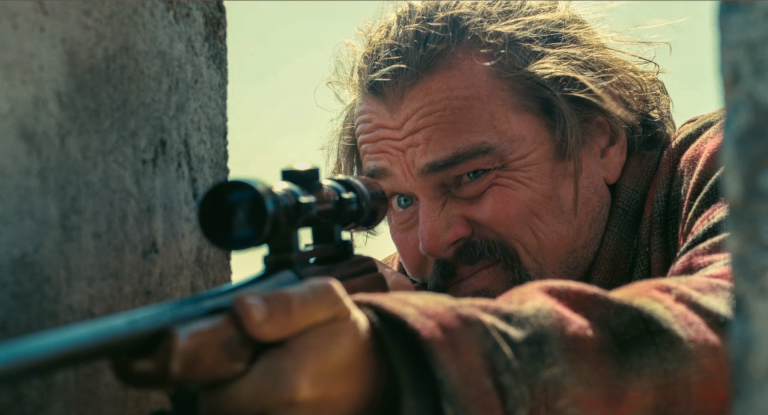
Watch Hartman’s opening with a child’s eyes and you have the question Lanterns should have asked. Which is more frightening to a boy: that man at the dinner table, or John’s parents? Now watch the apple. Bernadette gives the order, do it, see if he’s afraid. John Sr. sighs, asks the question the ring asked him, and fires. The boy says no, sir. The apple is applesauce, the kid asks if he can eat it, and they go for a cheeseburger.
William Tell
The skill in a William Tell shot belongs to the man holding the gun. The person under the apple has one job, hold still. And watch the man with the gun. The son trusts his father but does the father trust himself? Later, with the rifle in the boy’s hands and the apple on his own head, he asks whether they shouldn’t work up to this. The fear in the yard is the father’s.
The parents are demanding a quality they don’t possess, and the drill works only because a five-year-old can’t tell a straight face from courage. Hartman wears a mask too, but his is built to put fear into the men in front of him. The Stewarts’ mask hides their own. It’s a drill without a drill instructor, a fear test whose only source of fear is the weapon, administered by the one man in the yard who already failed it.

The night walk
The other training beat is the night walk, and the episode’s own objection is in the van: Aaron says his brother can’t survive out there, he’s never been in places like this. Bernadette says get out. John Sr. says get out of the car, son, and shuts the older boys down. It’s the one beat where the Marine executes. What aired is two voices from the dark, and then home: his mother waiting on his bed, a plate in the microwave, and a boy crying into the mattress while she stands in the hallway, hears it, and walks away. By the writers’ own account, they shot the neighbors who point him home and cut them for time.
Aaron is right because exposure isn’t instruction. Shooting has been taught by then. How to be in that place has not. The parents apply the stress with no skill underneath it to test. A Marine father would not just ask the question. He would be the reason the answer was hard.
The Great Santini, 31m
Bull Meechum’s backyard
Now Bull Meechum in the backyard. He plays his son one-on-one, fouls him, elbows him, changes the rules when he’s losing, and for the first time Ben beats him. Bull can’t accept it. Lillian stands up for the win. He knocks her hand away and tells her to get in the house before he kicks her butt. She goes. Then Bull targets Ben, bouncing the ball off his head the whole way inside the home, up the stairs, and calls him his favorite daughter. Ben stands up for himself once he gets to his room. “This little girl just whipped your ass good, Colonel!”
Later on, Ben tells his mother he’s been praying for a war so his father can fight somebody besides him. Pat Conroy confirmed decades later that he’d prayed for Vietnam, literally. Peace, in a Marine house, is when the weapon has no target left but the family.
The Great Santini, 69m
The real game
Then the real game. Bull is on the sideline in uniform, a drunk Marine fighter pilot, and when a rival player gets rough he orders Ben to put the kid on the deck. Ben obeys. A boy’s arm breaks, the referees eject Ben and the team drops him, and it’s the last order of his father’s he ever follows. The Marine isn’t watching his son play basketball. He’s running an engagement, and the son is the asset. What Conroy understood and Duvall plays is that the Marine father’s fear is personal, because the man producing it sleeps down the hall, and his idea of love, in his own words, is to give his sons “the gift of fury.”
The signature
That’s the signature. Inspection, cadence, rank, a house where the father’s identity sets the terms even when the mother executes them. In Santini the mother translates the father’s violence for the children; in “OutKast” the mother replaces him. The register survives in the manners, the sir and the ma’am, and in that one shut-down at the car, and nowhere else. Bernadette’s training is aimed outward, at a test the ring will give; Bull’s is aimed at the boy. The apple and the night walk are dares, not a contest with the man himself. Take the Corps out of the show and the household is unchanged, which tells you it was never load-bearing.
Signature element
The escalation: three apples
The episode runs its own escalation: three apples, one for each stage of the house. The first is the five-year-old under the gun. The second starts at the satellite dish, where Bernadette talks into a radio nobody answers, then cuts to the yard and the demand that the boy shoot the apple off his father’s head. The third is the one he chooses. Read them across and the household’s whole structure is on the table: who holds the rifle, who stands under the apple, who gives the order, and who can pull the trigger.
Apple one
The father fires
The rifle
John Sr.
Under the apple
The boy, about five
The order
Bernadette: do it, see if he’s afraid
The Marine
Asks the ring’s question, fires, offers a cheeseburger.
Apple two
The son can’t fire
The rifle
The boy, about ten
Under the apple
John Sr.
The order
Bernadette: he’s not done, the apple off you
The Marine
Asks if they should work up to it. Overridden. The boy can’t fire at him.
Apple three
The son reverses
The rifle
The boy
Under the apple
Bernadette
The order
John: not Dad, you
The Marine
Asleep. The skill is finally the son’s, and the fear belongs to the person under the gun.

The reversal
Read the three together and the boy fails the way his father did. Under the apple he holds still; with the rifle on his father he can’t fire, because the thing he’s afraid for is the man in front of him. That is the bubble again, a decade later, with the family asleep down the hall. The ring called it fear. His mother calls it fear, out loud, with a bird she made up as the witness. The third apple is the boy’s answer: not Dad, you. He puts the parent who called it fear under the gun and fires. That’s Santini’s backyard turned around, and it works for the reason the Conroy scene works: the skill finally belongs to the son and the fear to the person under it. The instinct was in the room for one scene. It needed to be the whole house.
The drill only becomes training when the son reverses it.
Three apples, one Marine, one brake
Third
The institution
The show handed its father a tradition that had already answered his question. Frank Petersen aced the Navy’s entrance exam in 1950 and was told by the recruiter that he’d make a great steward. He became the first black Marine aviator, flew more than 350 combat missions across Korea and Vietnam, and retired a lieutenant general; there is a destroyer with his name on it. He came up in a Corps that hadn’t taken a black recruit until 1942, and then only because Roosevelt’s order of the year before forced it, over the objections of its own leadership.
Those black recruits trained at a separate camp, Montford Point, until 1949, and integrated units came only with Korea. Edgar Huff, one of the first through Montford Point and one of its first black drill instructors, became the Corps’s first black sergeant major, the rank the show hangs on a thirty-year-old; he earned it across three wars and retired in 1972. That history is part of what every black Marine inherits: the institution said no, the men came anyway, and the ones who stayed ended up running it.
Organized fear
What the Houston Post veteran was defending is a system, and the system has a shape. Two Army researchers writing in the AMA Journal of Ethics lay out the old theory of recruit training in three parts: strip the recruit of who he was so the institution can install who he’ll be, bond the platoon through stress they survive together, and weed out the ones who can’t. The fear is deliberate, it comes from a man with a title and a campaign cover, and it ends: thirteen weeks, then you’re a Marine and the DI never screams at you again. Whatever you think of the method, the man who walks out has a second identity, and it outranks what the recruiter thought.
Disorganized fear
Now put the Stewart house beside it. The fear has no source; the only thing in the yard that’s dangerous is the rifle, and the man holding it would rather be at a cheeseburger stand. There’s no platoon: John sleeps in a different room from his brothers and goes to a different school, the one recruit in a company of three. There’s no weeding out, because failure isn’t the boy washing out, it’s the family losing the only thing it’s been living for since the night of the bubble. And it never ends. Boot camp is a door you walk through. The Stewarts built a hallway.
John Sr. walked through that door as a young man. He is a Marine who was told no by a ring, in a house where that already had an answer. The episode gives his wife the response and gives him, in her words to the Guardian, a man nearly drinking himself to death every night.

Fourth
The quote that gives it away
“John has to be precise. He can’t miss.”
Vanessa Baden Kelly, TheWrap
Explaining why John’s constructs are so exact, Kelly told TheWrap that Hal and Guy are allowed to be imaginative and silly, but John has to be precise. That is a sniper’s creed, and the adult hour has the sniper: patient, a kill record, a mile, nine months in the woods, I don’t do panic, and “much better, sir,” delivered flat, when his father’s struggles come up over steak.
The script files the creed the same way the press tour does. Bernadette, convincing her husband, asks why he became a Marine and why she gets up to teach, and answers for both of them: to be better than where they came from. The son says the same thing to Lianna: he became a Marine so he could get across the table from her, part of the path. In this family the Corps was never a self. It was a step.
The one Marine beat the show gets right
The one time the show understands the Marine’s code is the discharge, where John takes a dishonorable discharge to keep his Corps and the government out of a story about a drunk superhero in a strip club, and says okay before the officer finishes explaining what he’s agreeing to. The show knows what a Marine does when it needs the son to fall on a sword. It forgets when it needs the father to raise a child.
The writing
What the dialogue does
The dialogue follows from the design. Early in the hour, Bernadette sits Lianna down at the kitchen table, tells her that her husband is nearly drinking himself to death, and asks whether she understands how unfair it is to ask a black man in America if he’s afraid. It’s a thesis, delivered to an alien who stands in for the audience, and it’s quotable because it’s built to be quoted.
Ten years on, after the second apple, Bernadette sits on her son’s bed and admits the birds were a lie. Consoling him, she says Hal Jordan had the privilege of never knowing fear, and that’s the gift they’re giving him; and they don’t know when the Guardians will call, so the work goes on. The line about Hal is an assumption about a man she’s never met, made from his face on a television, and the series disproves it four episodes later. In substance it’s an excuse: he didn’t have it as hard, so he couldn’t have been as afraid. The hour never shows the hard. It asserts it, at the table and on the bed, and what it puts on screen instead is a mother who lies to her son and a father who drinks. How that produced the man in the Kamchatka woods is the one thing the episode never dramatizes.
The freedom Bernadette got
The irony is that Kelly’s stated principle would have fixed this. On the Midnight Boys podcast she says she won’t judge her characters, that she wants the freedom to write any kind of black person, that black women shouldn’t have to be written as saints. She gave Bernadette that freedom and spent it on a woman who announces her themes: the kitchen-table speech, the privilege line on the bed, the plan she explains to a Guardian while her son sleeps through it.
Whatever that makes Bernadette, it makes her a person with reasons. John Sr. didn’t get even that. He’s the one person in the house who had been through a selection before, who had been told no by an institution and earned his way in, and the hour gives him a bubble nobody initially believes and a bottle his wife reports. The freedom Kelly describes went to the parent who explains and not to the one who could have shown. That’s the whole problem in one allocation: the hour asserts the hard because the only character who could have demonstrated it was written to lose. The son’s version, to Lianna, is that he grew up in that house missing the people in it.
The Corps’s theory of the yes does get spoken, once. On the bed, after the discharge, Bernadette tells her grown son that courage is fear that’s said its prayers. It’s the sergeant’s line. The script hands it to the mother, aimed at art school, years after the father needed it. He never says it. She does, and not to him.
What the reaction did to the audience
The numbers
The episode drew the loudest reaction of the season: review-bombing on the audience-score sites, a week of “woke” accusations online, and a writer who said she expected an argument about abuse and got one about race. Since that reaction became a story in its own right, the figures are worth stating. Warner announced episode 3 as a series high, 10 million viewers worldwide and 7 million in the U.S. across three days of HBO and HBO Max combined.
The audience watching on the HBO channel itself, the Sunday-night cable number Nielsen counts separately, tells a different story: it peaked with episode 3 at 690,000, fell by almost half the following week to 390,000, and then climbed back through the season to 630,000 by episode 7. The finale set a new combined high, 10.5 million worldwide and 7.2 million in the U.S., and the premiere has kept growing toward 30 million. The honest reading is that some of the Sunday-night audience walked away after “OutKast” and the show got them back. The reaction neither built the series nor broke it. Whatever that week was, it wasn’t a strategy and it wasn’t a wound.
The close
The missed scene
Here is the scene nobody wrote. The night after the diamond, the baby asleep, Bernadette lays out the plan. John Sr. doesn’t ask how you make a Green Lantern. He tells her what a drill instructor told him at nineteen: that every man on the yellow footprints is afraid, that the ones who say otherwise are the ones who get people killed, and that the job of the next thirteen weeks is to teach you how to move despite your fear and pain. Then he says the ring asked the wrong question, and he’d answer it the same way again. She still gets her plan. He gets to be the reason it’s hard. That’s one scene, and it would have changed every scene after it.
Questions readers arrive with
Lanterns episode 3: questions
The Marines
Is John Stewart a Marine in Lanterns?
Yes, and so is his father. Lianna asks for Sergeant Stewart at the door, John tells her he became a Marine because his father was one, and the adult John is introduced as a former sergeant major, a rank the episode puts on his sleeve. The piece above is about what the show did with that.
Who plays John Stewart’s father in Lanterns?
J. Alphonse Nicholson plays John Stewart Sr. in the childhood flashbacks of episode 3. Jasmine Cephas Jones plays Bernadette Stewart, and Laura Linney plays the Guardian Lianna.
The episode
What song is playing in the car in Lanterns episode 3?
“ATLiens” by OutKast, from the 1996 album of the same name. “Gasoline Dreams,” from Stankonia, plays as Hal leaves and over the end titles. The episode title is spelled the way the band spells it.
Who wrote Lanterns episode 3, “OutKast”?
Vanessa Baden Kelly, a co-executive producer on the series. Stephen Williams directed. It aired on HBO and HBO Max on August 30, 2026.
Where this comes from
Sources
The makers’ accounts are from Scott Collura’s interview with Chris Mundy at IGN, Casey Loving’s interview with Vanessa Baden Kelly at TheWrap, Ronda Racha Penrice’s interview with Kelly at The Hollywood Reporter, HBO’s official Lanterns podcast for episode 3, and Kelly and Justin Britt-Gibson’s conversation on The Midnight Boys. Viewership figures are from Variety, TheWrap and Deadline, with the linear numbers as reported by The TV Ratings Guide. The 1976 Houston Post column is in the Congressional Record for July 22 and 23, 1976. Frank Petersen’s record is from the Marine Corps’s own biography and the Navy’s commissioning release for USS Frank E. Petersen Jr.; the recruiter’s remark is from his Washington Post obituary. Promotion floors are from the Marine Corps Promotion Manual.
The boot-camp theory is from Gia DiRosa and Gerald Goodwin in the AMA Journal of Ethics, March 2014. The growth-chart reading of the garage wall was Dennis Perkins’s first, at The A.V. Club. The Great Santini commentary is from this site’s own analysis of the film, and the Conroy family’s account is from their 2015 panel.
Go deeper
Read next
The Marine father
The Great Santini (1979) analysis
Bull Meechum, the basketball game, the Order Log, and the ending explained.
The series
Deep SHT screenplay analysis books
Long-form, primary-source film analysis. Pay what you want.