Three Billboards Outside Ebbing, Missouri: The Architecture of Hope and Vigilantism
Any honest reading of Three Billboards‘ meaning has to reckon with a strange fact about the film. Across his press tour, in long-form interviews with David Poland and Charlie Rose, and in retrospective conversations since, Martin McDonagh has consistently framed Three Billboards Outside Ebbing, Missouri the same way: it is about hope, change, and humanity, not about vigilantism. Whether he means it, or whether he is steering audiences toward the most generous reading of his own film, or whether he is — as playwrights sometimes are — being deliberately coy with interviewers, is a question this analysis will not adjudicate.
The screenplay he wrote does not let vigilantism go.
The architecture of the contradiction
This is not a contradiction. It is the architecture of the film. Three Billboards is built on a refusal to separate two ideas that most American crime films are designed to separate: hope and vigilante violence, redemption and the willingness to do harm, the change a person can undergo and the formation that change cannot fully escape. McDonagh is right that the film is about hope, change, and humanity. He is incomplete when he says it is not about vigilantism. The screenplay is doing both at once, and the structural genius of the film is that it makes the audience sit in the contradiction without resolving it.
The argument of this Three Billboards analysis is that the film stages a choice — at its ending and throughout — that it never adjudicates: between vigilantism done in companionship and self-destruction done alone. Both characters who reach that choice were produced by violent households, both are themselves violent, and what they find in each other is something neither institution nor family ever gave them. The Willoughby letters are the structural pivot that makes the convergence possible. A final image — two people in a car with a shotgun in the trunk, asking each other if they’re sure — is the screenplay’s truest answer to its own question. It is not an ambiguous ending. It is a definitive one. The question it answers is not the question most viewers think they are being asked.
Table of Contents
The two violent households at the heart of Three Billboards’ meaning
Both protagonists of Three Billboards are products of households where violence was operational, and the screenplay establishes this with care.
Mildred’s marriage and the violence she inherited
Mildred Hayes is a survivor of domestic abuse. The film tells you this twice. First, in the flashback fight with her daughter Angela the week before Angela’s murder, Mildred admits she once drove drunk with the children in the car — “when he was in the middle of beating the shit out of me.” Angela, repeating her father’s framing, dismisses this: “Which we’ve only got your word about, right?” Then, more directly, Mildred describes Charlie to Willoughby: “Ex-cop, ex-wife-beater. Same difference, I guess, right?”
The equation Mildred draws between Charlie’s two former roles — police officer and abuser — is not metaphorical. Her ex-husband was both. When Mildred goes to war with the Ebbing Police Department, she is going to war with an institution she has inside knowledge of. She lived with one of its members and was beaten by him. The institutional violence and the domestic violence are continuous in her experience. This is why Mildred refuses to be intimidated by Willoughby and Dixon. She has been in rooms with violent cops before. They were her marriage.
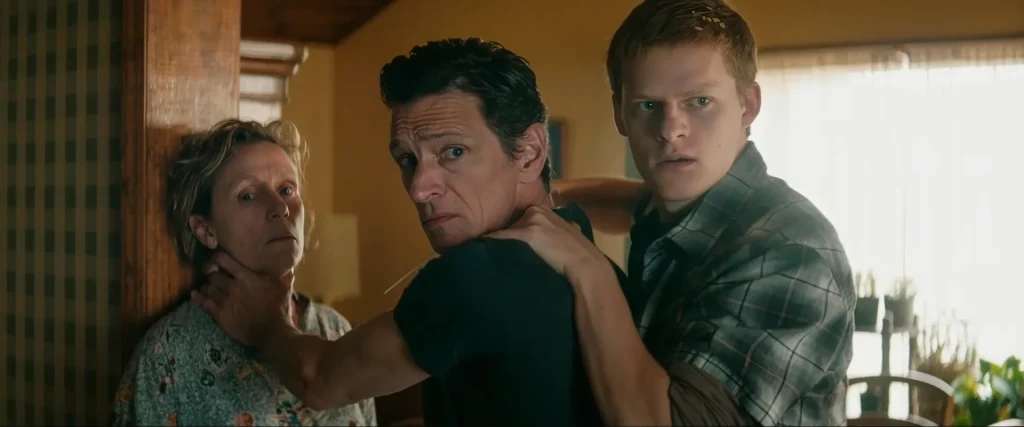
The abuse, moreover, is not historical. When Charlie shows up at the house mid-film, he pins Mildred against the wall by the throat. Robbie has to put a knife to his father’s neck to make him let go. Whatever Mildred is becoming in the course of the film, she is becoming it from inside an active dynamic of male violence she has spent her adult life navigating.
Mildred’s violence does not discriminate by who deserves it
After Willoughby’s suicide, Mildred drops Robbie at school. A boy throws a Coke can at her windshield. She gets out of the car, walks up to him, and asks if he saw who threw it. He says no. She kicks him in the crotch. Turning to the girl beside him, she asks the same question. The girl says she didn’t see. Mildred kicks the girl in the crotch. Robbie, watching from the passenger seat, says under his breath: “Thanks Mom.” He has lived inside this pattern long enough to recognize it. Mildred’s grief-rage does not target people who did the thing she’s angry about. It targets whoever is available. The kids are children. One of them, maybe, threw a can. She assaulted both of them.
This is the structural rhyme to Dixon’s defenestration of Welby later in the film. Both characters lash out at adjacent targets when the actual targets — Angela’s killer, Mildred herself, the disease that killed Willoughby — are unreachable. Both characters’ violence is undisciplined by the question of whether the recipient deserved it. The road trip to Idaho is what happens when two people whose violence has historically not cared about who was wrong or right are asked to make a decision together about a man who is bad but is not the man they want.
Dixon’s mother and the household that produced him
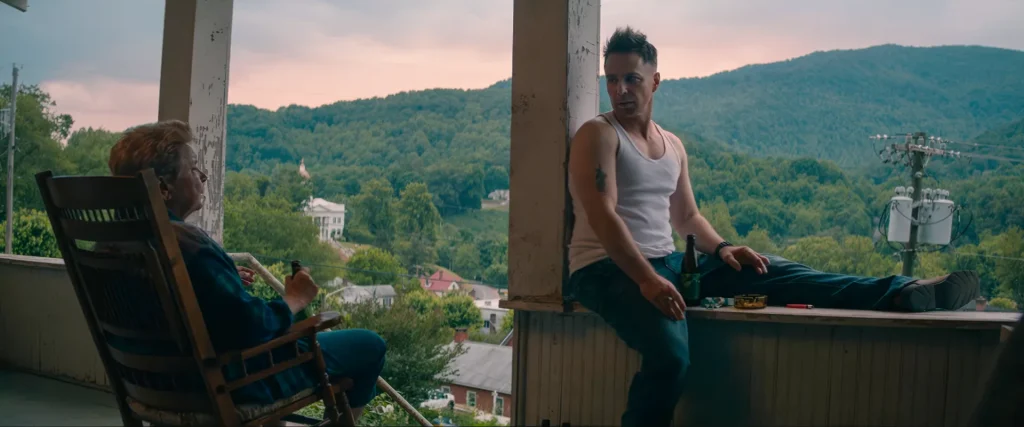
Officer Jason Dixon’s household is differently violent, and the screenplay shows you the dynamic with comedic precision that does not soften what it depicts. Dixon lives with his mother. He is approximately thirty-five. The mother — credited only as Momma, played by Sandy Martin — is not a passive presence in his life. In an early scene, after the billboards have gone up and Dixon is complaining that Mildred won’t listen to reason, Momma proposes the harassment strategy that Dixon then executes:
MOMMA: Why don’t you just fuck her over thru her friends then?
DIXON: Huh?
MOMMA: Y’know, why don’t you fuck her friends over? Make her come around that way. Has she got some friends you could fuck over?
Dixon nods. He arrests Mildred’s friend Denise Watson for marijuana possession in the next scene, then asks the judge to deny her bail. Momma is the strategist. Dixon is the instrument. This is not a mother giving a son terrible advice in passing. This is a mother operationally directing her adult son in the police harassment of a grieving woman.
After Dixon has been fired, Momma offers to go to the station and negotiate his job back. The dialogue’s comedy comes from Dixon’s correct recognition that this is humiliating, and from Momma’s complete inability to see that it is. But what registers underneath the comedy is more troubling. Momma tracks Dixon’s career chronology in detail: “A couple grand, maybe? You’ve been there three years. Not counting the five years at the Academy. Six if you count the year you were held back.” She remembers the year he was held back. That is not a mother who has launched her son into adult life. That is a mother still holding him.
Coriolanus way: McDonagh on Dixon’s mother
McDonagh, in an Academy Conversations interview, described Dixon’s relationship with his mother as Hamlet-like and then corrected himself: “Coriolanus way.” Coriolanus is Shakespeare’s tragedy of a violent man whose violence is made and aimed by his mother. Volumnia raises him to be a weapon, deploys him politically, and bends him at the play’s end. McDonagh’s reference was glancing, but the screenplay does the work. Sandy Martin’s Momma is Volumnia in a housecoat with a margarita. Dixon’s racism, his arrested development, his inability to function as an adult — these are not just Dixon’s pathologies. They are the output of a household where his mother strategizes harassment campaigns against grieving women.
“Cut from the same cloth”: McDormand on Mildred and Momma
The actor playing Mildred recognized the structural rhyme. In a Charlie Rose conversation, Frances McDormand named the connection directly: “Mama Dixon is played by an extraordinary actress, Sandy Martin… they really are like spores from the same tunnel… Mildred and Mama Dixon are cut from the same cloth.” Same cloth, opposite directions. Mildred’s machismo is directed outward at the institutions that failed her daughter. Momma’s is directed inward at her son, weaponizing him against the world. That is why Mildred can do for Dixon at the end what his mother never could: ask him a question and accept that the answer might be uncertain.
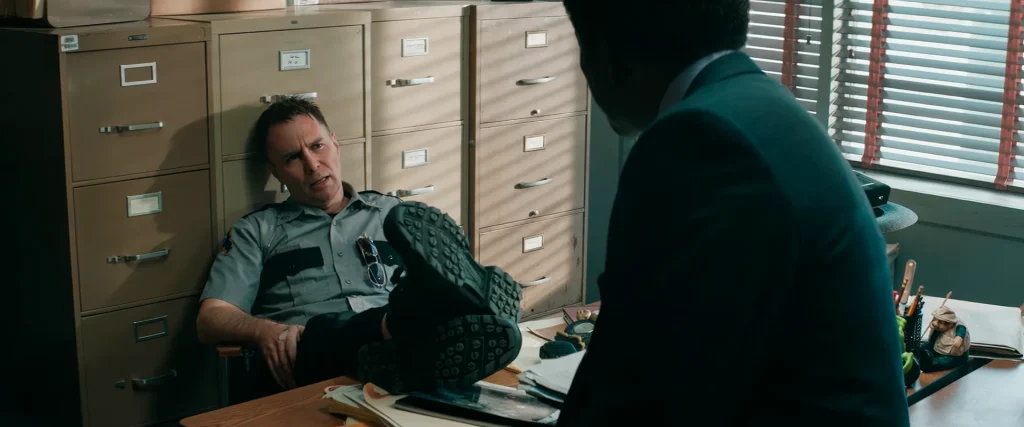
What Dixon’s racism actually is in Three Billboards’ analysis
The discourse around Three Billboards in 2017 and 2018 fixed on Dixon as a racist cop receiving redemption. The screenplay supports a more careful read, and it is worth being precise about what Dixon’s racism actually is in the text, because the cruder version has shaped how the film is remembered.
The household racism belongs to Momma
Momma is openly, explicitly racist. After Dixon is fired, she proposes that he ask the department to “get rid of the black guy” — meaning Abercrombie, the new chief. Dixon’s response is not agreement. It is a flat practical objection: “They ain’t gonna listen to some guy’s mother, asking them to get rid of some black guy. Things have moved on in The South!” Momma’s reply — “Well it shouldn’t’ve!” — is the line that locates the household’s racism. She is upset that desegregation happened. She wants black people removed from positions of authority. Dixon, in this scene, is the less racist of the two. He is the one telling his mother that the racial framing won’t work and that things have changed.
The torture-in-custody backstory the film never depicts
The torture-in-custody backstory that drives the film’s racial framing is referenced but never shown on screen. In Willoughby’s office, the Desk Sergeant says, “He tortured a guy in custody, Bill,” and Willoughby replies, “There was no real evidence to support that.” On television, Mildred accuses the department of “torturing black folks.” Dixon denies it directly: “I didn’t torture nobody.” The screenplay deliberately leaves the incident unverified. Audiences never see what happened, never learn whether the suspect was guilty or innocent of whatever he was suspected of, and never get confirmation that the torture occurred at all. Willoughby characterizes the department’s racial situation in a single line — “if you got rid of every cop with vaguely racist leanings then you’d have three cops left” — locating Dixon’s racism on a spectrum where he is institutional-baseline rather than exceptional.
Dixon’s most severe onscreen violence — beating Welby unconscious and throwing him from a second-story window — is directed at a white man. The film does not show Dixon harming any of the black characters his racism is supposedly directed at.
Every onscreen Dixon victim is white
The actual blood Dixon spills in this film is white. He throws Welby out of a second-story window. He clubs Pamela in the face. Mildred is the target of an attempted punch that Willoughby restrains before it lands. Welby’s beating is by far the most severe violence Dixon commits in the film. The likely-real torture incident referenced in Willoughby’s office is off-screen and unconfirmed. The likely-fictional torture incident in Mildred’s TV speech is rhetorical.
Dixon’s vocabulary of contempt is also broad rather than racially targeted. He calls people “retards,” “faggots,” and at one point misidentifies Jerome and a black workman as “Mexican sons of bitches” — getting both their nationality and their race wrong in the same insult, in what is McDonagh’s joke about how undisciplined Dixon’s hatred is. Even his hostilities are unreliable. He explicitly states, in a drunken bar speech, that he is against killing gay people. The speech is bigoted in its framing but the position it lands on is don’t kill them. Low bar, but he names it. Dixon is a man whose hostility is broad and thoughtless, not a man whose violence is specifically racial.
The bar scene. Dixon provokes the Crop-Haired Guy specifically to scratch DNA from his face — and absorbs the beating to get it. Jerome, the black man Dixon called a “Mexican son of a bitch” earlier in the film, stops the beating by shouting “He’s a cop.”
Jerome stops the beating
Among the structural choices McDonagh made that the discourse missed, the most telling is this one: Jerome — the black character with the most cause to want Dixon hurt — stops Dixon’s beating at the bar. The scene did not have to be written that way. Any other character could have intervened. Instead, the man Dixon called a “Mexican son of a bitch” in the film’s first act is the one who steps in and shouts “He’s a cop!” to stop the beating in the third act. That is a structural choice. The black character with the most reason to walk past has agency, and exercises it on Dixon’s behalf.
Environmental racism, not characterological racism
The careful reading the screenplay supports is this: Dixon’s racism is environmental. He grew up in a racist house. His police department, Willoughby tells us, has institutionally racist leanings. Dixon uses the institutional language. The arrest he carries out has racial overtones because his mother told him to harass Mildred and Denise was the available friend. But Dixon himself, as written, is not driven by racial animus. He is driven by violence-as-grief-response, by undisciplined contempt for everyone, and by his mother’s drunken instructions. The man is dim and unethical. Nobody’s rights are safe with him. He is, as far as the film shows you, more dangerous to white citizens of Ebbing than to black ones.
This does not redeem Dixon. He remains a violent, ethically untethered cop. But it changes the question the film is asking. The film is not asking whether a racist cop can be redeemed. It is asking whether a man formed by violent enmeshment with his mother and his institution can be displaced from that formation by another set of relationships. Those are different questions. The discourse adjudicated the first one and missed the second.
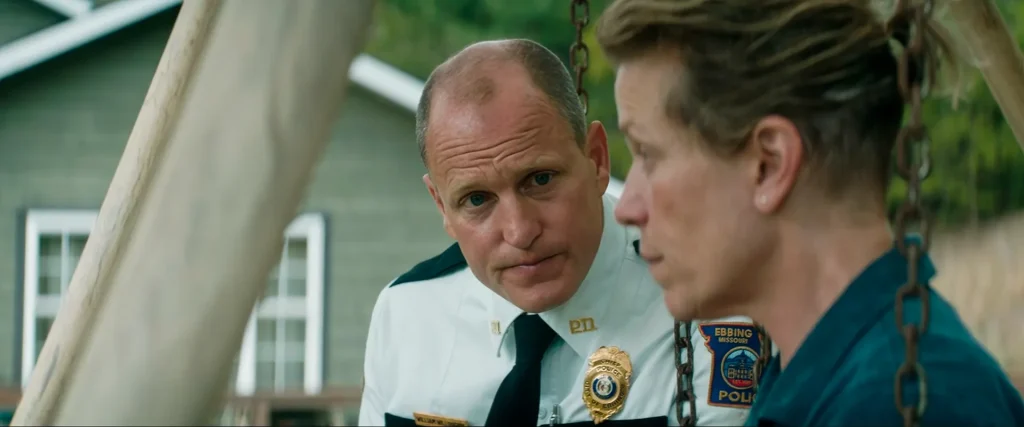
The Willoughby pivot: where Three Billboards’ analysis turns
The structural turn of Three Billboards is not a plot event. It is a piece of paper.
Roughly halfway through the film, after his cancer diagnosis has begun to overtake him, Chief Bill Willoughby goes to his stable and shoots himself. Before he does, he writes three letters: one to his wife Anne, one to Mildred, one to Dixon. The letters are read in voiceover across the second half of the film, and they perform the structural work that no living character in Three Billboards is capable of performing.
The first letter — Willoughby to his wife Anne. Private grief, addressed to a sleeping woman on the couch making Oscar Wilde jokes hours earlier. The personal letter that frames everything the public letters will do.
The second letter — Willoughby to Mildred. The chief calls the billboards “a great fucking idea” and reveals he has paid the next month’s rent on them himself. The man Mildred was attacking funds her attack from beyond the grave.
Three letters, three redirections
The letter to Anne is private grief. It does not concern the public action of the film.
The letter to Mildred reframes the billboards from her perspective. Willoughby tells her the billboards were “a great fucking idea… like a chess move,” and that he has paid the next month’s rent on them as his counter-move. The dying chief wants her to defend them for another month after he is in the ground. There is a wish in the letter that she gets the man who killed her daughter, and an apology for his own failure to get there himself.
The letter to Dixon does something the film has not yet done. It diagnoses Dixon. It names the source of his anger — “I know it’s all since your dad died and you had to go look after your Mom” — and it prescribes a cure:
What you need to become a detective is Love. Because thru Love comes Calm, and thru Calm comes Thought. And you need Thought to detect stuff sometimes, Jason. It’s kinda all you need… Hate never solved nothing. But Calm did. And Thought did.
The third letter — Willoughby to Dixon. Read aloud in voiceover while Dixon burns alive in the police station Mildred has just firebombed. The only paternal directive Dixon has ever received, delivered by a dead man during a fire.
Paternal address from a corpse
The letter is, structurally, paternal address. Willoughby is older, dying, married, the father of two daughters. He writes Dixon a letter that diagnoses him as a son and prescribes for him as a man. The fact that Willoughby is a corpse before Dixon reads the letter is the McDonagh inversion — the only adult male voice that ever told Dixon how to be a man is a dead one’s. And Dixon receives the letter while burning alive, because Mildred has just thrown a Molotov cocktail through his window.
Read together, the three letters do something rare in American cinema. They take a film that has spent its first half setting up a revenge architecture — angry mother, indifferent police, building hostility between them — and reroute it through grace. Mildred’s billboards continue, paid for by the man she was attacking. Dixon receives, in his moment of greatest physical and professional ruin, the only paternal directive he has ever been given. The letters do not resolve the plot. They redirect the moral architecture from confrontation to reconciliation, from revenge to something more difficult.
What that something more difficult is, the film does not yet name. It will be staged in the road trip.
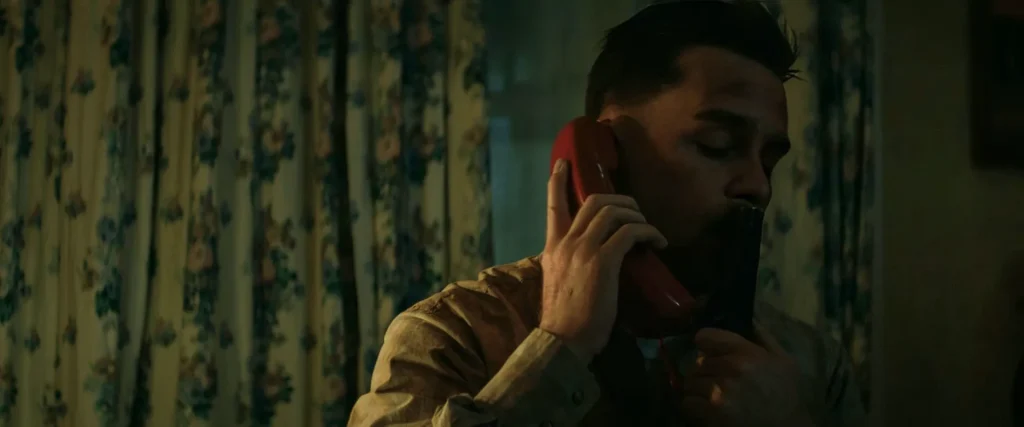
The shotgun: where Three Billboards’ meaning lives
The structural detail most easily missed in Three Billboards is what Dixon is holding when he calls Mildred to tell her the DNA was not a match.
The shotgun against his lips
The screenplay specifies it explicitly. Scene 127, interior of Dixon’s house, night: “DIXON watches her [his sleeping mother] a while, then dials a number on the phone, which he then carries into his MOM’s bedroom, sitting on her bed. We now see that he has a shotgun in his hand.” And while delivering the bad news to Mildred — that the man whose DNA he risked his life to obtain is not Angela Hayes’ killer — the screenplay direction reads: “DIXON idly taps the shotgun against his lips.”
He is contemplating suicide. The phone call is the only thing keeping him from it. He is thirty-five years old, has just been fired from the only career he ever had, has been beaten unconscious in a bar, has disgraced the memory of the one man who believed in him, and has discovered that the one piece of useful police work he ever did — collecting DNA from a man bragging about raping a woman — was useless to the woman he was trying to help.
The shotgun in the trunk
When Mildred says she will drive to Idaho with him, the shotgun comes down. The next scene, scene 130: “DIXON puts the phone back in its cradle. Looks at the gun in his arms. Leaves it on his bed. He looks in on his sleeping MOMMA.” The morning after, he places the shotgun in Mildred’s trunk, laid on a blanket like they are going to a picnic. The screenplay says wrapped; what McDonagh shot was uncovered. The director chose to show the weapon rather than hide it. “MILDRED looks at it lying there. They exchange a look, get in the car and drive.”
This is the structural detail this Three Billboards analysis has been building toward, and once you see it, you cannot un-see it. The shotgun travels with Dixon’s intent. When the intent was suicide, the shotgun was at his mouth. When the intent shifted to shared mission, the shotgun went in the car. The weapon is the same; the meaning of the weapon changes based on whether Dixon is alone or with Mildred.
What stopped Dixon from killing himself was finding someone to potentially go kill someone else with.
The McDonagh filmography
This is not how McDonagh frames the ending in interviews. He has said the road trip is “not about vigilantism in those final moments.” Hope and change, in his framing, are the headline themes. Both of these things can be true. They are not the whole truth. The screenplay is showing you that the choice these two characters make at the end is not a choice between vigilante justice and resolution. It is a choice between vigilante justice and despair. The “hope” in this film’s actual architecture is the hope of companionship in moral compromise, not the hope of redemption.
This is, it should be noted, continuous with the rest of McDonagh’s filmography. In Bruges ends with a man bleeding out in the costume of a child. The Banshees of Inisherin ends with two men staring across a beach in mutual destruction. McDonagh’s films do not deliver redemption. They deliver moments where characters glimpse the alternative to total ruin and reach for it, and the alternative is usually another person who is also reaching. Three Billboards is not the optimistic outlier in that filmography. It is continuous with it.
The No Country and LA Confidential parallels
Two structural rhymes locate Three Billboards in a tradition.
No Country for Old Men: the procedural that withholds
The first is the Coen brothers’ No Country for Old Men, which Frances McDormand’s husband Joel Coen — McDormand having been initially reluctant to take the part, asking McDonagh to make Mildred a grandmother instead of a mother — told her plainly to take. No Country is a procedural that withholds procedural satisfaction. The killer is never apprehended. The chase ends mid-frame. Sheriff Bell delivers a monologue about a dream and the film cuts to black. The institutional structures the genre promised would solve the crime simply run out of capacity, and the film ends with the survivors talking about what it means to keep going in a world the institutions cannot organize.
Three Billboards is the same architecture. The killer is never found. The chase ends mid-drive. Mildred and Dixon deliver a four-line exchange and the film cuts to black. The catharsis the vigilante film promises is withheld in exactly the way No Country withholds the catharsis the procedural promises. Coen recognized the family resemblance immediately. He told McDormand to take the part because he had seen this film before — he had made it.
LA Confidential: convergence of opposites
The second parallel is LA Confidential, Curtis Hanson’s 1997 adaptation of James Ellroy’s novel. In LA Confidential, Detective Ed Exley and Officer Bud White begin as institutional opposites. Exley is the careerist with a moral framework who turned in his fellow officers to advance. White is the brute who beats suspects and is used by his department as a blunt instrument. They despise each other for two acts. They converge at the second-act turn when both recognize — separately, then together — that the institution they serve is corrupt at the level above them. The convergence costs both of them their integrity in different ways and binds them together in a violence neither could have committed alone. They walk into the Victory Motel together, and what comes out of the Victory Motel is not justice. It is something they had to do because the system they served would not.
Convergence after the institution fails
Three Billboards stages the same arc with similar structural beats. Mildred and Dixon begin diametrically opposed — she is the citizen accusing the institution, he is the institution at its worst. Their convergence happens after the institution has failed both of them. Mildred has lost her daughter and gotten no investigation that produced results. Dixon has lost his career, his mentor, and his last belief that he could matter inside the badge. Together they converge through shared violence already committed (her arson, his defenestration) and shared hope of completing one more violence together.
The road trip is the convergence the film has been building toward — two people who began as enemies now committed to one violence together, the way Exley and White end up bound in a violence neither could have done alone. The “not really” exchange is the hesitation before they decide whether to go through with it. The difference is what each film does at that threshold. L.A. Confidential gives you the violence it has been promising. No Country withholds it. Three Billboards withholds it the way No Country does, and the withholding is itself the answer.
What makes Three Billboards‘ withholding more than a refusal of genre satisfaction is that the alternatives the screenplay has set up for both characters are not survivable. If Mildred goes home, she goes back to a house with the daughter’s empty room, the swing set, and the husband who will appear at the door whenever he wants to. Dixon’s home is the bedroom where he was sitting with the shotgun against his lips. The Idaho trip is what they have, because it is what they made when nothing else was on offer.
The American precedent for Three Billboards’ meaning
The instinct Mildred and Dixon are following has American precedent on both sides, and it is worth naming because the film is not pretending otherwise.
The Ada miscarriage
John Grisham documented one half of it in The Innocent Man — the Ada, Oklahoma police who, in 1982, fabricated a case against Ron Williamson and Dennis Fritz for the rape and murder of Debra Sue Carter while the actual killer, Glen Gore, walked free in the same town for over twenty years. Ada’s police acted on the same impulse Dixon would recognize: we know who the bad guys are, let’s take care of it. The result was eleven years on death row for the wrong man and freedom for the right one. Williamson died of cirrhosis at fifty-one, having never recovered from his incarceration. The instinct produced one of the most documented miscarriages of American criminal justice.
The other half of the instinct
Mildred is reaching for the other half: a community response to violence that the institution has failed to address. Angela Hayes’ killer is not in custody, and the DNA does not match anyone in the system. The institution has reached the end of its capacity. What Mildred and Dixon are about to do in Idaho is what people have done when institutions have failed them, in American small towns, for as long as American small towns have existed. The film does not pretend this is admirable, and it does not pretend it is foreign.
Three Billboards is a film about characters who have inherited that instinct from a culture that has produced both Mildred’s grief and the Ada miscarriage, and who are about to act on it anyway, knowing what we know. McDonagh’s “not about vigilantism” frame protects something he wants to protect, which is the moral seriousness of his characters. It does not protect them from what the screenplay has them doing.
The final scene. Mildred and Dixon driving to Idaho with the shotgun in the trunk, asking each other if they’re sure, answering “not really,” and deciding to decide along the way. The film cuts to black on this exchange.
What the ending answers, and the question it leaves you with
The “not really / not really” exchange is read by most online Three Billboards analysis as ambiguous. It is not ambiguous. It is the most precise line reading McDonagh wrote.
What the line answers
What the line answers is this: both characters are uncertain about what they will do, and they are in the car together anyway. That is not ambiguity about action. That is certainty about companionship. They have committed to whatever happens being a thing they decide together. Mildred could not say “not really” if she were alone. Dixon could not say “not really” if he were with his mother. The “not really” is only sayable to a person who has accepted that you might say “yes” or “no” later, and that whichever you say, they will be there for it.
This is what Willoughby’s letter prescribed. Through Love comes Calm, and through Calm comes Thought. Dixon has not become calm by the end of the film. He has not become thoughtful. He has, however, found a single person in his adult life to whom he can address the question of what he is doing without being told the answer in advance. That person is Mildred. The love the letter prescribed has arrived in a form Willoughby probably did not anticipate. It is not romantic love. It is the love that consists in someone asking you a real question and waiting for a real answer.
The film does not show you what they decide in Idaho. It does not need to. What was at stake was never whether they would kill the Crop-Haired Guy. What was at stake was whether two people produced by violent households could reach each other across the formations that made them. The “not really / not really” is the demonstration that they have.
The question the analysis cannot answer for you
Here is the question the film leaves you with, and this is the question this analysis cannot answer for you. Evidence on one side: McDonagh, in numerous interviews, has said this film is about hope, change, and humanity, and that what these characters need is each other. Evidence on the other side: Mildred’s violence does not care who deserved it; Dixon’s violence does not care who deserved it; the shotgun is in the trunk; they are driving toward a man who is bad but is not the man either of them wants. By every textual measure the screenplay supplies, they are the most unlikely of friends.
Do you think they will be good for each other?
The film does not answer that. It is not supposed to. The architecture of Three Billboards‘ meaning is that the question remains open at the end — that the audience leaves the theater holding it, weighing the evidence, and arriving at a conclusion the writer-director has carefully refused to make for them. The shotgun is in the trunk because what they came from is in the trunk. Whether that is hope or vigilantism — whether it is friendship or shared self-destruction — depends on what you, having seen everything the film has shown, decide.
That is the architecture. That is the question. The evidence has been laid out. The answer is yours.
For a plot-level summary of the ending, see Three Billboards Outside Ebbing, Missouri Ending Explained.