Born on the Fourth of July True Story: What Ron Kovic Said Before the Movie Existed
In 1977, Ron Kovic sat for a television interview. His memoir had come out a year earlier; Oliver Stone’s film was still twelve years away. That interview survives. So does a 2014 festival Q&A in which Stone, decades removed from the film’s release, states plainly which scenes he invented and why. One is the subject’s account before Hollywood touched it; the other is the director’s accounting long after.
The short version: the film stays faithful to Ron Kovic’s account in its spine and invents at two load-bearing joints. Stone has confirmed both inventions himself. What follows is the evidence.
What Born on the Fourth of July Shows
The film opens with Ron Kovic’s voiceover — “It was a long time ago. Sometimes I can still hear their voices.” From there it moves through a twenty-year arc in five movements: Massapequa boyhood, Vietnam, the Bronx VA hospital, the collapse at home, and the activist rebirth.
A Norman Rockwell Massapequa
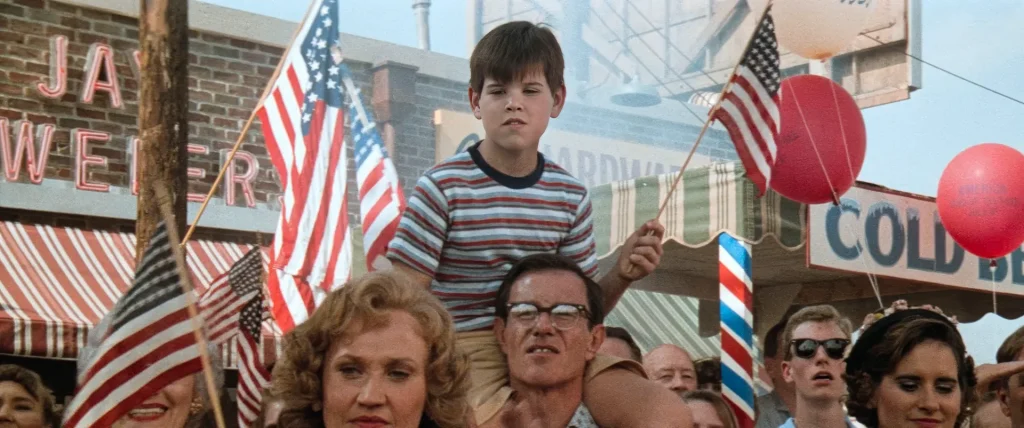
The first movement is home, painted in Norman Rockwell colors — flags, balloons, backyard heroics, a sentimentality closer to Frank Capra than to anything in Platoon. The warmth is the setup. Every emblem in the sequence carries an undertow. Boys play war in the woods (1m) before the film shows what war does. The parade thrills young Ron — “Look, Daddy, the soldiers!” (4m) — until the wounded veterans roll past, one flinching at firecrackers. A boyhood home run plays as pure Mickey Mantle triumph (6m); the wrestling match answers it with public defeat (13m), staged under a coach who barks like a drill instructor: “If you want to win, you got to suffer! You got to pay the price for victory” (10m).
The iconography keeps stacking. A ten-year-old Kovic watches Kennedy’s inaugural on the family television — “the torch has been passed to a new generation of Americans” (8m). Six years later, a Marine recruiter played by Tom Berenger stands in the high school gym reciting battle honors: “First to fight. We have never lost a war” (16m) — pride measured in the Corps’ bloodiest names: Tarawa, Iwo Jima, Belleau Wood, the Chosin Reservoir. At the family dinner table, Ron turns the icon on his mother: “Remember what President Kennedy said? There won’t be an America anymore unless people are willing to sacrifice. I love my country” (24m). Even romance joins the pattern. The teenage longing for Donna peaks at the prom, the two of them dancing to “Moon River” (27m) — and from that dance, the film cuts to Vietnam.
The film never announces that the postcard is a facade. It builds the postcard, prints a crack into every corner, and lets the cut make the argument. Massapequa is the height; everything after is descent.
Two Catastrophes in One Engagement
Vietnam arrives as two catastrophes in a single engagement. In October 1967, Kovic’s unit fires into a village hut and discovers women, children, and infants inside. A soldier’s cry of “The baby!” cuts through the retreat order (33m). Minutes later, in the chaos of the withdrawal, Kovic shoots a young Marine named Wilson. He reports it to his major — “Sir, I think I killed Wilson” — and the major shuts him down: “I don’t think so, Kovic… Don’t talk like that!” (36m). The film places Kovic’s own wounding in a separate firefight shortly after; the cry of “Corpsman!” marks it at 35m.
The Bronx VA and the Long Fall
The Bronx VA section is the film’s descent. A doctor delivers the sentence — “You’re a T-6, paralyzed from the midchest down” — and Ron Kovic answers with denial: “Oh, I’ll walk again. I know I’ll walk again” (49m). What follows is rats, overflowing waste, broken equipment, and an orderly culture of neglect, and an accident that sets him back and nearly costs him a leg.
Home is worse. At a Fourth of July parade, an announcer introduces him: “He was born on the 4th of July, 1946” (72m). Kovic freezes mid-speech at the sound of a crying baby. His descent into alcoholism accelerates toward the film’s most infamous scene, the night confrontation with his mother: “It’s just me and this fucking wheelchair for the rest of my life, for nothing” (97m). His father ships him to a veterans’ colony in Mexico. There he falls in love with a Mexican sex worker and a drunken roadside fight with a fellow paraplegic (Willem Dafoe) bottoms out the spiral there — “You ever have to kill a baby?” (114m).
Two scenes of reckoning close the arc. Kovic travels to Venus, Georgia, and confesses to Wilson’s family: “I think I was the one that killed your son” (124m). The widow’s reply is the film’s moral hinge: “What’s done is done, sir. I can’t ever forgive you… but maybe the Lord can” (124m). From there the film jumps to the 1972 Republican National Convention. Kovic tells a reporter, “I’m here to say this war is wrong, that this society lied to me and my brothers” (128m). The film ends at the 1976 Democratic National Convention: “Just lately I’ve felt like I’m home. Like maybe we’re home” (137m). The film ends moments before he gives his speech to the convention.
That is the film’s version of the Born on the Fourth of July true story. Now the record.
The Real Story: What Ron Kovic Said in 1977
In the 1977 television interview embeded above, Ron Kovic describes his life before Hollywood had any say in it, promoting his memoir that was already in print.
The All-American Boy, in His Own Words
His self-portrait matches the film’s first act beat for beat. “I was born on the 4th of July in 1946, and I guess you could say I was an all-American boy,” he tells the host, before reaching for his icons: “I believed in what John Wayne said… I can remember John F. Kennedy — ask not what your country can do for you.” He joined the Marines in September 1964 “because the ad down at the post office said the Marine Corps builds men — body, mind, and spirit — and I wanted to be a man.” The film’s Kennedy scene and its recruiter scene dramatize the two influences Kovic himself named. They even keep his order.
Then the interview turns. Kovic delivers the sentence that governs everything the film would later stage: “The first person that I killed was an American, and I didn’t feel good about that at all. And the second group of people that I killed were Vietnamese children, and that made me feel worse.”
Two Killings, in Kovic’s Order
Kovic’s 1977 account gives a sequence: American first, children second. He elaborates minutes later, laying out three events that led to his wounding. First, he returned from his initial tour, saw antiwar demonstrations, considered the protesters traitors, and volunteered to go back. Second, “while on the night patrol I shot and killed an American soldier from Georgia, accidentally.” Third came a later night ambush — one he volunteered for, hoping in his words “to make up for killing the corporal.” On it, “children and Vietnamese were killed and shot and maimed, and I had to pick up the body of a young man… with tears streaming down my face.”
The film reverses this order and fuses the two events into one engagement: the innocent villagers die first, and Wilson dies during the retreat from it. The compression works as economy in screenwriting — one catastrophe flows into the next. It also changes the moral mechanics. In Kovic’s own telling, the dead villagers follow partly from his guilt over the dead American. He was on that ambush because he had volunteered to atone. In the film, both horrors simply happen to him in one terrible afternoon. The 1977 account makes Ron Kovic an agent in his second tragedy. The film makes him a witness to both.
January 20, 1968
He describes the wounding itself at length. A shot through the foot left him unable to retreat — “I had tried to be an American hero… the only thing left was to move forward.” Then a round through the shoulder “hit me like an express train,” and “my body just disappeared from my chest down” (9m). The film stages a wounding at 35m.
One more line from Ron’s 1977 interview explains the film’s homecoming half: “When we came home and tried to tell the American public about the reality of the Vietnam War… they didn’t listen to us. They threw us in jail,” he says. The rest lands like a verdict: “They called me a traitor. They spit in my face.” By 1977, police had arrested Kovic ten times — most recently at a Kent State protest the previous week.
The Georgia Confession Never Happened — Stone Says So
The film’s emotional climax is the Venus, Georgia sequence: Kovic meeting Wilson’s parents and widow, and confessing. It plays as a deeply emotional reckoning with his past that helps him move forward from the chaos of his personal life. It is not — and the source for that is Oliver Stone.
At a 2014 Ebertfest Q&A, Stone addressed the scene directly: “Of course Georgia never happened. The Georgia sequence was much contested, and I was criticized for it.” His defense deserves an examination, because it is a screenwriting argument rather than a denial. The memoir, Stone explained, “is pitched as a confession.” Kovic “never looked up the family, he never found them.” The film converted the book’s confessional address to the reader into a dramatized confession to the family, with “sections of his description that become dialogue in that scene.” In short, the book was Kovic’s catharsis and Stone felt the movie needed more.
A 210-Page Confession
Stone added a structural detail about the memoir itself: “It’s a 210-page book, and it’s not until the last five pages that he talks about the massacre and the accidental shooting of a fellow soldier. He takes the entire book building up the nerve to tell you what happened.” A memoir can withhold its central wound for two hundred pages; a film cannot withhold it for two hours. So Stone moved the confession from the book’s form into the film’s plot. Whether that counts as fidelity or fabrication is a judgment each viewer can make. The facts of the change are no longer in dispute, because the man who made it has described it.
The same Q&A settles a second question. Asked about the memoir’s literary models, Stone named Dalton Trumbo’s Johnny Got His Gun as the book that moved Kovic to write. All Quiet on the Western Front served as a further influence. The film footnotes the detail itself by placing a copy of Remarque’s novel on Kovic’s desk after his disillusionment.
Donna Was Not in the Book — Not by That Name
Kyra Sedgwick’s Donna threads through the entire film: the childhood friend at the parade, the prom dance before boot camp, the Syracuse reunion, the Kent State vigil. She is the film’s emotional measure of everything Ron Kovic lost.
The memoir contained no Donna. Recalling the book, Stone said the character existed “not by that name,” and characterized the underlying reality more loosely — “it was difficult for him to relate to women.” Kovic, Stone noted in the same answer, was a virgin when he shipped out. The prom, the promise, and the Syracuse visit as the film stages them are dramatic construction built on that general truth. Donna works as a composite serving a structural role. The film needs a human face for the future Kovic’s paralysis forecloses, and a two-hour movie cannot dramatize an absence.
A screenplay draft dates the invention precisely. The Stone/Kovic draft carries the date on its title page — “Draft 1978, Revisions August, 1988” — and opens with a ten-year-old Donna arriving at a Fourth of July parade, birthday gift in hand. Stone and Kovic wrote her into the film’s architecture from the screenplay’s first incarnation. That incarnation belonged to a different star entirely (more on that below), and she survived every revision across the following decade.
The Syracuse Apology
The Syracuse sequence built around her carries a separate accuracy problem, documented in the public record rather than the corpus. The film depicts Syracuse police brutalizing peaceful protesters at a post-Kent State demonstration. Contemporary news accounts record two facts. A New York state senator who attended the actual 1970 Syracuse protest objected to the depiction. And Stone wrote a letter of apology to the city of Syracuse and its police officials after the film’s January 1990 wide release. That is a rare artifact among movies based on a true story: a director conceding, in writing, that a specific scene wronged a specific real place. (This paragraph rests on press coverage — secondary sourcing, labeled as such.)
The Parade the Film Moved to the Fourth of July
A quieter change hides in the film’s homecoming parade, and the memoir’s own author dates it. In his 2005 introduction to the fortieth-anniversary edition, Kovic recalls writing “the Memorial Day chapter” of the book one afternoon at a San Francisco hotel. The film restages the parade on the Fourth of July. There, the announcer can bind the event to Kovic’s birthday over the public-address system (72m).
The date is not the only alteration. An academic account of the memoir’s parade chapter describes Ron Kovic arriving with a fellow wounded veteran, Eddie Dugan. The crowd stares in silence rather than cheering. The chapter’s anger, in that account, fixes on the men running the town — who never gave the wounded veterans themselves a chance to speak. The film runs the grievance in reverse. Its Kovic gets the microphone and cannot use it, freezing at the sound of a crying baby (72m).
Read side by side, the two versions argue different things. The memoir’s parade is about a town that will not listen. The film’s parade is about a man who cannot yet speak. Moving the date to the Fourth of July completes the compression. The parade now rhymes with the title, the birthday, and the film’s opening sequence in a single instance.
Is Born on the Fourth of July Accurate? What the Film Kept
The inventions number two. The fidelity is everywhere else, and Stone has been equally specific about it.
“I Didn’t Exaggerate”: The Bronx VA
At a Texas Theatre Q&A, discussing the Bronx VA sequence, Stone said: “That comes from Ron’s book… I tried to be as accurate as possible to what he was saying. It was such a horrible experience. It was the Bronx VA, which was busted as one of the worst of those hospitals… I didn’t exaggerate.” The hospital section — the film’s most frequently disbelieved stretch — is the part its director defends as unembellished.
The Record the Film Could Not Invent
The activist arc anchors to the public record. Kovic’s disruption of the 1972 Republican National Convention happened, and the film blends its restaging with archive footage of the actual event. The ending is not an ending at all but a historical citation. Kovic addressed the 1976 Democratic National Convention in New York. The appearance made him nationally famous; his 1977 interviewer cites it as established fact from the previous summer. The film closes on the one scene it could not have invented if it wanted to, because it happened on live television.
One fidelity operates at the level of form. The memoir’s epigraph is Kennedy’s inaugural line — “Ask not what your country can do for you” — printed opposite the dedication. Stone’s film converts the book’s epigraph into a scene: the Kovic family gathered at the television as the inaugural plays (8m) and his mother’s dream that Kovic would grow up to speak “great things” in front of a large crowd. In effect, the movie dramatizes the page the book opens with.
What Kovic’s 2005 Introduction Confirms
Kovic’s 2005 introduction to his book corroborates more of the film’s spine in passing. He gives the enlistment date as September 2, 1964, matching the “September 1964.”. He recalls the march in Miami in August 1972 with Vietnam Veterans Against the War, which the film stages as its RNC sequence. And he tallies the arrests for protest — ten by the 1977 interview’s count, twelve by the introduction’s. The introduction adds a detail about the source text worth knowing. Kovic wrote the memoir in the fall of 1974 “in one month, three weeks, and two days,” on a forty-two-dollar manual typewriter. Single-spaced, no paragraphs, front and back of the pages. The book behind this true story was itself written like a confession under pressure, which bears directly on Stone’s defense of the Georgia scene.
Smaller fidelities accumulate. The birthday is real — July 4, 1946 — and the film’s title and parade announcer state it verbatim. Both tours of duty are real; Kovic confirms them in 1977, including the bitter detail that he volunteered for the second. The real Ron Kovic appears in the film’s opening parade as a World War II veteran flinching at firecrackers. The film later gives that reflex to Cruise’s Kovic. And the production’s governing intention is on the record from the start. At the 1989 Dallas press conference, Cruise said of Kovic: “It’s about his life, and I want to portray him accurately.” Cruise was born, he noted, on the third of July.
Oliver Stone Was a Screenwriter First: The Al Pacino Version
Stone and Kovic wrote the film Tom Cruise made in 1989 for Al Pacino, in 1978. The screenplay draft in circulation says so on its title page: “Draft 1978, Revisions August, 1988.” One document, two eras.
Stone has told the story on the record a number of times. His framing at Ebertfest: before he directed anything, “I was a screenplay writer working for those directors — Billy Friedkin and Dan Petrie.” Producer Martin Bregman, who had optioned Stone’s Platoon screenplay, hired him to adapt Kovic’s memoir for Pacino in 1977. Stone and Kovic wrote together for months, “in the hotel rooms, talking, talking, talking.” The production advanced further than most abandoned films ever do. The team cast the picture fully and rehearsed it. Stone watched “the entire rehearsal with Pacino,” and his assessment cuts both ways. Pacino was “37, 38 years old… frankly, he was too old for it, but he was such a marvelous actor.” Stone “learned a lot, made improvements” from the rehearsal alone.
Three Days or Two Weeks from Shooting
Then the money died. Stone’s contemporaneous account at the 1989 Dallas press conference: it was “a six-million-dollar movie, believe it or not,” considered too expensive for material the industry judged uncommercial. The financing came together as “a co-production between Germany and… Bahamas money and Orion Pictures.” Then, “three days before we’re supposed to shoot, after we’d rehearsed the whole thing, the financing fell out, and Pacino went on to do another film.” Twenty-five years later at Ebertfest, Stone remembered the margin as “two weeks to go.” Three days or two weeks — the tellings disagree on the countdown and agree on everything that matters: cast, rehearsed, dead. The 1989 version sits closer to the event and carries the presumption of accuracy. This article reports the discrepancy rather than resolving it.
The collapse registered as grief. “It was very heartbreaking for Ron and for me… we put it on the shelf, and it went into the attic.” At Ebertfest the wound had aged into a joke: “We wanted to kill Al.”
The revival completes a symmetry Stone flagged himself. He wrote Platoon in 1976 and finished this screenplay in 1978, and each film reached theaters exactly a decade after its script. Per Stone’s 1989 account, “ten years later, Tom Cruise read it and felt strongly about it.” The implication for the Born on the Fourth of July true story is the timeline of its fictions. Donna at the parade and the compressed Vietnam sequence date to 1978, written for Pacino. The memoir was two years old, and Kovic was in the room. The 1988 revisions inherited them. Whatever the film changed about Ron Kovic’s life, it changed early, with Kovic co-signing, and held the changes for a decade.
The Born on the Fourth of July True Story: Verdict
The film permits an unusually precise accounting. Oliver Stone has documented its two significant departures from the record, and its subject co-wrote the screenplay and visited the set daily.
The evidence sorts the Born on the Fourth of July true story as follows. Ron Kovic himself attests to the boyhood iconography, the enlistment, both tours, and the January 1968 wounding. He attests to the accidental killing of an American and the killing of Vietnamese civilians. He attests to the Bronx VA’s conditions, the homecoming hostility, the arrests, the RNC disruption, and the DNC speech. The Georgia confession and the Donna relationship are constructions. One converts the memoir’s confessional form into a scene; the other gives a face to a foreclosed future.
What distinguishes this film among movies based on a true story is the direction of its inventions. Adaptations of real lives usually invent toward flattery: cleaner motives, kinder endings. Both of this film’s inventions push the other way. The Georgia scene manufactures an accountability its subject never sought in life; Stone’s own account is that Kovic never found the family. The film, co-written by Ron Kovic, stages Kovic performing the hardest act he never performed. Readers can decide what that means. The evidence for it is above.