Deep SHT / Beat Sheet
Memento Structure: The Beat Sheet in Reverse
All 15 Save the Cat beats, minute by minute, from the film, read against the Memento screenplay
Written and directed by
Christopher Nolan (2000)
Based on the short story
“Memento Mori” by Jonathan Nolan
Starring
Guy Pearce, Carrie-Anne Moss, Joe Pantoliano
2
Timelines: color backward, black and white forward
6m
Teddy is shot: the ending, shown first
101m
Where the two timelines meet
111m
The closing voice-over, then: Now, where was I?
The argument
How Memento’s Structure Works
Deconstructing the Reverse Narrative
The Memento structure is built on a reverse chronological narrative, and that is the part everyone remembers. The part that matters for writers is that the film’s emotional structure still lands on the fundamental beats of dramatic storytelling. The order in which the audience receives the story is fragmented; the function of each beat is intact. This page maps the story’s core movements onto the Save the Cat! methodology’s 15 beats, with minute markers checked against the film.
Two Timelines, Read in Screen Order
Nolan has said on the disc’s structure featurette that his solution to telling the story in the first person was to deny the audience the same information Leonard is denied, and that the color scenes run backward in a series of jumps while the black-and-white scenes run forward, alternating until the two meet in the last reel. He describes the shape as a hairpin. The beat sheet below follows the screen order; the hairpin section renders the two timelines side by side.
On this page
- The Hairpin: Two Timelines, One Meeting Point
- Act One: Setup (Beats 1-5)
- Act Two, Part A: Action and Midpoint (Beats 6-10)
- Act Two, Part B: Despair and Payoff (Beats 11-13)
- Act Three: Resolution (Beats 14-15)
- Memento in Chronological Order
- Why the Memento Beat Sheet Is Essential for Writers
- Memento Structure: FAQ
Note: The 15 beats are presented in Save the Cat!’s structural order. Each beat carries the minute (m) at which it plays in the film’s runtime as screened. The beats are in Save the Cat! order; the minutes are in screen order; the story order is a third clock, and the reverse structure means the three do not line up. The color rail of the hairpin section puts the same events in story order.
Signature structure
The Hairpin: Two Timelines, One Meeting Point
Read the two rails top to bottom. Both run in screen order. The color rail moves backward through the story with every station; the black-and-white rail moves forward. They arrive at the same minute, in the same room, and the only account the film ever gives of what Leonard has done is spoken there.
Color / runs backward
Each station is earlier in the story than the one above it.
6m
Teddy is shot
The last thing Leonard does. The Polaroid of Teddy’s body un-develops and the film runs backward from here.
13m
Leonard reads the registration
A photocopied license with a name on it, John Edward Gammell, and a plate, SG137IU. He checks it against his thigh and calls the number.
19m
Natalie hands over the plate
In the diner, she has a copy of the license and registration for the plate he gave her. Neither of them knows yet whose it is.
29m
Leonard wakes in Natalie’s bed
A stranger’s room, a phone number on his hand, and an offer to run the plate through a friend.
56m
Burning her things
The brush, the clock, the bag. He has probably done this before. He cannot remember to forget her.
91m
Fact 6 goes on his thigh
The tattoo parlor. Natalie’s note sends him to Ferdy’s Bar, and the trap he built for Teddy is now permanent.
Black and white / runs forward
Each station is later in the story than the one above it.
3m
A motel room
You just wake up, and you are in a motel room. A week, three months. Leonard cannot say.
7m
Sammy had no system
Notes on the mirror, a Gideon Bible, and the first mention of the man whose story Leonard keeps telling.
22m
The insurance investigator
How Leonard met Sammy Jankis: an accident claim, a strange case, and a first real challenge.
40m
Conditioning failed
Sammy never learned to avoid the electrified objects. Leonard says he lives the way Sammy couldn’t.
87m
The insulin
Mrs. Jankis gives Sammy his final exam. She goes into a coma. Leonard says he was wrong about both of them.
98m
A cop on the phone
The caller has a name for John G. and an address. Leonard packs the gun and drives to the derelict building.
101m
The meeting point: the Polaroid develops
Leonard photographs Jimmy’s body and the picture develops into color. The black-and-white day has caught up with the color story’s earliest scene. Everything on the color rail above this card happens after it; everything on the black-and-white rail happens before it. From here the film runs forward in color for its last ten minutes: Teddy’s account (102m-107m), the note on the Polaroid and the plate number written down as Fact 6 (108m-109m), the drive to the tattoo parlor (111m). Nolan’s own account is that this is where the forward-running line and the backward-running line join, that the black-and-white scenes stop being objective as they approach it, and that the gap before them, however long Leonard has been living this way, is deliberately unspecified.
Act One
Act One: Setup (Beats 1-5)
Leonard’s memory system and his core mission are established, leading up to the shocking act of shooting Teddy.
Beat 1 / 1m – 3m
Opening Image
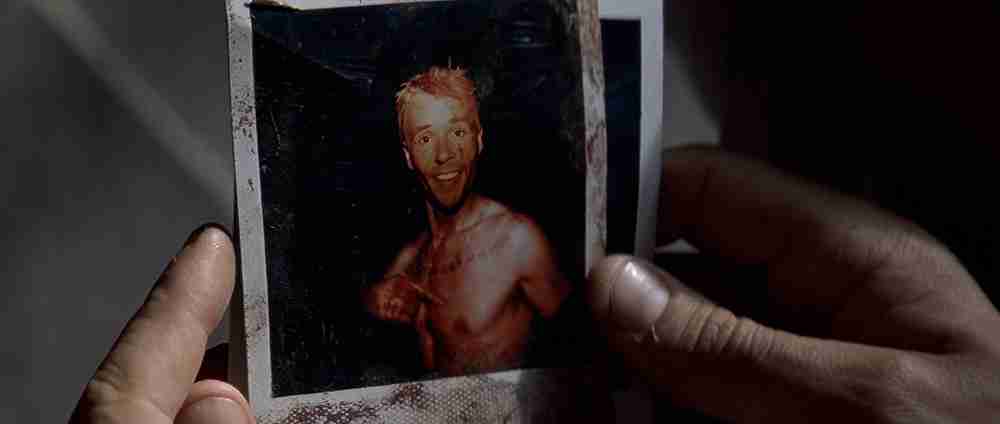
A Polaroid of a dead body fades to blank in Leonard Shelby‘s hand, and a bullet returns to the gun. The film’s central visual metaphor for memory loss and for its reverse structure is stated before a word is spoken.
Beat 2 / 7m
Theme Stated
In the first black-and-white interstitial, Leonard explains his condition and the notes he lives by, then draws the contrast with Sammy Jankis, who had no system. The theme is set: a life built from facts, and a man who decides which facts count.
Beat 3 / 3m – 12m
Set-Up
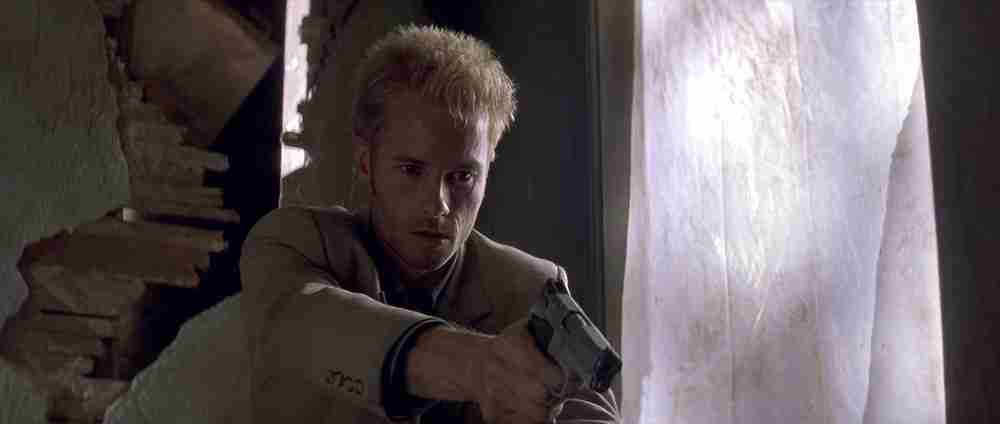
Leonard wakes confused in a motel room. Notes, Polaroids, and body tattoos establish his system, and he explains the condition to Burt at the desk. His External Goal is finding and killing John G., the man who killed his wife.
Beat 4 / 6m
Catalyst (Inciting Incident)
Leonard pulls his gun on Teddy and shoots him. The shocking action is the very end of the main color timeline, and it establishes the Central Dramatic Question: why did Leonard shoot Teddy?
Beat 5 / 7m – 27m
Debate
Leonard navigates his confusion. He answers phone calls, consults his notes, and meets with Teddy and Natalie, while the audience watches him decide whom to trust and whether his system can be relied on at all.
Act Two, Part A
Act Two, Part A: Action and Midpoint (Beats 6-10)
Leonard is manipulated by those around him as he executes his revenge quest, while the B Story reveals the tragic truth about his past.
Beat 6 / 29m
Break into Two
Leonard wakes up next to Natalie in her house. The dynamic shifts from gathering clues to acting on them: he becomes a participant in a plot against Dodd, and Natalie’s manipulation opens the second act’s upside-down world.
Beat 7 / 7m – 90m (black and white)
B Story
The black-and-white interstitials take over as the B Story. They tell the story of Sammy Jankis, an insurance case Leonard investigated, running parallel to the color plot from the first interstitial to the insulin scene at 87m-90m. It carries the internal struggle and the flawed nature of memory.
Beat 8 / 33m – 51m
Fun and Games
Leonard‘s pursuit and capture of Dodd, at Natalie‘s behest. The section demonstrates his skill as a detective and his ingenious, compromised system of clues. He tracks Dodd and runs him out of town with Teddy‘s help.
Beat 9 / 56m – 57m
Midpoint
Leonard visits the abandoned building and burns his wife’s few remaining things. He cannot remember to forget her. It is a False Victory, a moment of closure, and a True Defeat: he fails to let go of the pain or the obsession.
Beat 10 / 58m – 86m
Bad Guys Close In
Teddy and Natalie apply increasing pressure and reveal their manipulative intentions. Teddy warns Leonard about Natalie; Natalie sets up his next target, Dodd, and tests his condition to confirm she can exploit him. On screen this arrives after the Dodd hunt it sets in motion; the reverse structure shows the audience the consequence before the cause.
We all need mirrors to remind ourselves who we are.
Leonard Shelby, 111m. The closing voice-over, and a line that began in Jonathan Nolan’s short story.
Act Two, Part B
Act Two, Part B: Despair and Payoff (Beats 11-13)
The Sammy Jankis story pays off, and Leonard begins to act on things he has not written down.
Beat 11 / 87m – 90m
All Is Lost
The Sammy Jankis story culminates. Sammy’s wife stages the insulin test, falls into a coma, and never recovers. A flash frame puts Leonard in Sammy’s place, and the tragic possibility lands: Leonard may be his own wife’s killer, and Sammy his substitution.
Beat 12 / 91m – 93m
Dark Night of the Soul
Leonard grapples with the instability of his memory and the horror of what his past may hold. He has the license plate tattooed onto his thigh as Fact 6 and immediately justifies it. The plate leads him to his next John G.
Beat 13 / 98m – 101m
Break into Three
Leonard arrives at the derelict building and kills Jimmy Grants, believing Jimmy is his final target. The action completes the cycle of revenge and sets the stage for the Climax: the truth about his past.
Act Three
Act Three: Resolution (Beats 14-15)
The final confrontation forces Leonard to choose between the painful truth and the self-deception he needs to keep living.
Beat 14 / 102m – 107m
Climax
Teddy reveals the truth: Leonard killed the real John G. over a year ago, and Teddy, a cop named John Edward Gammell, has kept the search alive. Leonard rejects it and rigs his own clue system to frame Teddy as the next John G.
Beat 15 / 109m – 111m
Final Image
Leonard drives off in Jimmy‘s Jaguar with the plate number written down as his next fact. His closing voice-over says that everyone needs a mirror to remind them who they are, and that he is no exception. The image shows him choosing the reality he wants.
You don’t want the truth. You make up your own truth.
Teddy, 106m. Spoken to the man who will use it against him.
Story order
Memento in Chronological Order
Here is the Memento structure unwound into story order, with the minute each event appears on screen. The minutes run backward because the film does. Three things are worth holding onto: the black-and-white scenes are one continuous day, the color scenes are the days after it, and the film never tells you how long the gap before the black-and-white scenes lasted.
Before the film
Leonard and his wife are attacked at home. Leonard is hit from behind and wakes with no ability to form new memories; his own account of the assault is on screen at 79m-81m. According to Teddy at 105m-106m, the police assigned him to the case, he believed Leonard, and he helped Leonard find and kill the attacker over a year before the film’s events. Leonard did not remember doing it, so the search began again. Teddy’s account of the wife’s fate, that she survived the assault and later died of an insulin overdose, is disputed by Leonard and left open by the film.
The black-and-white day
Leonard is in a room at the Discount Inn, talking on the phone, narrating the Sammy Jankis case, and reading the tattoos on his body. This is 3m through 98m in screen time, told in forward order. The caller gives him a name and a location for John G., and Leonard drives to a derelict building.
The color days
At the derelict building he kills Jimmy Grants, photographs the body, and the picture develops into color (98m-101m). Teddy arrives and tells him the truth (102m-107m). Leonard writes that he should not believe Teddy’s lies, burns the photograph of himself, writes down Teddy’s plate number as his next fact, and takes Jimmy’s Jaguar and clothes (108m-109m). He has the plate tattooed as Fact 6 (91m). Natalie’s note takes him to Ferdy’s Bar (84m-86m) and then to her house (80m), where she learns what he is and provokes him to see whether it can be used (74m-76m). Believing Dodd beat her, he hunts Dodd (48m-51m, 36m-45m), then returns to her house and stays the night (33m-35m, 29m). She runs the plate for him (17m-21m). Leonard reads the registration against his tattoos, calls Teddy, and drives him to the derelict building, where the film began (13m-6m).
The burning of his wife’s things (56m) sits inside the color days as well, but Leonard’s own line is that he has probably done it before, and the film does not fix the night. Treat it as a repeated ritual rather than a single event.
For writers
Why the Memento Beat Sheet Is Essential for Writers
The Unique Structural Challenge
The Memento beat sheet rests on a classical framework. The film faced a unique structural challenge: the inherent difficulty of a reverse chronological story, solved while still maintaining dramatic tension and character empathy. The non-linear structure could easily confuse the audience. Screenwriter Christopher Nolan‘s design of the emotional action aligns with the Save the Cat! framework anyway, and Nolan has said on the commentary track that the structure is such that no scene could be removed.
A Universal Solution for Narrative Structure
The All Is Lost moment hints that Leonard is potentially his wife’s killer, and the audience stays invested in his quest regardless of the timeline order. Studying the Memento structure offers a working solution for writers of mystery, psychological thriller, and non-linear narrative. The order in which the audience receives information can be fragmented. The function of that information, the plot beats, must remain intact. That is the fundamental architecture of a successful story, and this film satisfies it backward.
The Power of Emotional Peaks
Writers gain a practical lesson from this beat sheet: how to place core dramatic reveals, like the B Story payoff at All Is Lost, at maximum-impact points. Structural complexity serves narrative clarity instead of sabotaging it. Nolan’s own account of the Climax is instructive here. He has said the scene is edited so that Teddy’s answers feel contradictory while the second half never contradicts the first, and that audiences reject the answer because they trust the note on the Polaroid over the man in front of them. The beat works because the audience has been trained, for a hundred minutes, to believe Leonard’s handwriting.
Questions readers search
Memento Structure: FAQ
Sammy Jankis and the ending
Who is Sammy Jankis in Memento?
A 58-year-old semiretired accountant whose insurance claim Leonard investigated after a car accident. Sammy could not form new memories, and Leonard decided the condition was mental rather than physical, which cost the Jankises their coverage. Leonard tells the story in the black-and-white scenes as a warning about a man with no system, until Teddy suggests the story is really about Leonard.
Is Leonard actually Sammy Jankis?
The film does not settle it. Teddy says at 103m that Sammy had no wife, that it was Leonard’s wife who was diabetic, and that Leonard’s story of the insulin test is his own memory rewritten. The film shows the injection both ways, once as Sammy’s wife and once as Leonard pinching his wife’s thigh, and Nolan has said on the commentary that this is the point where the unreliable narrator is made explicit. Leonard’s answer is that his wife was not diabetic. Teddy’s account is the only version the film gives.
The ending
Did Leonard kill his wife in Memento?
According to Teddy, she survived the assault and died later from insulin Leonard injected, the way Sammy’s wife did in Leonard’s story. According to Leonard, she did not have diabetes, and the attacker killed her. The film presents both, shows Leonard’s memory changing on screen, and leaves the choice to the audience.
What is the twist at the end of Memento?
Teddy tells Leonard that he already found and killed the real John G. over a year ago, that Teddy is a cop who helped him do it, and that he has kept Leonard hunting ever since, this time steering him toward Jimmy Grants (the shooting script spells it Grantz) for a share of the drug money. Leonard responds by writing that Teddy is not to be trusted and by taking down Teddy’s plate number as his next fact. The film’s first scene, Teddy’s death, is the result.
Was Teddy lying?
The film gives no way to show it. His full name, John Edward Gammell, is on his own license, and the plate SG137IU is his. His story explains the photograph of Leonard smiling that no other account explains. Nolan has said on the commentary that the two halves of Teddy’s speech do not contradict each other and that Teddy’s is the only version of events the audience is given.
The screenplay and the structure
How is Memento different from the short story Memento Mori?
Jonathan Nolan’s story, printed with the shooting script, is a different plot. Its protagonist is named Earl, not Leonard; he is in an institution, not a motel; there is no Natalie, Teddy, Jimmy, Dodd, or insurance case; and the revenge is carried on a forearm tattoo that tells him the attacker raped and killed his wife. What survives into the film is the method, a man run by notes from an earlier self, and the mirrors line, which the story says to Earl and the film gives to Leonard. Nolan has said on the structure featurette that his brother told him the story on a drive and that the screenplay is an extrapolation of the idea, not an adaptation of the text.
What are the black and white scenes in Memento?
One continuous stretch of time in Leonard’s room at the Discount Inn, told in forward order, during which he takes phone calls, narrates the Sammy Jankis case, and reads his tattoos. They alternate with the backward-running color scenes and catch up to them at 101m, when Leonard’s Polaroid of Jimmy’s body develops into color.
Watching it in order, and the screenplay
Where can I watch Memento in chronological order?
The theatrical cut never plays that way, and current streams carry only the theatrical cut. A chronological edit of the whole film was hidden as a menu puzzle on the 2002 two-disc Limited Edition DVD (disc two, the clock icon, then the tire-change photos placed in reverse order), and later special editions carried it too. The hairpin section above and the chronological-order section give the story in sequence with the screen minute for each event, so the disc or stream you already have can be followed in story order.
Is there a Memento screenplay PDF?
Christopher Nolan’s shooting script, dated as a Final Draft of August 10, 1999 with colored revision pages through October 4, 1999, has circulated for years, and the title page credits Jonathan Nolan’s short story “Memento Mori” as its source. It has 183 numbered scenes, each tagged as a color or black-and-white sequence, and its last scene is the one the film ends on: Leonard braking outside a tattoo parlor, cut to black. The Memento screenplay is worth reading against the film for small differences: the script itself carries two wordings of the note on Teddy’s Polaroid, one telling Leonard not to listen to his lies and one telling him not to believe them, and only the second reaches the screen.
Go deeper
More Christopher Nolan on ScreenplayHowTo
Beat sheet
All 15 beats, minute by minute, and the villain relay that manufactures Two-Face.
Beat sheet
Fear, a nonlinear origin, and the first film in the trilogy mapped beat by beat.




First page to visit after watching the movie.Very well written.Thank you :D
Thanks, Sriraj. Check out our Nolan book for a detailed analysis of Memento. We also have a chronological map, as well as the one you see above. Here’s a sample:
http://actfourscreenplays.com/wordpress/wp-content/uploads/2013/02/Story-Maps-Nolan-eBook-Sample.pdf
As a deep fan of Chris Nolan, i like this article but as a aspiring filmmaker,i love this work guys and i have already started to check your other works which i hope to getting help from it to write my script as much quality as professionals. Thank you and keep up.
Great. Thanks for the kinds words. Good luck with your work.
I watched memento more than 10 times..big brain behind script..
Mesmerizing storytelling.
It’s the constant nagging of a persons mind, in every day situations.
It’s full of dread, anxiety, stress, doubt, paranoia , hope, disappointment, anger, frustration.
Insecurity. Profound self conflict.
It’s a little piece of everyone’s life in one form or another.
I recently viewed the film ‘Memento’ in chronological order just to try dissect it even more.
I have never took the time to comment on anything but I have to say Christopher Nolan is the best movie director screen writer in the biz I loved memento inception the uh one about the magicians all superior movies best I’ve seen in the new century keep up the good work
Thanks, Eddie. I completely agree.