Deep SHT film analysis
Superman (2025) Script Analysis: Defeat, Recovery, and “That’s Being Human”
James Gunn skips the origin, opens on a loss, and never lets the hero get back to full strength
Written and directed by
James Gunn
Released
July 2025, Warner Bros. / DC Studios
Script read
Undated release screenplay, 132 pages
Commentary
Gunn’s director’s commentary (YouTube) and the CBS Mornings interview
Superman
David Corenswet
Lois Lane / Lex Luthor
Rachel Brosnahan / Nicholas Hoult
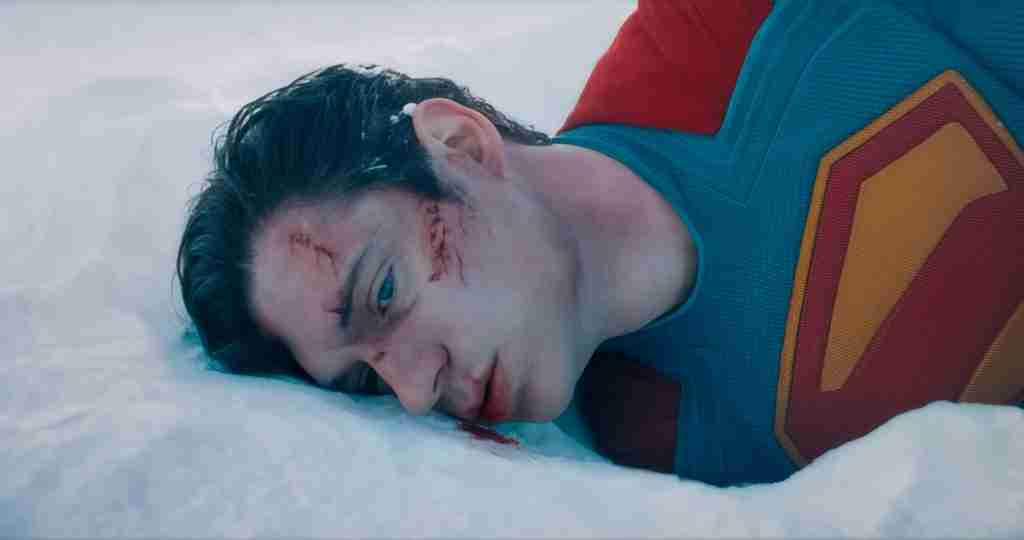
The Superman 2025 script opens on the first defeat of the hero’s career and never shows the fight he lost. Six lines of text count down from three centuries to three minutes, and then a body falls into the snow (script p. 1). James Gunn spends his first page establishing that the most powerful metahuman on Earth is bleeding and that his dog is useless, and his second page that the robots who carry him inside have, in their own words, no consciousness whatsoever (p. 2). Everything the film argues about being human starts from that floor.
What this reading uses
The film is read here against Gunn’s 132-page release screenplay, the finished picture, and his own director’s commentary, which is the closest thing to a draft history this script has: the pages match the release cut, so the scenes Gunn describes cutting live only in his account. Page numbers point at the script; minute markers point at the film. The two disagree in a few places worth knowing about, starting with the setting of page 1, which the script calls Antarctica and which Gunn shot in Svalbard, in the Arctic.
The number that runs the film
The script gives Superman a health readout on page 5 and lets it stand for the whole story. He leaves the Fortress at eighty-three percent restored, over the robots’ objection, because the city needs him now. The script never gives a second number. His body is repaired again, twice, by yellow sun (pp. 98, 130) after Kryptonite nearly kills him (p. 91), and none of those repairs gets a readout. What the film measures on screen is the other recovery: a sentence on a porch and a choice in front of Lex Luthor, I’m as human as anyone (p. 126). The body heals offstage; the man is restored in dialogue, and that is the writing lesson underneath the spectacle.
132
Pages in the release script
83%
Restored when he leaves the Fortress (p. 5)
6
Lines of countdown text before the first image
111m
“That’s being human” (p. 126)
Act one
Opening on defeat
The crash: stakes without a backstory
The six lines of countdown text do the work of an origin story in under a minute of screen time: metahumans three centuries ago, a baby from another world three decades ago, the name Superman three years ago, the Boravia intervention three weeks ago, the Hammer of Boravia three hours ago, and three minutes ago, a battle lost for the first time (p. 1). Gunn told the commentary he wanted the opening to carry the history of his whole universe; the script does it in a form a reader can absorb in one glance. Then the speck falls.
The dog is the second decision. Krypto arrives at super-speed and pounces on a man who may be dying, and the script stops to tell the reader, in Gunn’s own voice on the page, that this is a terrible dog with no respect for boundaries (p. 1). That aside reads as tone instruction written into the action line: the film will play brutality and comedy in the same frame, and it will not apologize for either. Gunn has said Krypto is his own rescue dog, Ozu, and that the dog’s worst behavior was filmed as reference.
The ticking recovery: sterile robots, unruly duty
Inside the Fortress the robots inventory the damage, fourteen fractured bones among it, and lay him under concentrated sunlight (5m). Robot Four disclaims any consciousness on the way in (p. 2) and then, on page 5, tries to keep him in bed: eighty-three percent restored, you must rest. He goes anyway. The exchange solves the invincibility problem in one line. A hero who cannot be hurt is inert; a hero who leaves at eighty-three percent has made a choice the audience can weigh.
The robots are the sterile half of a pair. Krypto is the unruly half. The script keeps cutting between machine logic and animal chaos in the same room, and the effect is to make the man in the middle feel like the only one making decisions. That is the mechanism the rest of the film runs on.
Lex’s assault on the story
The second fight with the Hammer of Boravia (8m to 12m) is the first Lex Luthor scene, and it is a scene about information. Lex calls moves from a control room, the Hammer executes them, and the fight is lost or won on who knows the other man better. When the mask comes off it is Ultraman, and the script holds his identity back for most of the film. Lex’s real weapon is not the clone. It is the damaged message from Krypton, which he will finish decoding and broadcast at 41 minutes as an instruction to conquer. The villain does not try to kill Superman first. He rewrites who Superman is, and lets the world do the rest.
Signature
The restoration gauge
The script gives its hero a percentage on page 5 and then stops reporting it. Sunlight repairs the body twice more, offstage and unmeasured. Read the film as the gauge it does keep: it moves at the moments Clark decides who he is, and it reads full only when he says so.
0%
Snow
1m
First image. The most powerful metahuman on Earth, bleeding into the ice (p. 1).
83%
Leaves anyway
7m
Robot Four says rest. He goes back to the fray (p. 5). The number is never updated.
Reset
The message
40m
Lex airs the restored Kryptonian message (p. 48). Clark’s certainty about who he is drops to nothing.
Low
Mali
64m
Lex shoots the falafel vendor in front of him (p. 78). Power is useless; witness is all he has.
Rising
The porch
85-87m
Pa Kent: your choices, your actions (p. 100). Restoration comes from a sentence, not sunlight.
100%
Human
111m
“I’m as human as anyone.” Full strength is a decision, made in front of Lex (p. 126).
The reading
The script re-heals the body with sunlight and never re-reads the number. The gauge it keeps on screen measures who he thinks he is.

Themes
Legacy, the porch, and kindness as a choice
Weaponized legacy: the midpoint nightmare
The Fortress hologram is introduced as comfort. Robot Four plays the fragment of Jor-El and Lara to soothe him (4m), and the script is explicit that the rest of the message was lost in transit. When Lex restores the missing half and broadcasts it at 40 minutes (script p. 48), the parents’ farewell becomes a colonial instruction: lord over the planet, take wives, rule without mercy. Clark does not argue with it. Within ten minutes he is discussing turning himself in (50m), and by 53 minutes he is in Lex’s pocket universe.
The structural move is to convert backstory into an active antagonist. Most superhero scripts treat heritage as a reservoir the hero draws on in the third act. Gunn makes it the thing that breaks him at the midpoint, so that identity, not survival, is the question the second half has to answer. The corrupted mentor is doing the villain’s work from inside the hero’s own head.
Porch wisdom: choices over fate
The answer arrives on the Kent porch (85m to 87m; script pp. 99-100). Clark, a bowl of oatmeal on his lap, tells his father he is not who he thought he was. Pa’s reply is the script’s thesis in plain speech: parents are not for telling children who they are supposed to be, they hand out tools and let you make a fool of yourself on your own, and then the line the film is built to deliver, your choices, your actions, that is what makes you who you are (p. 100). He cannot get through the next sentence. Ma calls him an old mush.
Gunn says on the commentary that this was among the hardest scenes to shoot because so much of the film rests on it, and that he wanted a real Kansas farmer in the part rather than an aging movie star, an actor who would bring groundedness and kindness. On the page the scene is almost entirely dialogue and two stage directions about weeping. It resolves the midpoint crisis without a single superpower, which is the point: the message from the stars was a claim about nature, and the porch answers it with a claim about conduct.
Kindness as deliberate power
The line audiences quote most is Clark’s, from the apartment scene at 49 minutes (script p. 58). Lois has just told him she questions everyone and he trusts everyone and finds them beautiful; his answer is that maybe that is the real punk rock. Gunn calls it one of the lines most often repeated back to him, and says the internet rewrote it as “kindness is the real punk rock” on shirts and memes; the word kindness is not on the page. On the commentary he frames it as a reaction against a decade of gritty, murdering superheroes he also enjoys: a suspicion that edginess is fearful media, running from what people are like in their raw state.
The script earns the slogan by making kindness cost something every time. The Metropolis kaiju is a creature Superman wants to relocate rather than kill while the Justice Gang wants it dead (35m to 38m). The squirrel he saves during the fight is a running joke with a serious spine. And the final confrontation with Lex is not won with a punch. It is won with a paragraph about screwing up and trying again (p. 126). Deliberate, repeated, expensive choice is what turns a value into a character.
Your choices, Clark, your actions. That’s what makes you who you are.
Pa Kent, script p. 100, film at 87m
Primary source
What Gunn says he cut, and why
The screenplay circulating for this film is a clean release script; it contains none of the material Gunn describes removing. His commentary is therefore the draft history, and four cuts in it are worth a writer’s attention because each one is a tonal calibration rather than a plot change.
The dog punch
In early cuts, when Krypto is taken down by the nanites at the Fortress (29m), Lex gave Ultraman a nod and Ultraman punched the dog unconscious. Gunn says the audience jumped, that it read as if Krypto had died, and that people hated Lex even more than they do now. He cut it anyway: the reaction was too large for that point in the film. The lesson is about proportion. A villain can be made hateful too early, and the hate spends itself before the scene that needs it.
The blood on the platform
Mali’s murder at 64 minutes (script p. 78) was shot with a longer aftermath: blood pooling toward Lex’s shoes, and Ghurkos, the president of Boravia, ordered to lie down and soak it up so it would not reach them. Gunn says he cut it very early and is glad he did, while admitting he liked what it said about where power sits between corporations and countries. The script keeps the shot in an ultra-wide, the body falling, and nothing after. Sometimes the strongest version of a scene is the one that ends first.
The petri dish and the arm
Two smaller cuts round out the picture. A line in which Lex explains that Mr. Handsome, the platform driver and a character original to the film, was something he grew in a petri dish at twelve went out because it explained more than the scene could carry. And after the finale, a gag in which Lex tries to stand on a broken arm and it bends the wrong way went out before Gunn ever screened the film to anyone; it played as one beat of cruelty too many. Read together, every cut moves in the same direction: less explanation, less viciousness, the same stakes.

Cast of functions
Character breakdown: lessons for screenwriters
Each figure below is doing one structural job. The table names the arc as the script plays it and the transferable technique.
| Character | Arc as written | Screenwriting lesson |
|---|---|---|
| Clark Kent / Superman | Loses on page 1, acts at 83 percent, learns from the porch that conduct outranks origin. | Open on the failure. Let the hero choose before he is whole. |
| Lex Luthor | Fights with information: the studied moves, the decoded message, the broadcast. | Give the villain the hero’s story, not just his weakness. |
| Krypto | A terrible dog, on the page and on screen, who still drags him home. | A foil that breaks tone on purpose keeps grief from turning solemn. |
| Jonathan Kent | One scene, five minutes, no powers; delivers the thesis and weeps. | Put the theme in the mouth of the least super person in the film. |
| Lois Lane | Interviews him on the record first (20m; pp. 25-34), loves him second, breaks the story last (92m). | Let the love interest test the ethics, not just the feelings. |
| Ultraman | A silent proxy whose identity is withheld until the last fight. | A masked threat lets the real antagonist stay in the control room. |

Plot and production
Plot and production insights from Superman 2025
Spoiler-aware plot snapshot
A defeat by the Hammer of Boravia sends Superman to the Fortress and back to Metropolis at 83 percent (1m to 7m). A second fight reveals Ultraman (12m). Lois interviews him as a reporter and the interview becomes an argument about Boravia and Jarhanpur (20m). The kaiju fight introduces the Justice Gang (35m). Lex broadcasts the restored Kryptonian message (40m); Clark surrenders and is held in a pocket universe (53m), where Lex murders Mali (64m). Mr. Terrific and Lois break him out through a black hole (68m to 77m); Kryptonite poisoning and a morning of sun follow (pp. 91-98). The porch (85m to 87m). Lex’s rift tears at Metropolis (89m), the Daily Planet publishes (92m), the Ultraman fight (98m), the speech to Lex (111m), and Kara Zor-El collects her dog (118m).
What stays on the page
Three writing decisions carry from script to screen without loss. The exposition is delivered by characters who do not care about it: the robots explain the message because it is their job, and the script tells us they have no feelings about doing so (p. 2). The percentage on page 5 replaces a whole recovery montage. And the interview scene at 20 minutes (script pp. 25-34, with the ethics argument on p. 24) lets Lois say out loud that Clark interviewing himself is a problem, so that the film’s political argument is staged as a couple’s quarrel rather than a lecture.
What changed between page and screen, per Gunn’s commentary, is almost entirely subtraction: the four cuts above, and more of Steve Lombard in tears during the rooftop scene, which he hopes will surface as a deleted scene. The script that circulates is the film. The commentary is the draft.
Structure, minute by minute
The Superman 2025 beat sheet, retimed
Minute markers are timed to the film; page numbers to the release script. The four acts below use the film’s own beats rather than a borrowed template, and several times differ from earlier versions of this breakdown: the interview lands at 20 minutes, the broadcast at 40, Mali’s death at 64, and the porch at 85.
Act I: The broken beacon (min 1-13)
The first act is a recovery, not an origin. Text stands in for backstory, the Fortress stands in for a montage, and the act ends when the hero goes back out at less than full strength and learns that the man who beat him is being coached.
| Beat | Minute | Synopsis |
|---|---|---|
| Six lines of countdown | 1m | Three centuries to three minutes; a speck falls into the snow (p. 1). |
| The terrible dog | 2m | Krypto pounces; the whistle; the drag home. |
| No consciousness whatsoever | 4m | Robot Four disclaims feeling and plays the parents’ fragment (p. 2). |
| Eighty-three percent | 7m | He leaves against orders; back to the fray (p. 5). |
| Round two, coached | 8-12m | Lex calls the moves; the Hammer is unmasked as Ultraman. |
Act IIa: Kindness is the real punk rock (min 13-41)
The promise of the premise is a Superman who is argued with. Lois tests his ethics before his feelings, the Justice Gang tests his methods, and the act closes on the message that tests his nature.
| Beat | Minute | Synopsis |
|---|---|---|
| The Daily Planet | 15m | Clark, Lois, Jimmy, and the Boravia question in the newsroom. |
| The interview | 20m | Lois interviews him on the record; it becomes a fight about Jarhanpur (pp. 25-34). |
| Kaiju and colleagues | 35-38m | He wants the creature out alive; Terrific goes for its eyes. |
| The broadcast | 40m | Lex airs the restored message: rule without mercy, take wives (p. 48). Lombard removes his pin. |
Act IIb: The pocket universe (min 41-87)
The descent is a loss of story rather than of power. He surrenders, is imprisoned, watches a man die for him, escapes, and is put back together on a porch.
| Beat | Minute | Synopsis |
|---|---|---|
| Maybe that’s the real punk rock | 49m | The apartment scene; kindness as a position (p. 58). |
| Surrender | 50-53m | He turns himself in; Lex holds him in a pocket universe. |
| Mali | 64m | Lex shoots the vendor who helped him (p. 78). His name was Mali (p. 80). |
| Black hole | 68-77m | Terrific and Lois break in; the escape through the vortex; Kryptonite poisoning (p. 91). |
| Morning sun, then the porch | 85-87m | He heals in the sun (p. 98); Pa Kent: your choices, your actions (p. 100). |
Act III: Chosen triumph (min 87-129)
The third act pays off the gauge. The city is saved by a team, the story is broken by a newspaper, and the villain is beaten by a paragraph.
| Beat | Minute | Synopsis |
|---|---|---|
| The rift | 89m | Lex’s split universe tears into Metropolis. |
| The Planet publishes | 92m | Lois breaks the LuthorCorp story. |
| Ultraman | 98m | The fight; the clone into the black hole. |
| That’s being human | 111m | I’m as human as anyone; the speech to Lex (p. 126). |
| Kara | 118m | Supergirl collects her dog (p. 131). |
| Final image | 119m | Ma and Pa on video; Pa flies baby Clark over imaginary skies (p. 132). |
Eighty-three percent is the only reading the script ever gives.
The Superman 2025 script, page 5; the next number is never written
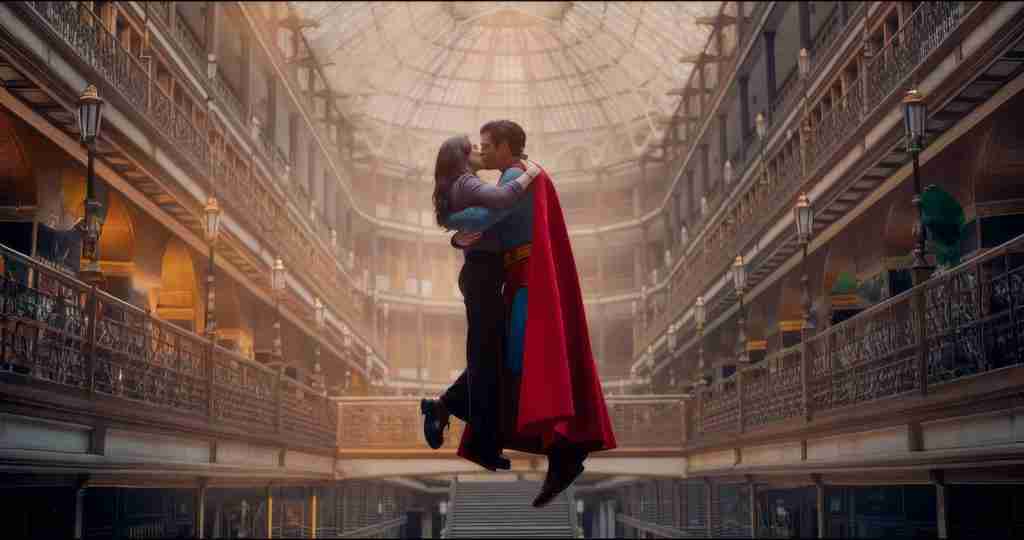
Superman 2025 ending explained
Superman 2025 ending explained: choice over destiny
The ending inverts the opening. A man face-down in snow becomes a man floating over a saved city, and the message that was supposed to define him is answered rather than obeyed. Lex, beaten, calls him an alien (p. 126). The reply is the film’s argument in first person: he is as human as anyone, he loves, he gets scared, he puts one foot in front of the other and makes the best choices he can, he screws up all the time, and that is being human, and that is his real strength. The film’s subtitle track has him say “that is being human” rather than the script’s contraction; the sense is identical.
Why the speech lands
The speech works because it is the third statement of the same idea and the first one Clark makes himself. Pa said it on the porch (p. 100). Lois half-said it in the apartment when he called trusting everyone the real punk rock (p. 58). Here, in front of the man who rewrote his story, Clark says it as a claim about his own nature, and the gauge fills. The Daily Planet exposure restores his public standing; the speech restores the rest. Kara’s arrival (118m) is a franchise beat, but the true final image is the Kent home video: Pa holding a baby over his head, flying him (p. 132). The last shot of a film about a man from another planet is his human father teaching him how.
The lesson
Audacious closures survive when they resolve a character’s question rather than the plot’s. The question here was set on page 1 and asked out loud on the porch: who decides what you are? The ending answers it with conduct, and the conduct has been on screen since he walked out of the Fortress at eighty-three percent, the last number the script gives him.

For writers
Why Superman 2025 still matters for screenwriters
The big idea
Gunn humanizes an icon by denying him completion. The health readout is the device, and the script is careful never to write a second number: a near-omnipotent character becomes dramatic the moment the script establishes something he cannot fix by force, and this script establishes three in its first act (a lost fight, a damaged message, a dog that will not obey). Lex then attacks the one thing strength cannot defend, the story of who Superman is. Gunn told CBS the film is about the man rather than the super, and the structure bears that out: every turn of the plot is a turn in Clark’s account of himself.
Maybe that’s the real punk rock.
Clark Kent, script p. 58; film at 49m
Practical applications
Open after the failure and let text do the origin. Give the hero a number that stands for his condition and then stop updating it, so the audience keeps score. Turn heritage into an antagonist by letting the villain finish the hero’s backstory for him. Put the theme in the mouth of the least powerful person on screen, and let it cost him something to say. Stage the political argument as a couple’s quarrel. And when the climax arrives, have the hero win with the thing the villain said he lacked. The Superman 2025 script does each of these on a page you can cite.
Reader questions
Superman 2025 script: questions readers ask
The script and the quote
Who wrote the Superman 2025 script, and how long is it?
James Gunn wrote and directed. The release screenplay runs 132 pages, undated, and matches the finished film; the scenes Gunn describes cutting on his commentary are not in it.
What is the “that’s being human” quote in Superman 2025?
It is Superman’s answer to Lex calling him an alien, at 111 minutes (script p. 126): that he is as human as anyone, loves, gets scared, makes the best choices he can, screws up all the time, and that this is being human and his real strength. The film’s subtitles render the key line as “that is being human.”
The opening and the ending
What does the opening text of Superman 2025 say?
Six lines counting down: metahumans appeared three centuries ago; a baby was sent to Earth three decades ago; he announced himself as Superman three years ago; he stopped Boravia invading Jarhanpur three weeks ago; the Hammer of Boravia attacked three hours ago; and three minutes ago he lost a battle for the first time (script p. 1).
Where is Superman when he crashes at the start?
The script sets the scene in Antarctica. Gunn shot the sequence in Svalbard, in the Arctic north of Norway, with practical drone photography, and says so on the commentary.
Go deeper
Read next
Screenplay analysis
Superman (1978): from Puzo’s draft to Donner’s film
Four drafts, one fixed point. The film Gunn’s opening text is answering.