Deep SHT Beat Sheet · Warner Bros. · 1942
Casablanca Script Breakdown: the Beat Sheet and Story Map, Minute by Minute
A time-keyed Casablanca beat sheet: every turn of the screenplay, the letters of transit, and the four times Renault calls Rick a sentimentalist
Directed by
Michael Curtiz
Screenplay
Julius J. Epstein, Philip G. Epstein, Howard Koch
Based on the play
Everybody Comes to Rick’s by Murray Burnett and Joan Alison
Released
1942
Running time
103 minutes (minute markers below are rounded up)
Protagonist
Rick Blaine, 37, owner of Rick’s Cafe Americain
103
minutes, opening map to closing fog
4
times Renault calls Rick a sentimentalist
10k
francs riding on whether Laszlo escapes
86m
the End of Act Two turn: “All right. I will.”
The Story Map
The Casablanca Story Map
Most Casablanca beat sheets online run the film through a fifteen-beat template and call it done. That misses the shape of the thing. The map below was built from the Casablanca script’s scene order and the film’s running time, minute by minute. Every marker is the minute in which the moment lands, rounded up. The Story Map fields come first, then the four acts, sequence by sequence, then the one device that ties the plot to the arc: Captain Renault keeps calling the ending, and Rick keeps denying it.
On this page
Protagonist
Rick Blaine, 37, owner of Rick’s Cafe in Casablanca
Characterization / main misbehavior
Cynical, aloof, jaded
External goal
To hide the letters of transit, then to help Ilsa and Laszlo escape
Internal goal
To be selfish, then to be selfless
Main dramatic conflict
Ilsa
Themes
Sacrifice and redemption
Central dramatic question
Will Rick help Laszlo and Ilsa escape Casablanca?
Ending
Rick gives the letters to Laszlo and Ilsa and shoots Strasser so the plane can leave
Arc
From a hard-nosed cynic to a man who risks his life for a woman he loves and a cause greater than himself
Deconstructing the War-Time Sacrifice and Redemption Narrative
Casablanca is the story of a cynical man who rediscovers his capacity for self-sacrifice when confronted with the woman he loves and a cause greater than himself. The structural trick is delay: the film keeps re-contextualizing the conflict between love and duty, reveals Ilsa’s marriage at 59m and holds the reason for it back until 84m. Rick’s journey from jaded saloon owner to a man back in the fight anchors everything. For a thematic deep dive, see the essay on sacrifice and redemption.
A note on the map’s engine. Each act is driven by the letters of transit: who holds them, who wants them, and what Rick refuses to do with them. Act One puts them in his piano. Then Act Two-A makes him remember why he cannot be bought, and Act Two-B brings a gun into the room and still cannot pry them loose. Act Three is the only time they change hands, and Rick writes someone else’s name on them.
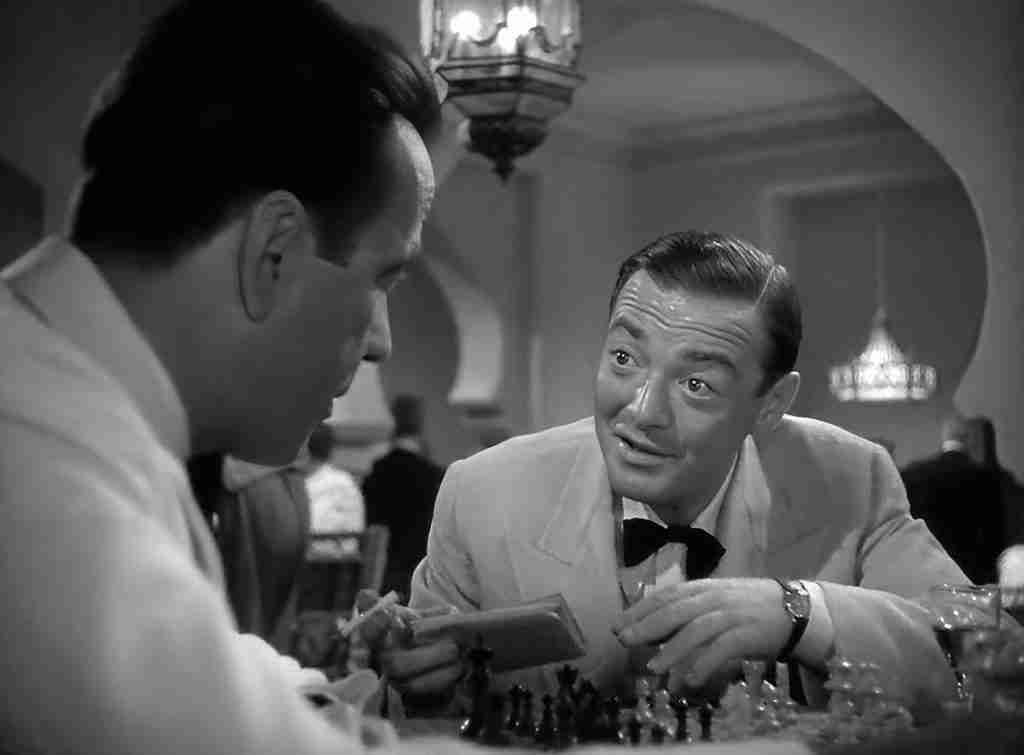
Act One · 1m to 36m
Act One: Everybody Comes to Rick’s
Story engine. Rick hides the missing letters of transit for Ugarte, knowing full well Ugarte killed the two German couriers. Laszlo and Ilsa come to Rick’s for the letters and learn Ugarte has been arrested. Ilsa has Sam play “As Time Goes By.” Rick storms over, furious, and finds Ilsa sitting with Laszlo. He is bitter, but he sits down for a drink. By the end of the act he knows Ilsa and her husband need the letters to leave.
Sequence I: The refugee trail (1m to 7m)
1m. A map of Africa over the titles, then a spinning globe and a narrator laying out the roundabout refugee route: Paris to Marseilles, across to Oran, then by train, auto or foot to Casablanca, where the fortunate buy exit visas and the rest wait. 3m. A police wire: two German couriers murdered on the train from Oran, the killer headed for Casablanca. 4m. Two police officers stop a civilian with expired papers. He runs; they shoot him in the back and find Free French literature on the body.
6m. Jan and Annina Brandel, a young Bulgarian couple, watch a plane come in. “Perhaps tomorrow we’ll be on that plane.” A setup the film pays off at 69m. 7m. Major Strasser steps off that plane and is met by Captain Renault, who has rounded up twice the usual number of suspects and already knows where the murderer will be tonight. Everybody comes to Rick’s.
Sequence II: Inciting Incident (8m to 13m)
8m. Rick’s on a busy night. Sam sings “It Had to Be You” while half the room negotiates its way out of the country. 9m. Carl tells two women that Rick never drinks with customers, a setup that pays off at 35m. 10m. Rick turns a German away from the gambling room. No allegiance to the Reich, and no explanation. 12m. Inciting Incident. Ugarte lays an envelope on the table: letters of transit signed by General de Gaulle, cannot be rescinded, cannot even be questioned. He asks Rick to hold them for the night because Rick despises him, which makes Rick the only man in Casablanca he trusts. Rick agrees. Then, at 13m, Rick mentions a rumor that the two couriers were carrying letters of transit. Ugarte has heard that rumor too. Rick is, he says, a little more impressed with him.
Sequence III: A wise foreign policy (14m to 18m)
14m. While Sam plays “Knock on Wood,” Rick slides the letters into the piano. 15m. Ferrari offers to buy the cafe. Rick declines. 16m. Yvonne, drunk and jilted, gets put in a cab. 17m. Outside, Rick watches the Lisbon plane take off and Renault catches the one flicker of longing he ever lets show. Why did he never go back to America? Church funds, a senator’s wife, a killing: “a combination of all three.” What brought him here? The waters. 18m. Renault warns there will be an arrest in the cafe tonight, a murderer no less, and catches Rick’s eyes flick toward the gambling room. Rick’s answer is the film’s thesis, stated in the negative: “I stick my neck out for nobody.” Renault calls it a wise foreign policy.
Sequence IV: The bet and the arrest (19m to 25m)
19m. In the office, Renault explains why Rick’s stays open: exit visas are sold in the cafe, but Rick has never sold one. Then the name: Victor Laszlo, on his way to America, who will pay a fortune for a visa and will not get one. 20m. Rick puts 20,000 francs on Laszlo making it out; Renault, a poor corrupt official, makes it 10,000. Renault notes Laszlo will need two visas because he is traveling with a lady, and that a man who did not leave her in Marseilles or Oran will not leave her here. When Rick asks what gave Renault the idea he might help Laszlo, Renault delivers the line the whole film will test: under that cynical shell, Rick is at heart a sentimentalist.
22m. Renault tells Strasser the arrest is imminent. 23m. Strong Movement Forward. Renault’s men move in. Ugarte shoots, runs, and begs Rick for help. Rick does nothing. Ugarte is dragged out. 25m. Strasser questions Rick, whose answers are carefully neutral: his interest in whether Laszlo stays or goes is purely a sporting one, and he understands the point of view of the hound.
Sequence V: Laszlo and Ilsa arrive (26m to 33m)
26m. Laszlo walks in with Ilsa Lund on his arm. Ilsa and Sam recognize each other and say nothing. 27m. Berger offers Laszlo a ring whose stone lifts to show the Cross of Lorraine. 29m. Strasser and Renault sit down uninvited; Laszlo agrees to a meeting at Renault’s office the following morning. 31m. Berger tells Laszlo that Ugarte has been arrested and that there is a resistance meeting tomorrow night. 32m. Ilsa has Sam wheel the piano over. She asks about Rick; Sam tells her she is bad luck for him and begs her to leave him alone. 33m. “Play it once, Sam. For old time’s sake.” Sam does not know what she means. “Play it, Sam.” Then: “Play ‘As Time Goes By.'” Sam is rusty. She hums it. He plays.
End of Act One Turn (34m to 36m)
34m. End of Act One Turn. Rick storms over to stop the song and sees Ilsa. Renault and Laszlo arrive before either can speak, and Laszlo asks Rick to join them. Renault starts to say that Rick never does. “Thanks. I will.” 35m. The drink-with-Rick payoff. Ilsa: the last time we met. Rick: La Belle Aurore, the day the Germans marched into Paris. He remembers every detail; the Germans wore gray, she wore blue. 36m. Laszlo ends the evening and Rick covers his tab. Renault has now seen two things Rick never does in one night.
“I stick my neck out for nobody.”
Rick Blaine, 18m. Renault calls it a wise foreign policy. The next 85 minutes repeal it.
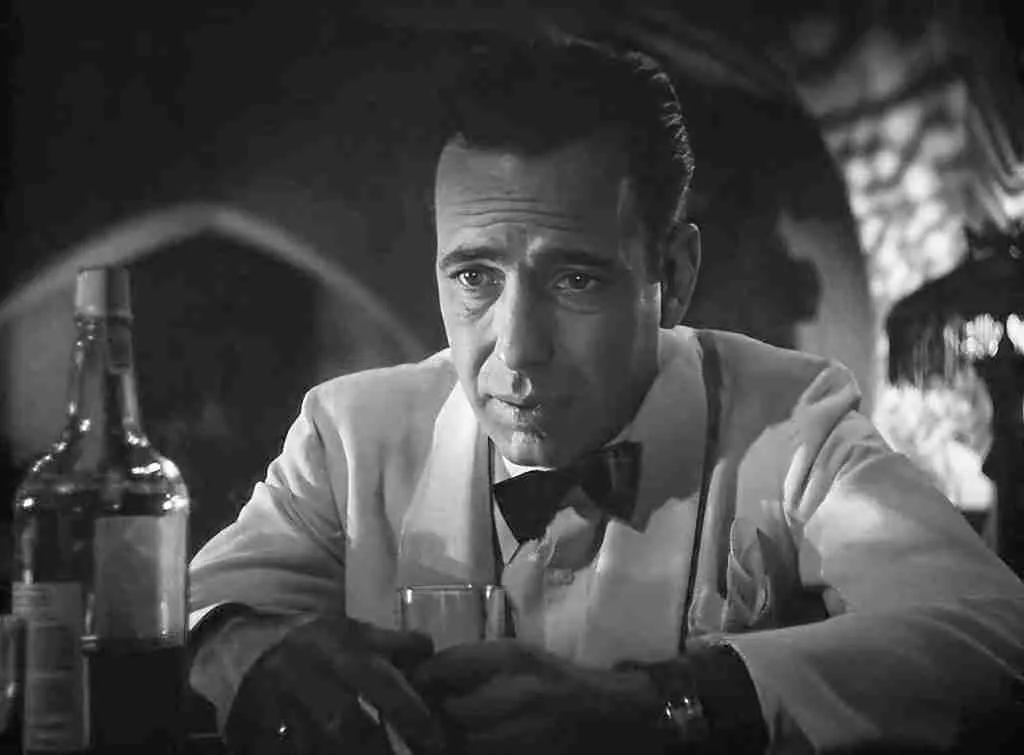
Act Two-A · 37m to 51m
Act Two-A: Paris, and the Midpoint
Story engine. Sam tries to talk Rick into leaving Casablanca, but Rick is not over Ilsa. He remembers falling in love in Paris and her leaving him at the train station. She appears in the empty cafe and begs his forgiveness; he insults her and she leaves.
Sequence I: The gin joints (37m to 39m)
37m. Break into Two. Rick drinks alone in the dark. Sam wants to take the car, drive all night, get drunk, go fishing and stay away until she is gone. Rick tells him to go home. Sam stays. 38m. If it is December 1941 in Casablanca, what time is it in New York? Sam’s watch has stopped. Rick bets they are asleep all over America, pounds the table, and gets to the line: of all the gin joints in all the towns in all the world, she walks into mine. 39m. He makes Sam play it.
Sequence II: Paris (40m to 48m)
40m to 48m. Flashback. Paris: the countryside, a boat on the Seine, champagne in Rick’s apartment. No questions. Here’s looking at you, kid. At 42m Ilsa says the last man in her life passed away. By 43m the Germans are close, and Ilsa tells Rick that, with his record, he has to leave. At La Belle Aurore the three of them finish the champagne while Sam plays the song and the loudspeaker announces the Germans will arrive tomorrow. Rick asks her to marry him. She asks him to kiss her as if it were the last time. 48m. Gare de Lyon in the rain. Sam hands Rick her note: she cannot go with him or ever see him again, he must not ask why. Sam pulls him onto the moving train; Rick crumples the letter in the steam.
Sequence III: Midpoint (49m to 51m)
49m to 51m. Midpoint. Back in the cafe, Ilsa walks in and asks if she can tell him a story. Has it got a wow finish? She does not know the finish yet. Her story is about a girl who came to Paris from Oslo and met a great and courageous man she had heard about her whole life, who opened up a world of knowledge and ideals to her. Rick cuts her off with a story of his own, the kind told over a tinny piano in a parlor, and asks who she left him for and whether there were others in between. She leaves. His head goes down on the table. The false defeat: she came to explain and he made it impossible.
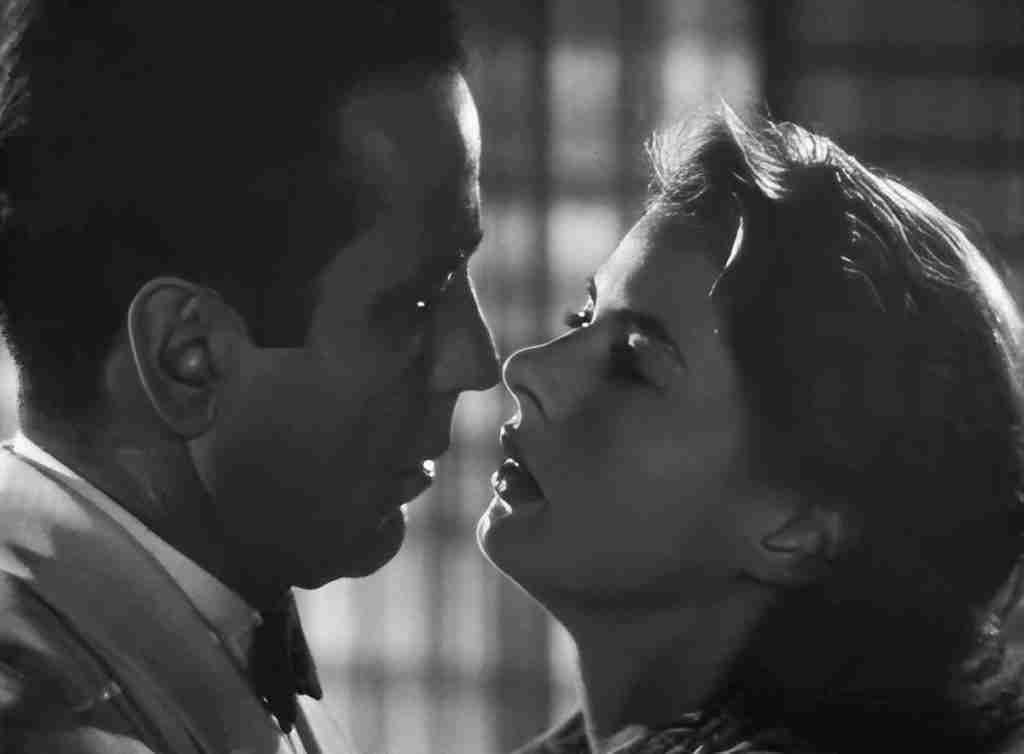
Act Two-B · 52m to 86m
Act Two-B: The Gun and the Confession
Story engine. Outside the Blue Parrot, Ilsa tells Rick that Laszlo was her husband while they were together in Paris. Fearing for Laszlo’s life, she comes back for the letters of transit; when Rick will not give them up she pulls a gun on him and cannot shoot. She admits she believed Laszlo was dead when she was with Rick, and learned he was alive moments before they were to leave Paris. She confesses her love, begs him to help Laszlo leave, and says she will stay if he does.
Sequence I: The Prefecture (52m to 55m)
52m. Renault and Strasser wait for Laszlo and Ilsa. Strasser believes Rick has the letters. 53m to 54m. Strasser tells Laszlo he is an escaped prisoner of the Reich and will stay in Casablanca indefinitely, or leave for Lisbon tomorrow on one condition: the names and whereabouts of the underground leaders in Paris, Prague, Brussels, Amsterdam, Oslo, Belgrade, Athens. Even in Berlin. Laszlo spent a year in a concentration camp and did not give the names there. 55m. Finally, Ugarte is dead; Renault has not decided whether it was suicide or an escape attempt.
Sequence II: My husband (57m to 61m)
57m. Ferrari, who also thinks Rick has the letters, offers to broker them for a percentage. Rick ignores it. 58m to 59m. Rick meets Ilsa outside the Blue Parrot and apologizes for last night; she is not having it. He turns cynical again, tells her to walk up a flight, says someday she will lie to Laszlo. Then the revelation: Victor Laszlo is her husband, and was even when she knew Rick in Paris. 60m. Inside, Ferrari can get a visa for Ilsa but not for Laszlo. Laszlo tells her to go without him. She asks whether he would take the one visa if the situation were reversed, and reminds him of Lille and Marseilles, when he could have left her and did not.
61m. Two visas or nothing. Ferrari lets them in on the rest: the letters were not found on Ugarte, and he would guess Ugarte left them with Rick.
Sequence III: Twenty-two, black (63m to 71m)
63m. Renault admits he told Strasser the letters would not be found at Rick’s, and told his men to be especially destructive anyway. 64m. Rick breaks up a fight between a French officer and Yvonne’s German. Strasser asks Renault which side he is on; Renault blows with the wind, and the prevailing wind is from Vichy. Strasser hints it may be too dangerous to let Laszlo go and too dangerous to let him stay. 67m. Annina asks Rick whether a woman who did a bad thing to secure the happiness of the man she loves could be forgiven. Rick: nobody ever loved him that much. His advice is to go back to Bulgaria. Then Laszlo and Ilsa come in and Rick, harsh with her, has Sam play the song.
69m to 70m. Assumption of Power. In the gambling room Rick asks Jan whether he has tried twenty-two. Twenty-two, black. Leave it there. Twenty-two, black. Cash it in and don’t come back. A customer asks Carl if the place is honest; honest as the day is long. 71m. The couple tries to pay Renault on the spot and he sends them to his office at ten. Then he finds Rick: as suspected, a rank sentimentalist. Rick’s answer is to put it down as a gesture to love.
Sequence IV: La Marseillaise (72m to 76m)
72m. Laszlo comes to the office and offers 200,000 francs for the letters. Rick would say no to a million or three. The reason? Ask your wife. 73m to 74m. German officers sing “Die Wacht am Rhein” around the piano. Laszlo goes downstairs and orders the band to play “La Marseillaise.” The band looks at Rick, and Rick nods. The cafe drowns the Germans out. 75m. Strasser tells Renault to close the cafe. Renault blows his whistle: everybody out. On what grounds? He is shocked, shocked to find gambling going on in here. The croupier hands him his winnings. 76m. Strasser tells Ilsa that Laszlo can go back to occupied France or die in Casablanca. Leaving, she asks Laszlo about Rick; they will discuss it later.
Sequence V: The hotel and the closed cafe (77m to 79m)
77m to 79m. In the hotel Ilsa begs Laszlo to skip the underground meeting. He is afraid and going anyway. He tells her Rick has the letters and will not sell, and that Rick said to ask his wife. Then the quietest scene in the film: was she lonely in Paris while he was in the camp? Yes. Is there anything she wishes to tell him? No. He loves her very much, and he leaves. She leaves a few minutes after him. 79m. Carl tells Rick the cafe can stay closed about two weeks before it goes broke; Rick keeps everyone on salary.
End of Act Two Turn (81m to 86m)
81m. Ilsa is waiting in Rick’s apartment. She asks him to put his feelings aside for something more important. Rick is not fighting for anything anymore except himself. 83m. She pulls a gun. Rick steps toward it: go ahead and shoot, you’ll be doing me a favor. Her hand drops. She tried to stay away. If he knew how much she loved him, how much she still loves him.
84m. The confession: the marriage was secret to protect her; Laszlo was taken by the Gestapo and she was told he died; a friend found her just before she and Rick were to leave Paris and said Victor was alive, sick, hidden in a freight car. If she had told Rick, he would have stayed and been caught. 86m. End of Act Two Turn. She cannot fight it anymore; she ran away from him once and cannot do it again. He will have to think for both of them, for all of them. All right. He will. Here’s looking at you, kid.
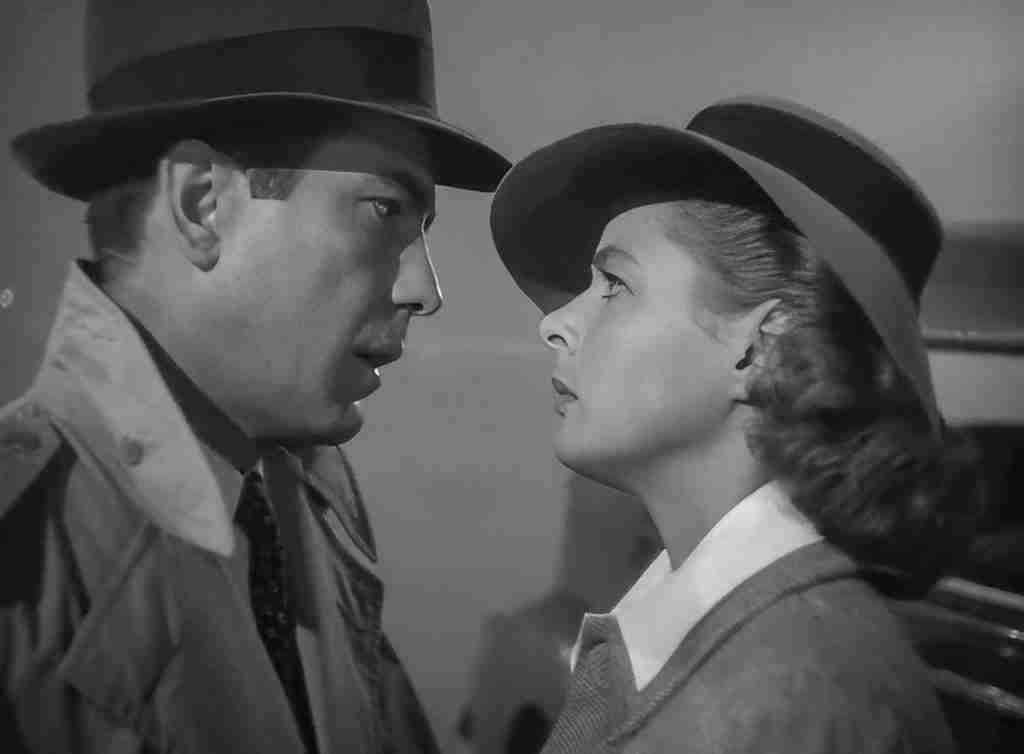
Act Three · 86m to 103m
Act Three: The Deal and the Airport
Story engine. Rick tells Renault he has the letters and intends to leave with Ilsa, the cover story Renault will call a fairy tale at 100m. He meets Laszlo and Ilsa to sell the letters, Renault moves to arrest Laszlo, and Rick pulls a gun on Renault. At the airport Rick has Renault write Laszlo and Ilsa’s names on the letters. They board. Strasser arrives and Rick shoots him.
Sequence I: Laszlo’s request (86m to 89m)
86m. The meeting has been raided. Laszlo and Carl hide from a police car and slip into the cafe. 87m. Rick sends Carl to take Ilsa home. 88m to 89m. Laszlo knows more than Rick suspects: that Rick is in love with a woman, and that it is strange they should both love the same one. He demands no explanation. He asks one thing: that Rick use the letters to take Ilsa away from Casablanca. Rick asks if he loves her that much. Yes, he loves her that much. 89m. French officers burst in and arrest Laszlo. Rick does nothing to stop them.
Sequence II: Point of No Return (90m to 92m)
90m. Rick argues the charge will not stick and Renault should let Laszlo go. Renault lists the reasons Rick might help him: the 10,000-franc bet, the letters he has stopped denying, and Strasser’s looks. 90m. Point of No Return. Rick says it out loud: he has the letters, and he is interested in what happens to Ilsa and him, not Laszlo. It is the story he needs Renault to believe. 91m. The deal. Release Laszlo. Be at the cafe half an hour before the plane. Rick will have Laszlo come for the letters, which gives Renault a charge that puts him in a camp for years. Renault gets Laszlo, Rick and Ilsa get away. 92m. Renault agrees, so Rick sells the cafe to Ferrari and makes Sam’s twenty-five percent part of the deal; Ferrari knows it is ten, but Sam is worth twenty-five.
Sequence III: The gun on Renault (93m to 96m)
93m. Renault hides in the office as Laszlo and Ilsa arrive. Rick tells Ilsa everything will be all right; she believes the trade is the letters for her staying. 94m. Rick hands Laszlo the letters. Renault steps out: Victor Laszlo, you are under arrest, accessory to the murder of the couriers. 95m. Rick’s gun comes out. Nobody is being arrested for a while yet. Renault will call the airport and Rick will listen, and the gun is pointed right at his heart, which Renault notes is his least vulnerable spot. 96m. Renault dials Strasser instead and reads the flight details into the phone. Strasser calls for his car and orders police to the airport.
Sequence IV: Climax, internal (97m to 100m)
97m to 98m. Climax, internal. Fog. Rick tells Renault to fill in the names: Mr. and Mrs. Victor Laszlo. Ilsa protests. Rick’s case: nine chances out of ten they would both end up in a concentration camp, and Renault confirms Strasser would insist. She belongs with Victor; she is part of his work. If the plane leaves without her she will regret it, maybe not today, maybe not tomorrow, but soon and for the rest of her life. They will always have Paris; they lost it until she came to Casablanca and got it back last night. He has a job to do too, where she cannot follow. The problems of three little people do not amount to a hill of beans in this crazy world. Here’s looking at you, kid.
99m. Laszlo shakes his hand: welcome back to the fight. 100m. Renault was right; Rick is a sentimentalist. Rick does not know what he means. She went, but she knew he was lying.
Sequence V: Climax, external, and Closing Image (101m to 103m)
101m. Climax, external. Strasser arrives, learns Laszlo is on the plane, and reaches for the phone to the tower. Rick, hand in his coat pocket, tells him to put it down. Strasser draws. Rick shoots him dead. 101m. Four gendarmes pull up. Major Strasser has been shot. Renault looks at Rick, and Rick looks back with nothing on his face. Round up the usual suspects.
102m. Renault pours a Vichy water, reads the label, drops the bottle in the bin and kicks it. Rick is not only a sentimentalist now but a patriot; it seemed like a good time to start. 103m. Closing Image. A Free French garrison at Brazzaville, and Renault could arrange passage. Rick’s letter of transit, then. And the bet still stands: Renault owes him 10,000 francs, which should just about cover their expenses. Louis, this is the beginning of a beautiful friendship. They walk off into the fog.
The Arc, as Renault Scores It
Renault’s Four Verdicts
Rick never announces that he has changed. Renault announces it for him, four times. The first time he is reading Rick’s past; the next three, Rick has just done something that proves him right. Read down the column and the arc is there without a single interior monologue: a laugh, a deflection, a denial, and finally an admission dressed as a shrug. This is how the script externalizes an internal goal. The sentimentalist line is the film’s yardstick, and Renault is the one holding it.
20m
Verdict 1
What Rick just did: Bet Renault that Laszlo gets out of Casablanca.
Renault
“Under that cynical shell, you’re at heart a sentimentalist.”
Rick
A laugh. Renault reads him the record behind the verdict: guns to Ethiopia in 1935, the Loyalist side in Spain in 1936.
71m
Verdict 2
What Rick just did: Rigged the roulette wheel so Jan and Annina could buy their visas.
Renault
“You’re a rank sentimentalist.”
Rick
“Put it down as a gesture to love.”
100m
Verdict 3
What Rick just did: Put Ilsa on the plane with Laszlo and told her a fairy tale to make her go.
Renault
“I was right. You are a sentimentalist.”
Rick
“Stay where you are. I don’t know what you mean.”
102m
Verdict 4
What Rick just did: Shot Major Strasser.
Renault
“You’re not only a sentimentalist, but you’ve become a patriot.”
Rick
“Maybe. It seemed like a good time to start.”
Two things fall out of the column. First, the bet at 20m is not a gag; it is the film’s first proof that Rick already believes in Laszlo, and the script cashes it on the runway at 103m when Renault agrees the 10,000 francs will cover their expenses. Second, every escalation of the plot (visas, the wheel, the plane, the gun) is answered by an escalation of the admission. Plot mechanics and character mechanics are the same machine. Renault is not alone in the diagnosis: at 72m Laszlo asks whether it isn’t strange that Rick always seems to fight with the underdog, and Rick calls it an expensive hobby.
“I was right. You are a sentimentalist.”
Captain Renault, 100m. The third verdict. The fourth, at 102m, adds “patriot.”
For Writers
Why the Casablanca Beat Sheet Is Essential for Writers
Three things in this map are worth stealing, and none of them is a beat label.
The Structural Challenge of the Delayed Love Triangle
Ilsa and Laszlo walk in at 26m, but the audience does not learn they are married until 59m, does not learn the marriage predates Paris in a way that excuses her until 84m, and does not get the End of Act Two Turn until 86m. That is a very late turn, and the film earns it by releasing the secret in three installments, each one reframing the last. Writers with a relationship secret should treat it as structural dynamite and ration the fuse: one reveal per act, and the last one at the moment it can do the most damage.
A Universal Solution for Political Thrillers and Melodramas
The external goal (the letters) and the internal goal (selfish to selfless) are welded so tightly that every refusal to sell the letters is also a refusal to change. The roulette scene at 69m and Strasser closing the cafe at 75m are not plot points parked beside the love story; they are moral benchmarks that raise the pressure on Rick from both sides. If your thriller has a political layer and a personal layer, give them one object to fight over. Here the object is two sheets of paper.
Hitting Emotional Peaks and Maintaining Narrative Focus
The Story Map keeps the film’s real peaks where the running time puts them: the Inciting Incident at 12m, the End of Act One Turn at 34m, the Midpoint at 51m, the End of Act Two Turn at 86m, the Point of No Return at 90m, and the split Climax at 97m and 101m. Generic templates that force the Midpoint to the exact center or move the roulette scene up to fit a “fun and games” slot have to lie about where the scenes are. The minute markers above do not need to.
Page to Screen
The Casablanca Script
The Casablanca script is credited to Julius J. Epstein, Philip G. Epstein and Howard Koch, adapted from Murray Burnett and Joan Alison’s unproduced play Everybody Comes to Rick’s. The screenplay won one of the film’s three Academy Awards from eight nominations. The beat sheet above quotes the screenplay’s dialogue and scene order, keyed to the finished film’s running time rather than to page numbers, because the two do not line up: the flashback alone runs from 40m to 48m, and several exchanges were tightened on the set.
Where the film departs from the page
Small differences between the published script and the spoken lines show up throughout. Rick’s line to Renault at 95m reads “Nobody’s going to be arrested” on the page and arrives as “Nobody’s gonna be arrested” on screen. Ilsa’s request at 33m comes in three pieces: “Play it once, Sam. For old time’s sake.” This is followed by “Play it, Sam.” Then “Play ‘As Time Goes By.'” Rick’s at 38m is “You played it for her, you can play it for me.” Then “If she can stand it, I can. Play it!” Nobody ever says “Play it again, Sam.” If you are quoting the film, quote the film; if you are quoting the screenplay, say so.
How to read the script alongside this map
Take the minute markers as the index. Find the beat here, then read the corresponding scene on the page and watch for what was cut, reordered or compressed. The Story Map fields at the top (goal, misbehavior, main dramatic conflict, central dramatic question) are the questions to ask of every scene: whose goal is in play, and what does the scene cost Rick? The four verdicts are the answer key.
Questions readers arrive with
Casablanca FAQ
The plot, the letters and the ending
How does Casablanca end?
At the airport (97m to 103m) Rick has Renault countersign the letters of transit for Mr. and Mrs. Victor Laszlo, talks Ilsa onto the plane with her husband, and shoots Major Strasser when Strasser tries to stop the flight. Renault covers for him (“Round up the usual suspects”), throws away his Vichy water, and the two walk into the fog toward a Free French garrison at Brazzaville. Rick loses Ilsa and gets back into the fight.
What are the letters of transit?
Two documents Ugarte stole from the murdered German couriers. As he describes them at 12m, they are signed by General de Gaulle, cannot be rescinded and cannot be questioned, which makes them the only guaranteed way out of Casablanca. Rick hides them in Sam’s piano at 14m and refuses Ferrari, Laszlo, Ilsa and a gun before handing them to Laszlo at 94m.
Is Casablanca based on a play?
Yes. The screenplay adapts an unproduced play, Everybody Comes to Rick’s, by Murray Burnett and Joan Alison. Renault’s line at 7m that everybody comes to Rick’s is the play’s title.
Who wrote the Casablanca script?
Julius J. Epstein, Philip G. Epstein and Howard Koch hold the screenplay credit. The screenplay won one of the film’s three Academy Awards, alongside Best Picture and Best Director for Michael Curtiz.
Quotes and themes
Does anyone say “Play it again, Sam”?
No. At 33m Ilsa says “Play it once, Sam. For old time’s sake,” then “Play it, Sam,” then “Play ‘As Time Goes By.'” At 38m Rick says “You played it for her, you can play it for me,” then “If she can stand it, I can. Play it!” The misquote is the famous one; neither character says it.
What are the themes of Casablanca?
Sacrifice and redemption. Rick’s external goal moves from hiding the letters to using them for someone else; his internal goal moves from being selfish to being selfless. The central dramatic question, whether Rick will help Laszlo and Ilsa escape, is answered by an act of sacrifice, and the reward is Laszlo’s line at 99m: welcome back to the fight.
Arc and runtime
What is Rick’s character arc?
From a hard-nosed cynic who sticks his neck out for nobody (18m) to a man who risks his life for a woman he loves and a cause greater than himself (101m). The arc is tracked by Renault, who calls Rick a sentimentalist at 20m, 71m, 100m and 102m; see the four verdicts above.
How long is Casablanca, and why minute markers?
On this map’s clock the film runs 103 minutes, opening map to closing fog; catalog listings round it to 102. Each beat above carries the minute in which it lands, rounded up, so the sheet can be checked against any copy of the film rather than against a page count that varies by edition.
Go deeper
Read Next
Essay
Costly Redemption: Sacrifice as Structure
Why the redemption arc only works when it costs the protagonist the thing he wants most.
Beat Sheets
Time-keyed breakdowns of the scripts worth studying, built the same way as this one.



Who is the antagonist in Casablanca? Thanks.
I would say Major Strasser is the antagonist; the character standing in the way of Rick’s goals.